11 questions
Let \( \vec{W}=\hat{i}+\hat{j}-2\hat{k} \), and \( \vec{u} \) and \( \vec{v} \) be two vector, such that \( \vec{u}\times\vec{v}=\vec{w} \) and \( \vec{v}\times\vec{w}=\vec{u} \). Let \( \alpha, \beta, \gamma, \) and \( t \) be real numbers such that \( \vec{u}=\alpha\hat{i}+\beta\hat{j}+\gamma\hat{k} \), \( -t\alpha+\beta+\gamma=0 \), \( \alpha-t\beta+\gamma=0 \), and \( \alpha+\beta-t\gamma=0 \).
Match each entry in List-I to the correct entry in List-II and choose the correct option.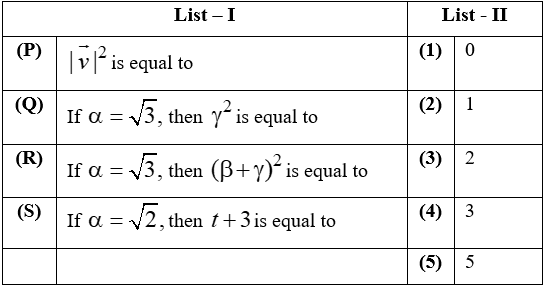
Consider the vectors \( \vec{x}=\hat{i}+2\hat{j}+3\hat{k},\quad \vec{y}=2\hat{i}+3\hat{j}+\hat{k},\; \text{and}\; \vec{z}=3\hat{i}+\hat{j}+2\hat{k}. \)
For two distinct positive real numbers \( \alpha \) and \( \beta \), define \( \vec{X}=\alpha \vec{x}+\beta \vec{y}-\vec{z},\quad \vec{Y}=\alpha \vec{y}+\beta \vec{z}-\vec{x},\; \text{and}\; \vec{Z}=\alpha \vec{z}+\beta \vec{x}-\vec{y}. \)
If the vectors \( \vec{X}, \vec{Y} \) and \( \vec{Z} \) lie in a plane, then the value of \( \alpha+\beta-3 \) is ________.
Let \( \hat{\imath}, \hat{\jmath} \) and \( \hat{k} \) be the unit vectors along the three positive coordinate axes. Let
\( \vec{a}=3\hat{\imath}+\hat{\jmath}-\hat{k} \)
\( \vec{b}=\hat{\imath}+b_2\hat{\jmath}+b_3\hat{k},\quad b_2,\,b_3\in \mathbb{R} \)
\( \vec{c}=c_1\hat{\imath}+c_2\hat{\jmath}+c_3\hat{k},\quad c_1,\,c_2,\,c_3\in \mathbb{R} \)
be three vectors such that \( b_2b_3>0 \), \( \vec{a}\cdot\vec{b}=0 \) and 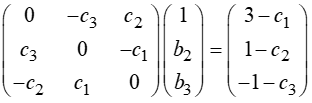 .
Then, which of the following is/are TRUE?
For any two points \( M \) and \( N \) in the \( XY \)-plane, let \( \overrightarrow{MN} \) denote the vector from \( M \) to \( N \), and \( \vec{0} \) denote the zero vector. Let \( P. Q \) and \( R \) be three distinct points in the \( XY \)-plane. Let \( S \) be a point inside the triangle \( \Delta PQR \) such that \( \overrightarrow{SP}+5\overrightarrow{SQ}+6\overrightarrow{SR}=\vec{0} \).
Let \( E \) and \( F \) be the mid-points of the sides \( PR \) and \( QR \), respectively. Then the value of \(\displaystyle \frac{\text{length of the line segment } EF}{\text{length of the segment } ES}\) is ________.
Let \( \vec{a}, \vec{b} \) be two vectors, and let \( P, Q \) and \( R \) be the points with position vectors \( \vec{a}, \vec{b} \) and \( \vec{a} + \vec{b} \), respectively, with respect to the origin \( O \). If \( |\vec{a} + \vec{b}| = \sqrt{21} \), \( |\vec{a} - \vec{b}| = 3 \), and \( \vec{a} \) and \( (\vec{a} - \vec{b}) \) are perpendicular to each other, then the area of the triangle \( OPR \) is:
Let \( O \) be the origin and \( \overrightarrow{OA}=2\hat{i}+2\hat{j}+\hat{k} \), \( \overrightarrow{OB}=\hat{i}-2\hat{j}+2\hat{k} \) and \( \overrightarrow{OC}=\dfrac{1}{2}\left(\overrightarrow{OB}-\lambda \overrightarrow{OA}\right) \) for some \( \lambda>0 \). If \( \left|\overrightarrow{OB}\times\overrightarrow{OC}\right|=\dfrac{9}{2} \), then which of the following statements is (are) TRUE?
Let \( \vec{u}, \vec{v} \) and \( \vec{\omega} \) be vectors in three-dimensional space, where \( \vec{u} \) and \( \vec{v} \) are unit vectors which are not perpendicular to each other and \( \vec{u}\!\cdot\!\vec{w} = 1 \), \( \vec{v}\!\cdot\!\vec{w} = 1 \), \( \vec{w}\!\cdot\!\vec{w} = 4 \). If the volume of the parallelepiped, whose adjacent sides are represented by the vectors \( \vec{u}, \vec{v} \) and \( \vec{w} \) is \( \sqrt{2} \), then the value of \( \lvert 3\vec{u} + 5\vec{v} \rvert \) is ________.
Let \( \vec{p} = 2\hat{i} + \hat{j} + 3\hat{k} \) and \( \vec{q} = \hat{i} - \hat{j} + \hat{k} \). If for some real number \( \alpha, \beta \) and \( \gamma \), we have
\( 15\hat{i} + 10\hat{j} + 6\hat{k} = \alpha(2\vec{p} + \vec{q}) + \beta(\vec{p} - 2\vec{q}) + \gamma(\vec{p} \times \vec{q}) \), then the value of \( \gamma \) is ________________.
Let \( \overrightarrow{OP} = \dfrac{\alpha - 1}{\alpha}\, \hat{i} + \hat{j} + \hat{k} \), \( \overrightarrow{OQ} = \hat{i} + \dfrac{\beta - 1}{\beta}\, \hat{j} + \hat{k} \) and \( \overrightarrow{OR} = \hat{i} + \hat{j} + \dfrac{1}{2}\hat{k} \), be three vectors, where \( \alpha, \beta \in \mathbb{R} - \{0\} \) and \( O \) denotes the origin. If \( (\,\overrightarrow{OP} \times \overrightarrow{OQ}\,) \cdot \overrightarrow{OR} = 0 \) and the point \( (\alpha, \beta, 2) \) lies on the plane \( 3x + 3y - z + l = 0 \), then the value of \( l \) is ______________.
For real numbers \( \alpha, \beta, \gamma, \delta \) and \( \mu \), consider the matrix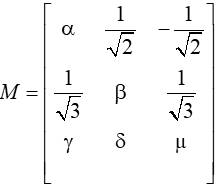 .
Suppose that \( MM^{T} = I \), where \( M^{T} \) is the transpose of the matrix \( M \), and \( I \) is the \( 3 \times 3 \) identity matrix.
Let $\vec{u} = \alpha\hat{i} + \frac{1}{\sqrt{3}}\hat{j} + \gamma\hat{k}$, $\vec{v} = \frac{1}{\sqrt{2}}\hat{i} + \beta\hat{j} + \delta\hat{k}$ and $\vec{w} = -\frac{1}{\sqrt{2}}\hat{i} + \frac{1}{\sqrt{3}}\hat{j} + \mu\hat{k}$.
Match each entry in List-I to the correct entry in List-II and choose the correct option.
Let the position vectors of the points $P, Q, R$ and $S$ be $\vec{a} = \hat{i} + 2\hat{j} - 5\hat{k}$, $\vec{b} = 3\hat{i} + 6\hat{j} + 3\hat{k}$, $\vec{c} = \frac{17}{5}\hat{i} + \frac{16}{5}\hat{j} + 7\hat{k}$ and $\vec{d} = 2\hat{i} + \hat{j} + \hat{k}$, respectively. Then which of the following statements is true?
