18 questions
Consider an experiment of tossing a coin repeatedly until the outcomes of two consecutive tosses are same. If the probability of a random toss resulting in head is \( \frac{1}{3} \), then the probability that the experiment stops with head is:
Two players, \( P_1 \) and \( P_2 \), play a game against each other. In every round of the game, each player rolls a fair die once, where the six faces of the die have six distinct numbers. Let \( x \) and \( y \) denote the readings on the die rolled by \( P_1 \) and \( P_2 \), respectively. If \( x > y \), then \( P_1 \) scores \( 5 \) points and \( P_2 \) scores \( 0 \) point. If \( x = y \), then each player scores \( 2 \) points. If \( x < y \), then \( P_1 \) scores \( 0 \) point and \( P_2 \) scores \( 5 \) points. Let \( X_i \) and \( Y_i \) be the total scores of \( P_1 \) and \( P_2 \) respectively, after playing the \( i^{\text{th}} \) round.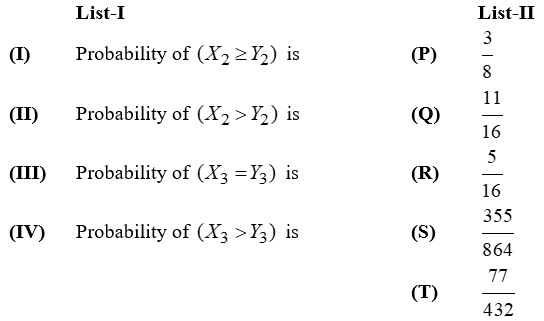
The correct option is:
A student appears for a quiz consisting of only true-false type questions and answers all the questions. The student knows the answers of some questions and guesses the answers for the remaining questions. Whenever the student knows the answer of a question, he gives the correct answer. Assume that the probability of the student giving the correct answer for a question, given that he has guessed it, is \( \dfrac{1}{2} \).
Also assume that the probability of the answer for a question being guessed, given that the student’s answer is correct, is \( \dfrac{1}{6} \). Then the probability that the student knows the answer of a randomly chosen question is:
Suppose that
Box-I contains \( 8 \) red, \( 3 \) blue and \( 5 \) green balls,
Box-II contains \( 24 \) red, \( 9 \) blue and \( 15 \) green balls,
Box-III contains \( 1 \) blue, \( 12 \) green and \( 3 \) yellow balls,
Box-IV contains \( 10 \) green, \( 16 \) orange and \( 6 \) white balls.
A ball is chosen randomly from Box-I; call this ball \( b \). If \( b \) is red then a ball is chosen randomly from Box-II, if \( b \) is blue then a ball is chosen randomly from Box III, and if \( b \) is green then a ball is chosen randomly from Box-IV. The conditional probability of the event ‘one of the chosen balls is white’ given that the event ‘at least one of the chosen balls is green’ has happened, is equal to:
Suppose that Box I contains \( 6 \) red balls and \( 9 \) green balls, and Box II contains \( 8 \) red balls and \( 12 \) green balls. All the balls of Box I and Box II are mixed together and a ball is chosen at random from them. Let \( E_1 \) be the event that the ball chosen belonged to Box I and let \( E_2 \) be the event that the ball chosen belonged to Box II. Let \( F_1 \) be the event that the ball chosen is red and let \( F_2 \) be the event that the ball chosen is green. Then which of the following statement is (are) TRUE?
A factory has a total of three manufacturing units, \( M_1, M_2 \) and \( M_3 \), which produce bulbs independent of each other. The units \( M_1, M_2 \) and \( M_3 \), produce bulbs in the proportions of \( 2:2:1 \), respectively.
It is known that \( 20\% \) of the bulbs produced in the factory are defective. It is also known that, of all the bulbs produced by \( M_1 \), \( 15\% \) are defective. Suppose that, if a randomly chosen bulb produced in the factory is found to be defective, the probability that it was produced by \( M_2 \) is \( \dfrac{2}{5} \).
If a bulb is chosen randomly from the bulbs produced by \( M_3 \), then the probability that it is defective is ___________.
Let \( E, F \) and \( G \) be three events having probabilities
\( P(E)=\dfrac{1}{8} \), \( P(F)=\dfrac{1}{6} \) and \( P(G)=\dfrac{1}{4} \) and let \( P(E \cap F \cap G) = \dfrac{1}{10} \).
For any event \( H \), \( H^{c} \) denotes its complement, then which of the following statements is(are) TRUE?
Consider three sets \( E_1=\{1,2,3\} \), \( F_1=\{1,3,4\} \) and \( G_1=\{2,3,4,5\} \). Two elements are chosen at random, without replacement, from the set \( E_1 \) and let \( S_1 \) denote the set of these chosen elements. Let \( E_2=E_1-S_1 \) and \( F_2=F_1 \cup S_1 \). Now two elements are chosen at random, without replacement, from the set \( F_2 \) and let \( S_2 \) denote the set of these chosen elements.
Let \( G_2=G_1 \cup S_2 \). Finally, two elements are chosen at random, without replacement, from the set \( G_2 \) and let \( S_3 \) denote the set of these chosen elements.
Let \( E_3=E_2 \cup S_3 \). Given that \( E_1=E_3 \), let \( p \) be the conditional probability of the event \( S_1=\{1,2\} \). Then the value of \( p \) is:
Three numbers are chosen at random, one after another with replacement, from the set \( S=\{1,2,3,\ldots,100\} \). Let \( p_1 \) be the probability that the maximum of chosen numbers is at least \( 81 \) and \( p_2 \) be the probability that the minimum of chosen numbers is at most \( 40 \).
The value of \( \frac{625}{4}\, p_1 \) is ______.
Let \( X \) be the set of all five digit numbers formed using \( 1, 2, 2, 2, 4, 4, 0 \). For example, \( 22240 \) is in \( X \) while \( 02244 \) and \( 44422 \) are not in \( X \). Suppose that each element of \( X \) has an equal chance of being chosen. Let \( p \) be the conditional probability that an element chosen at random is a multiple of \( 20 \) given that it is a multiple of \( 5 \). Then the value of \( 38p \) is equal to:
A number is chosen at random from the set \( \{1, 2, 3, \ldots, 2000\} \). Let \( p \) be the probability that the chosen number is a multiple of \( 3 \) or a multiple of \( 7 \). Then the value of \( 500p \) is \( \_\_\_\_\_\_\_\_ \).
A bag contains \( N \) balls out of which \( 3 \) balls are white, \( 6 \) balls are green, and the remaining balls are blue. Assume that the balls are identical otherwise. Three balls are drawn randomly one after the other without replacement. For \( i = 1, 2, 3 \), let \( W_i, G_i \) and \( B_i \) denote the events that the ball drawn in the \( i^{\text{th}} \) draw is a white ball, green ball, and blue ball, respectively. If the probability \( P(W_1 \cap G_2 \cap B_3) = \frac{2}{5N} \) and the conditional probability \( P(B_3 \mid W_1 \cap G_2) = \frac{2}{9} \), then \( N \) equals ______.
Let \( X \) be a random variable, and let \( p(X = x) \) denote the probability that \( X \) takes the value \( x \).
Suppose that the points \( (x,\; p(X = x)) \), \( x = 0, 1, 2, 3, 4 \), lie on a fixed straight line in the \( xy \)-plane, and \( p(X = x) = 0 \) for all \( x \in \mathbb{R} - \{0, 1, 2, 3, 4\} \). If the mean of \( X \) is \( \dfrac{5}{2} \), and the variance of \( X \) is \( \alpha \), then the value of \( 24\alpha \) ___________.
Paragraph-2
Consider the \( 6\times6 \) square in the figure. Let \( A_1, A_2, \ldots, A_{49} \) be the points of intersections (dots in the picture) in some order. We say that \( A_i \) and \( A_j \) are friends if they are adjacent along a row or along a column. Assume that each point \( A_i \) has an equal chance of being chosen.
Two distinct points are chosen randomly out of the points \( A_1, A_2, \ldots, A_{49} \). Let \( p \) be the probability that they are friends. Then the value of \( 7p \) is:
Three numbers are chosen at random, one after another with replacement, from the set \( S = \{ 1, 2, 3, \ldots, 100 \} \). Let \( p_1 \) be the probability that the maximum of chosen numbers is at least \( 81 \) and \( p_2 \) be the probability that the minimum of chosen numbers is at most \( 40 \).
The value of \( \frac{125}{4} \, p_2 \) is _______.
Paragraph-2
Consider the \( 6\times6 \) square in the figure. Let \( A_1, A_2, \ldots, A_{49} \) be the points of intersections (dots in the picture) in some order. We say that \( A_i \) and \( A_j \) are friends if they are adjacent along a row or along a column. Assume that each point \( A_i \) has an equal chance of being chosen.
Let \( p_i \) be the probability that a randomly chosen point has \( i \) many friends, \( i=0,1,2,3,4 \). Let \( X \) be a random variable such that for \( i=0,1,2,3,4 \), the probability \( P(X=i)=p_i \). Then the value of \( 7E(X) \) is:
Three students \( S_1,S_2 \) and \( S_3 \) are given a problem to solve. Consider the following events:
\( U \): At least one of \( S_1,S_2 \) and \( S_3 \) can solve the problem.
\( V \): \( S_1 \) can solve the problem, given that neither \( S_2 \) nor \( S_3 \) can solve the problem,
\( W \): \( S_2 \) can solve the problem and \( S_3 \) cannot solve the problem, \( T \): \( S_3 \) can solve the problem.
For any event \( E \), let \( P(E) \) denote the probability of \( E \). If \( P(U)=\dfrac{1}{2} \), \( P(V)=\dfrac{1}{10} \), and \( P(W)=\dfrac{1}{12} \), then \( P(T) \) is equal to:
In a study about a pandemic, data of \( 900 \) persons was collected. It was found that
\( 190 \) persons had symptom of fever,
\( 220 \) persons had symptom of cough,
\( 220 \) persons had symptom of breathing problem,
\( 330 \) persons had symptom of fever or cough or both,
\( 350 \) persons had symptom of cough or breathing problem or both,
\( 340 \) persons had symptom of fever or breathing problem or both,
\( 30 \) persons had all three symptoms (fever, cough and breathing problem).
If a person is chosen randomly from these \( 900 \) persons, then the probability that the person has at most one symptom is _____________.
