21 questions from 2025
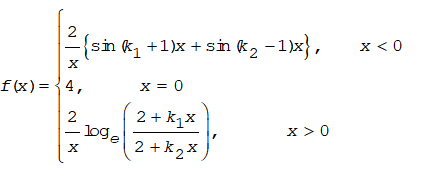
If the functionis continuous at \( x=0 \), then \( k_1^2+k_2^2 \) is equal to:
Let \( m \) and \( n \) be the number of points at which the function \( f(x) = \max \{ x, x^{3}, x^{5}, \ldots , x^{21} \} , \; x \in \mathbb{R}, \) is not differentiable and not continuous, respectively. Then \( m + n \) is equal to ________.
For some \( a,b \), let\( x\ne 0,\; \displaystyle\lim_{x\to 0} f(x)=\lambda+\mu a+\nu b. \) Then \(( \lambda+\mu+\nu)^{2} \) is equal to:
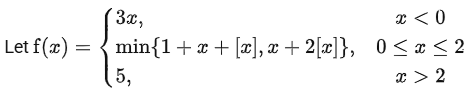
where \([.]\) denotes greatest integer function. If \( \alpha \) and \( \beta \) are the number of points, where \( f \) is not continuous and is not differentiable, respectively, then \( \alpha + \beta \) equals ______.
For \( \alpha, \beta, \gamma \in \mathbb{R} \), if \( \lim_{x \to 0} \dfrac{x^{2}\sin(\alpha x) + (\gamma-1)e^{\ x^{2}}}{\sin 2x - \beta x} = 3 \), then \( \beta + \gamma - \alpha \) is equal to:
If \( \lim_{x \to 0} \left( \frac{\tan x}{x} \right)^{\frac{1}{x^{2}}} = p \), then \( 96 \log_{e} p \) is equal to __________.
Let \( f \) be a differentiable function on \( \mathbb{R} \) such that \( f(2)=1 \), \( f'(2)=4 \). Let \( \displaystyle \lim_{x\to 0}\left(f(2+x)\right)^{3/x}=e^{\alpha} \). Then the number of times the curve \( y=4x^{3}-4x^{2}-4(\alpha-7)x-\alpha \) meets x-axis is:
Given below are two statements:Statement I: \( \displaystyle \lim_{x \to 0} \left( \frac{ \tan^{-1} x + \log_{e}\!\sqrt{\frac{1+x}{1-x}} - 2x }{ x^{5} } \right) = \frac{2}{5} \)Statement II: \( \displaystyle \lim_{x \to 1}(x^{\frac{2}{1-x}}) = \frac{1}{e^{2}} \)In the light of the above statements, choose the correct answer from the options given below:
\( \displaystyle\lim_{x \to \infty} \frac{(2x^2 - 3x + 5)(3x - 1)^{\frac{x}{2}}}{(3x^2 + 5x + 4)\sqrt{(3x + 2)^x}} \) is equal to:
Let $[t]$ be the greatest integer less than or equal to $t$. Then the least value of $p \in \mathbb{N}$ for which
$\lim_{x \to 0^+} \left( x \left( \left[\frac{1}{x}\right] + \left[\frac{2}{x}\right] + \dots + \left[\frac{p}{x}\right] \right) - x^2 \left( \left[\frac{1}{x^2}\right] + \left[\frac{2^2}{x^2}\right] + \dots + \left[\frac{9^2}{x^2}\right] \right) \right) \geq 1$
is equal to ______.
If \( \lim_{x \to 0} \dfrac{\cos(2x) + a \cos(4x) - b}{x^{4}} \) is finite, then \( (a + b) \) is equal to:
Let \( f: \mathbb{R} - \{ 0 \} \to \mathbb{R} \) be a function such that \( f(x) - 6 f\!\left( \frac{1}{x} \right) = \frac{35}{3x} - \frac{5}{2} \). If the \( \lim_{x \to 0} \left( \frac{1}{\alpha x} + f(x) \right) = \beta \) ; \( \alpha, \beta \in \mathbb{R} \), then \( \alpha + 2\beta \) is equal to:
be continuous at \( x = 0 \). Then \( e^{a} \, b \, c \) is equal to:
Let the function \( f(x) = (x^{2}-1)\lvert x^{2}-ax+2 \rvert + \cos \lvert x \rvert \) be not differentiable at the two points \( x = \alpha = 2 \) and \( x = \beta \). Then the distance of the point \( (\alpha,\beta) \) from the line \( 12x + 5y + 10 = 0 \) is equal to:
$\text{The number of points of discontinuity of the function } f(x) = \left[ \frac{x^2}{2} \right] - [\sqrt{x}], x \in, \text{[0,4] where}$$[.] \text{ denotes the greatest integer function, is __________ .}$
Let \( [x] \) denote the greatest integer function, and let \( m \) and \( n \) respectively be the numbers of the points, where the function \( f(x) = [x] + |x - 2|, \, -2 < x < 3, \) is not continuous and not differentiable. Then \( m + n \) is equal to :
If \(\displaystyle\lim_{x \to \infty} \left( \left( \frac{e}{1 - e} \right) \left( \frac{1}{e} - \frac{x}{1 + x} \right) \right)^x = \alpha \), then the value of \(\displaystyle {\frac{\log_{e}\alpha}{1+\log_{e}\alpha}} \) equals:
If \( \displaystyle \lim_{x \to 1^{+}} \frac{(x-1)\big(6+\lambda \cos(x-1)\big)+\mu \sin(1-x)}{(x-1)^3} = -1 \), where \( \lambda, \mu \in \mathbb{R} \), then \( \lambda + \mu \) is equal to:
is equal to:
\( \displaystyle \lim_{x\to 0} cosec x \left( \sqrt{2\cos^2 x + 3\cos x} - \sqrt{\cos^2 x + \sin x + 4} \right) \) is:
The value of\( \displaystyle \lim_{n \to \infty}\left( \sum_{k=1}^{n} \frac{k^3+6k^2+11k+5}{(k+3)!} \right) \) is:

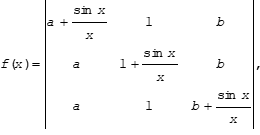 \( x\ne 0,\; \displaystyle\lim_{x\to 0} f(x)=\lambda+\mu a+\nu b. \) Then \(( \lambda+\mu+\nu)^{2} \) is equal to:

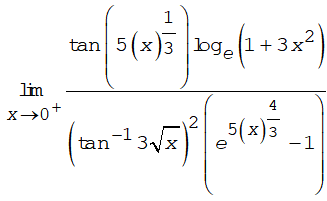 is equal to: