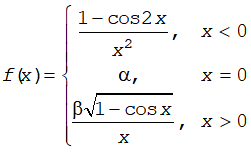
Let \( f : R \to R \) be a function given bywhere \( \alpha, \beta \in R \). If \( f \) is continuous at \( x = 0 \), then \( \alpha^2 + \beta^2 \) is equal to:
\( 3 \)
\( 12 \)
\( 6 \)
\( 48 \)
If the function \( f(x)=\dfrac{\sin 3x+\alpha x\sin x-\beta \cos 3x}{x^{3}},\, x\in \mathbb{R}, \) is continuous at \( x=0 \), then \( f(0) \) is equal to:
Let \( A=[2,3,6,8,9,11] \) and \( B=[1,4,5,10,15] \). Let \( R \) be a relation on \( A\times B \) defined by \( (a,b)R(c,d) \) if and only if \( 3ad-7bc \) is an even integer. Then the relation \( R \) is:
Consider the function \( f : (0,2) \to \mathbb{R} \) defined by \( f(x)=\frac{x}{2}+\frac{2}{x} \) and the function \( g(x) \) defined by
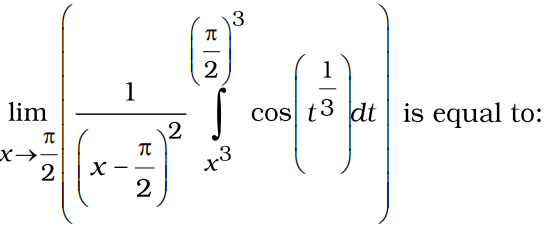
\( \displaystyle \lim_{x\to\frac{\pi}{2}} \left( \dfrac{\displaystyle\int_{x^{3}}^{\left({x}/{2}\right)^{3}} \left(\sin\!\left(2t^{1/3}\right)+\cos\!\left(t^{1/3}\right)\right)\\,dt}{\left(x-\frac{\pi}{2}\right)^{2}} \right) \) is equal to
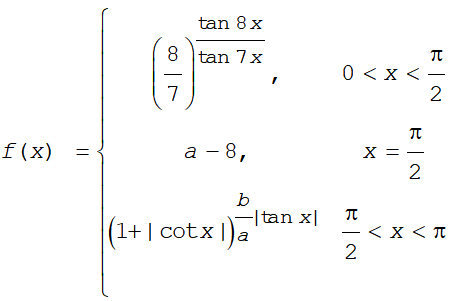
For \( a,b>0 \), let be a continuous function at \( x=0 \). Then \( \dfrac{b}{a} \) is equal to:
For the function \( f(x) = (\cos x) - x + 1, \ x \in \mathbb{R} \), between the following two statements:Statement-1 : \( f(x) = 0 \) for only one value of \( x \) in \( [0, \pi] \).Statement-2 : \( f(x) \) is decreasing in \( [0, \frac{\pi}{2}] \) and increasing in \( [\frac{\pi}{2}, \pi] \).
Let \( f : (0,\infty) \to \mathbb{R} \) and \(\displaystyle F(x) = \int_{0}^{x} t\,f(t)\,dt \). If \( F(x^{2}) = x^{4} + x^{5} \), then \(\displaystyle \sum_{r=1}^{12} f(r^{2}) \) is equal to ________.
If \( \log_{e} y = 3\sin^{-1}x \), then \( (1-x^{2})y''-xy' \) at \( x=\dfrac{1}{2} \) is equal to
Let \( y = \log_e\!\left(\dfrac{1-x^2}{1+x^2}\right) ,-1 < x < 1\). Then at \(x = \dfrac{1}{2}\), the value of \(225(y'-y'')\) is equal to:
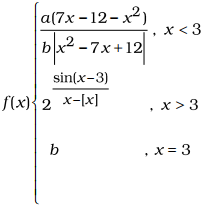
Consider the functionwhere \( [x] \) denotes the greatest integer less than or equal to \( x \). If \( S \) denotes the set of all ordered pairs \( (a, b) \) such that \( f(x) \) is continuous at \( x = 3 \), then the number of elements in \( S \) is:
then \( \dfrac{1}{5} f'(0) \) is equal to:
Let \( f:(0,\pi)\to \mathbb{R} \) be a function given by
Let $\displaystyle \lim_{n \rightarrow \infty} \left( \frac{n}{\sqrt{n^4+1}} - \frac{2n}{(n^2+1)\sqrt{n^4+1}} + \frac{n}{\sqrt{n^4+16}} - \frac{8n}{(n^2+4)\sqrt{n^4+16}} \right) + ... + \frac{n}{\sqrt{n^4+n^4}} - \frac{2n \cdot n^2}{(n^2+n^2)\sqrt{n^4+n^4}} $ be $\frac{\pi}{k}$, using only the principal values of the inverse trigonometric functions. Then $k^2$ is equal to _______.
If \( a = \displaystyle \lim_{x \to 0} \dfrac{\sqrt{1 + \sqrt{1 + x^4}} - \sqrt{2}}{x^4} \) and \( b = \displaystyle \lim_{x \to 0} \dfrac{\sin^2 x}{\sqrt{2} - \sqrt{1 + \cos x}} \), then the value of \( ab^3 \) is:
Let for a differentiable function \( f : (0, \infty) \to \mathbb{R} \), \( f(x) - f(y) \ge \log_e\!\left(\frac{x}{y}\right) + x - y, \, \forall \, x, y \in (0, \infty) \). Then \( \displaystyle \sum_{n=1}^{20} f'\!\left(\frac{1}{n^2}\right) \) is equal to ____________.
Let \([t]\) denote the greatest integer less than or equal to \( t \). Let \( f:[0,\infty)\to \mathbb{R} \) be a function defined by \( f(x)=\left[\frac{x}{2}+3\right]-[\sqrt{x}] \). Let \( S \) be the set of all points in the interval \( [0,8] \) at which \( f \) is not continuous. Then \( \sum\limits_{a\in S} a \) is equal to ______.
Consider the function \( f:(0,\infty)\to \mathbb{R} \) defined by \( f(x)=e^{-\lvert \log_{e} x \rvert} \). If \( m \) and \( n \) be respectively the number of points at which \( f \) is not continuous and \( f \) is not differentiable, then \( m+n \) is:
Let a line perpendicular to the line \( 2x - y = 10 \) touch the parabola \( y^{2} = 4(x - 9) \) at the point \( P \). The distance of the point \( P \) from the centre of the circle \( x^{2} + y^{2} - 14x - 8y + 56 = 0 \) is \( \_\_\_\_\_\_\_ \).
If \(\displaystyle \lim_{x \to 0} \frac{3 + \alpha \sin x + \beta \cos x + \log_e(1 - x)}{3 \tan^2 x} = \frac{1}{3} \), then \( 2\alpha - \beta \) is equal to:
The value of \( \displaystyle \lim_{x \to 0} 2\left( \frac{1-\cos x \sqrt{\cos 2x}\, \sqrt[3]{\cos 3x}\, \ldots \, \sqrt[10]{\cos 10x}}{x^2} \right) \) is ______.
Let \( f:[-1,2]\to \mathbb{R} \) be given \( f(x)=2x^{2}+x+[x^{2}]-[x] \) where \( [t] \) denotes the greatest integer less than or equal to \( t \). The number of points, where \( f \) is not continuous is:
Let \( f(x) = x^{3} + x^{2} f'(1) + x f''(2) + f'''(3), \, x \in \mathbb{R} \). Then \( f'(10) \) is equal to ____________.
Let \( g(x) \) be a linear function andis continuous at \( x = 0 \). If \( f'(1)=f(-1) \), then the value \( g(3) \) is:
If \(\displaystyle y = \frac{(\sqrt{x} + 1)(x^2 - \sqrt{x})}{x\sqrt{x} + x + \sqrt{x}} + \frac{1}{15}\,(3\cos^2 x - 5)\cos^3 x \), then \( 96\,y'\!\left(\dfrac{\pi}{6}\right) \) is equal to ________.
Let \( f(x) = x^5 + 2e^{x/4} \) for all \( x \in \mathbb{R} \). Consider a function \( g(x) \) such that \( (gof)(x) = x \) for all \( x \in \mathbb{R} \). Then the value of \( 8g'(2) \) is:
Suppose $f(x) = \frac{(2^x + 2^{-x})\tan x\sqrt{\tan^{-1}(x^2 - x + 1)}}{(7x^2 + 3x + 1)^3}$. Then the value of $f'(0)$ is equal to:
\( \displaystyle \lim_{x \to 0} \frac{e^{2|\sin x|}-2|\sin x|-1}{x^{2}} \)
If \(\displaystyle \lim_{x\to 0}\frac{ax^{2}e^{x}-b\log_{e}(1+x)+cxe^{-x}}{x^{2}\sin x}=1 \), then \( 16\left(a^{2}+b^{2}+c^{2}\right) \) is equal to ________.
Let \( f:\mathbb{R}\to\mathbb{R} \) be defined as:If \( f \) is continuous everywhere in \( \mathbb{R} \) and \( m \) is the number of points where \( f \) is NOT differentiable then \( m+a+b+c \) equals:
\( \displaystyle \lim_{n\to\infty}\frac{(1^{2}-1)(n-1)+(2^{2}-2)(n-2)+\cdots+((n-1)^{2}-(n-1))\cdot 1}{(1^{3}+2^{3}+\cdots+n^{3})-(1^{2}+2^{2}+\cdots+n^{2})} \) is equal to:
If \( \displaystyle \int \frac{\sin^{\frac{3}{2}} x + \cos^{\frac{3}{2}} x}{\sqrt{\sin^3 x \cos^3 x \sin(x - \theta)}} dx = A \sqrt{\cos\theta \tan x - \sin\theta} + B \sqrt{\cos\theta - \sin\theta \cot x} + C \), where \( C \) is the integration constant, then \( AB \) is equal to:
If for some \( a \in \mathbb{N} \), \( f(f(f(a))) = 21 \), then \(\displaystyle \lim_{x \to a^-} \left\{ \frac{|x|^3}{a} - \left[ \frac{x}{a} \right] \right\} \), where \( [t] \) denotes the greatest integer less than or equal to \( t \), is equal to:
Let \( f : (-\infty, \infty) - \{0\} \to \) \(\mathbb{R}\) be a differentiable function such that \( f'(1) = \lim_{a \to \infty} a^2 f\!\left(\frac{1}{a}\right) \). Then \( \lim_{a \to \infty} \left[ \dfrac{a(a+1)}{2} \tan^{-1}\!\left(\dfrac{1}{a}\right) \right] + a^2 - 2 \log_e a \) is equal to:
If the function is continuous at \( x=0 \), then the value of \( a^2 \) is equal to:
where \( a>0 \) and \( g(x):=(f(|x|)-|f(x|))/2 \). Then the function \( g:[-a,a]\to[-a,a] \) is:
Let \( f(x) = \left| 2x^2 + 5|x| - 3 \right| ,\; x \in \mathbb{R} \). If \( m \) and \( n \) denote the number of points where \( f \) is not continuous and not differentiable respectively, then \( m + n \) is equal to:
Let \( g : \mathbb{R} \to \mathbb{R} \) be a non constant twice differentiable function such that \( g'\!\left(\dfrac{1}{2}\right) = g'\!\left(\dfrac{3}{2}\right) \). If a real valued function \( f \) is defined as \( f(x) = \dfrac{1}{2}\,[g(x) + g(2 - x)] \), then:


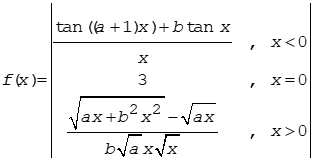 be a continuous function at \( x=0 \). Then \( \dfrac{b}{a} \) is equal to:
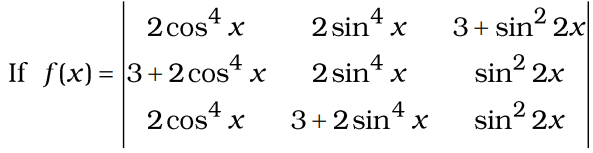 then \( \dfrac{1}{5} f'(0) \) is equal to:
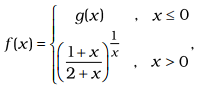 is continuous at \( x = 0 \). If \( f'(1)=f(-1) \), then the value \( g(3) \) is:
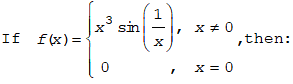
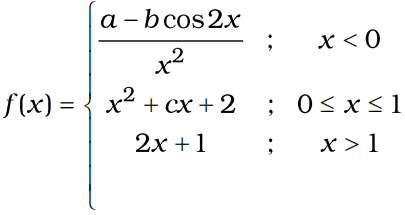
 If for some \( a \in \mathbb{N} \), \( f(f(f(a))) = 21 \), then \(\displaystyle \lim_{x \to a^-} \left\{ \frac{|x|^3}{a} - \left[ \frac{x}{a} \right] \right\} \), where \( [t] \) denotes the greatest integer less than or equal to \( t \), is equal to:
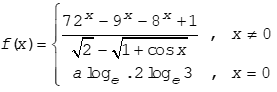 is continuous at \( x=0 \), then the value of \( a^2 \) is equal to:
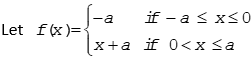 where \( a>0 \) and \( g(x):=(f(|x|)-|f(x|))/2 \). Then the function \( g:[-a,a]\to[-a,a] \) is: