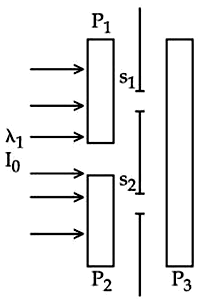
In a Young’s double slit experiment, three polarizers are kept as shown in the figure. The transmission axes of \( P_{1} \) and \( P_{2} \) are orthogonal to each other. The polarizer \( P_{3} \) covers both the slits with its transmission axis at \( 45^{\circ} \) to those of \( P_{1} \) and \( P_{2} \). An unpolarized light of wavelength \( \lambda \) and intensity \( I_{0} \) is incident on \( P_{1} \) and \( P_{2} \). The intensity at a point after \( P_{3} \), where the path difference between the light waves from \( s_{1} \) and \( s_{2} \) is \( \dfrac{\lambda}{3} \), is: