22 questions from 2025
Water falls from a height of \( 200 \, \text{m} \) into a pool. Calculate the rise in temperature of the water assuming no heat dissipation from the water in the pool. [Take: \( g = 10 \, \text{m}/\text{s}^{2} \), specific heat of water \( = 4200 \, \text{J}/(\text{kg} \, \text{K}) \)]
The length of a light string is \( 1.4 \, \text{m} \) when the tension on it is \( 5 \, \text{N} \). If the tension increases to \( 7 \, \text{N} \), the length of the string is \( 1.56 \, \text{m} \). The original length of the string is __________ \( \text{m} \).
Two cylindrical rods A and B made of different materials, are joined in a straight line. The ratios of lengths, radii and thermal conductivities of these rods are: \( \frac{L_A}{L_B} = \frac{1}{2} \), \( \frac{r_A}{r_B} = 2 \) and \( \frac{K_A}{K_B} = \frac{1}{2} \). The free ends of rods A and B are maintained at \( 400 \, \text{K} \), \( 200 \, \text{K} \), respectively. The temperature of rods interface is ___ \( \text{K} \), when equilibrium is established.
A steel wire of length \( 2 \, \text{m} \) and Young’s modulus \( 2.0 \times 10^{11} \, \text{N m}^{-2} \) is stretched by a force. If Poisson ratio and transverse strain for the wire are \( 0.2 \) and \( 10^{-3} \) respectively, then the elastic potential energy density of the wire is \( \underline{\hspace{1cm}} \times 10^{5} \) (in SI units).
A cup of coffee cools from \( 90^\circ \text{C} \) to \( 80^\circ \text{C} \) in \( t \) minutes when the room temperature is \( 20^\circ \text{C} \). The time taken by the similar cup of coffee to cool from \( 80^\circ \text{C} \) to \( 60^\circ \text{C} \) at the same room temperature is:
A gun fires a lead bullet of temperature \( 300 \, \text{K} \) into a wooden block. The bullet having melting temperature of \( 600 \, \text{K} \) penetrates into the block and melts down. If the total heat required for the process is \( 625 \, \text{J} \), then the mass of the bullet is ______ grams.
(Latent heat of fusion of lead \( = 2.5 \times 10^{4} \, \text{J} \, \text{Kg}^{-1} \) and specific heat capacity of lead \( = 125 \, \text{J} \, \text{Kg}^{-1} \, \text{K}^{-1} \))
The fractional compression \( \left(\frac{\Delta V}{V}\right) \) of water at the depth of \( 2.5 \, \text{km} \) below the sea level is ________ \( \% \). Given, the Bulk modulus of water \( = 2 \times 10^{9} \, \text{N m}^{-2} \), density of water \( = 10^{3} \, \text{kg m}^{-3} \), acceleration due to gravity \( = g = 10 \, \text{m s}^{-2} \).
Consider a rectangular sheet of solid material of length \( l = 9 \, \text{cm} \) and width \( d = 4 \, \text{cm} \). The coefficient of linear expansion is \( \alpha = 3.1 \times 10^{-5} \, \text{K}^{-1} \) at room temperature and one atmospheric pressure. The mass of sheet \( m = 0.1 \, \text{kg} \) and the specific heat capacity \( C_v = 900 \, \text{J\kg}^{-1}\text{K}^{-1} \). If the amount of heat supplied to the material is \( 8.1 \times 10^2 \, \text{J} \) then change in area of the rectangular sheet is:
Match List - I with List - II.
| List - I | List - II |
|---|---|
| (A) Heat capacity of body | (I) \( \text{J} \, \text{kg}^{-1} \) |
| (B) Specific heat capacity of body | (II) \( \text{J} \, \text{K}^{-1} \) |
| (C) Latent heat | (III) \( \text{J} \, \text{kg}^{-1} \text{K}^{-1} \) |
| (D) Thermal conductivity | (IV) \( \text{J} \, \text{m}^{-1} \text{K}^{-1} \text{s}^{-1} \) |
An air bubble of radius \( 1.0 \, \text{mm} \) is observed at a depth of \( 20 \, \text{cm} \) below the free surface of a liquid having surface tension \( 0.095 \, \text{J/m}^{2} \) and density \( 10^{3} \, \text{kg/m}^{3} \). The difference between pressure inside the bubble and atmospheric pressure is ________ \( \text{N/m}^{2} \). (Take \( g = 10 \, \text{m/s}^{2} \))
The volume contraction of a solid copper cube of edge length \( 10 \, \text{cm} \), when subjected to a hydraulic pressure of \( 7 \times 10^{6} \, \text{Pa} \), would be __________ \( \text{mm}^{3} \).
(Given bulk modulus of copper \( = 1.4 \times 10^{11} \, \text{Nm}^{-2} \))
Two spherical bodies of same materials having radii \( 0.2 \, \text{m} \) and \( 0.8 \, \text{m} \) are placed in same atmosphere. The temperature of the smaller body is \( 800 \, \text{K} \) and temperature of the bigger body is \( 400 \, \text{K} \). If the energy radiated from the smaller body is \( E \), the energy radiated from the bigger body is (assume, effect of the surrounding temperature to be negligible),
A \( 400 \, \mathrm{g} \) solid cube having an edge of length \( 10 \, \mathrm{cm} \) floats in water. How much volume of the cube is outside the water?
(Given: density of water \( = 1000 \, \mathrm{kg \, m^{-3}} \))
A sample of a liquid is kept at \( 1 \, \text{atm} \). It is compressed to \( 5 \, \text{atm} \) which leads to change of volume of \( 0.8 \, \text{cm}^3 \). If the bulk modulus of the liquid is \( 2 \, \text{GPa} \), the initial volume of the liquid was _______ litre. [Take \( 1 \, \text{atm} = 10^{5} \, \text{Pa} \)]
An amount of ice of mass \( 10^{-3} \,\text{kg} \) and temperature \( -10^{\circ}\text{C} \) is transformed to vapour of temperature \( 110^{\circ}\text{C} \) by applying heat. The total amount of work required for this conversion is,
(Take, specific heat of ice \( = 2100 \,\text{Jkg}^{-1}\text{K}^{-1} \), specific heat of water \( = 4180 \,\text{Jkg}^{-1}\text{K}^{-1} \), specific heat of steam \( = 1920 \,\text{Jkg}^{-1}\text{K}^{-1} \), Latent heat of ice \( = 3.35 \times 10^{5} \,\text{Jkg}^{-1} \) and Latent heat of steam \( = 2.25 \times 10^{6} \,\text{Jkg}^{-1} \))
Two slabs with square cross section of different materials \( (1, 2) \) with equal sides \( (l) \) and thickness \( d_{1} \) and \( d_{2} \) such that \( d_{2} = 2 d_{1} \) and \( l > d_{2} \). Considering lowest edges of these slabs are fixed to the floor, we apply equal shearing force on the narrow faces. The angle of deformation is \( \theta_{2} = 2 \theta_{1} \). If the shear moduli of material \( 1 \) is \( 4 \times 10^{9} \, \text{N} / \text{m}^{2} \), then shear moduli of material \( 2 \) is \( x \times 10^{9} \, \text{N} / \text{m}^{2} \), where value of \( x \) is _______.
Two wires A and B are made of same material having ratio of lengths \( \dfrac{L_A}{L_B} = \dfrac{1}{3} \) and their diameters ratio \( \dfrac{d_A}{d_B} = 2 \). If both the wires are stretched using same force, what would be the ratio of their respective elongations?
Three conductors of same length having thermal conductivity \( k_1 \), \( k_2 \) and \( k_3 \) are connected as shown in figure
. 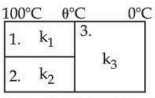
Area of cross sections of \( 1^{\text{st}} \) and \( 2^{\text{nd}} \) conductor are same and for \( 3^{\text{rd}} \) conductor it is double of the \( 1^{\text{st}} \) conductor. The temperatures are given in the figure. In steady state condition, the value of \( \theta \) is ________ \( ^\circ \text{C} \).
(Given: \( k_1 = 60 \, \text{J s}^{-1} \text{ m}^{-1} \text{ K}^{-1} \), \( k_2 = 120 \, \text{J s}^{-1} \text{ m}^{-1} \text{ K}^{-1} \), \( k_3 = 135 \, \text{J s}^{-1} \text{ m}^{-1} \text{ K}^{-1} \) )
A \( 3 \, \text{m} \) long wire of radius \( 3 \, \text{mm} \) shows an extension of \( 0.1 \, \text{mm} \) when loaded vertically by a mass of \( 50 \, \text{kg} \) in an experiment to determine Young's modulus. The value of Young's modulus of the wire as per this experiment is \( P \times 10^{11} \, \text{N m}^{-2} \), where the value of \( P \) is: [Take : \( g = 3\pi \, \text{m} \, /\text{s}^{2} \)]
A wire of length \( 10 \, \text{cm} \) and diameter \( 0.5 \, \text{mm} \) is used in a bulb. The temperature of the wire is \( 1727^\circ \text{C} \) and power radiated by the wire is \( 94.2 \, \text{W} \). Its emissivity is \( \frac{x}{8} \) where \( x = \) ________________.$(\text{Given } \sigma = 6.0 \times 10^{-8} \text{ W m}^{-2} \text{ K}^{-4}, \pi = 3.14 \text{ and assume that the emissivity of wire material}$ $\text{is same at all wavelength.})$
During the melting of a slab of ice at \( 273 \, \text{K} \) at atmospheric pressure:
A cylindrical rod of length \( 1 \, \text{m} \) and radius \( 4 \, \text{cm} \) is mounted vertically. It is subjected to a shear force of \( 10^5 \, \text{N} \) at the top. Considering infinitesimally small displacement in the upper edge, the angular displacement \( \theta \) of the rod axis from its original position would be:
(shear moduli, \( G = 10^{10} \, \text{N/m}^2 \) )
