29 questions from 2022
A uniform heavy rod of mass \( 20 \, \text{kg} \), cross sectional area \( 0.4 \, \text{m}^{2} \) and length \( 20 \, \text{m} \) is hanging from a fixed support. Neglecting the lateral contraction, the elongation in the rod due to its own weight is \( x \times 10^{-9} \, \text{m} \). The value of \( x \) is __________. (Given, young modulus \( Y = 2 \times 10^{11} \, \text{N m}^{-2} \) and \( g = 10 \, \text{m s}^{-2} \))
If the length of a wire is made double and radius is halved of its respective values. Then, the Young’s modulus of the material of the wire will:
A string of area of cross-section \( 4 \, \text{mm}^2 \) and length \( 0.5 \, \text{m} \) is connected with a rigid body of mass \( 2 \, \text{kg} \). The body is rotated in a vertical circular path of radius \( 0.5 \, \text{m} \). The body acquires a speed of \( 5 \, \text{m/s} \) at the bottom of the circular path. Strain produced in the string when the body is at the bottom of the circle is _______ \( \times 10^{-5} \).
(use young’s modulus \( 10^{11} \, \text{N/m}^2 \) and \( g = 10 \, \text{m/s}^2 \) )
If \( K_1 \) and \( K_2 \) are the thermal conductivities, \( L_1 \) and \( L_2 \) are the lengths and \( A_1 \) and \( A_2 \) are the cross sectional areas of steel and copper rods respectively such that \( \dfrac{K_2}{K_1} = 9 \), \( \dfrac{A_1}{A_2} = 2 \), \( \dfrac{L_1}{L_2} = 2 \). Then, for the arrangement as shown in the figure, the values of temperature \( T \) of the steel – copper junction in the steady state will be: 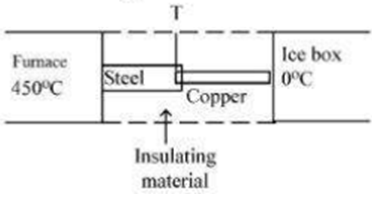
A wire of length \( L \) and radius \( r \) is clamped rigidly at one end. When the other end of the wire is pulled by a force \( F \), its length increases by \( 5 \,\text{cm} \). Another wire of the same material of length \( 4L \) and radius \( 4r \) is pulled by a force \( 4F \) under same conditions. The increase in length of this wire is ______ \( \text{cm} \).
A wire of length \( L \) is hanging from a fixed support. The length changes to \( L_{1} \) and \( L_{2} \) when masses \( 1 \, \text{kg} \) and \( 2 \, \text{kg} \) are suspended respectively from its free end. Then the value of \( L \) is equal to:
A lead bullet penetrates into a solid object and melts. Assuming that \( 40\% \) of its kinetic energy is used to heat it, the initial speed of bullet is: (Given, initial temperature of the bullet = \( 127^\circ \text{C} \), Melting point of the bullet = \( 327^\circ \text{C} \), Latent heat of fusion of lead = \( 2.5 \times 10^{4} \, \text{J} \, \text{kg}^{-1} \), Specific heat capacity of lead = \( 125 \, \text{J} \, \text{kg}^{} \, /\text{K}^{} \))
A block of ice of mass \( 120 \, \text{g} \) at temperature \( 0^{\circ}\text{C} \) is put in \( 300 \, \text{g} \) of water at \( 25^{\circ}\text{C} \). The \( x \, \text{g} \) of ice melts as the temperature of the water reaches \( 0^{\circ}\text{C} \). The value of \( x \) is _______.
\( \big( \text{Use specific heat capacity of water} = 4200 \, \text{Jkg}^{-1}\text{K}^{-1}, \ \text{Latent heat of ice} = 3.5 \times 10^{5} \, \text{Jkg}^{-1} \big) \)
A steel wire of length \( 3.2 \, \text{m} \) \( (Y_s = 2.0 \times 10^{11} \, \text{N m}^{-2}) \) and a copper wire of length \( 4.4 \, \text{m} \) \( (Y_C = 1.1 \times 10^{11} \, \text{N m}^{-2}) \), both of radius \( 1.4 \, \text{mm} \) are connected end to end. When stretched by a load, the net elongation is found to be \( 1.4 \, \text{mm} \). The load applied, in Newton, will be: (Given \( \pi = \dfrac{22}{7} \))
The bulk modulus of a liquid is \( 3 \times 10^{10} \, \text{N m}^{-2} \). The pressure required to reduce the volume of liquid by \( 2\% \) is:
A metal wire of length \( 0.5 \, \text{m} \) and cross-sectional area \( 10^{-4} \, \text{m}^2 \) has breaking stress \( 5 \times 10^{8} \, \text{N m}^{-2} \). A block of \( 10 \, \text{kg} \) is attached at one end of the string and is rotating in a horizontal circle. The maximum linear velocity of block will be _______ \( \text{ms}^{-1} \).
A square aluminum (shear modulus is \( 25 \times 10^{9} \, \text{N m}^{-2} \)) slab of side \( 60 \, \text{cm} \) and thickness \( 15 \, \text{cm} \) is subjected to a shearing force (on its narrow face) of \( 18.0 \times 10^{4} \, \text{N} \). The lower edge is riveted to the floor. The displacement of the upper edge is ______ \( \mu \text{m} \).
The velocity of upper layer of water in a river is \( 36 \, \text{km h}^{-1} \). Shearing stress between horizontal layers of water is \( 10^{-3} \, \text{N m}^{-2} \). Depth of the river is __________ \( \text{m} \). (Co-efficient of viscosity of water is \( 10^{-2} \, \text{Pa s} \) )
As per the given figure, two plates A and B of thermal conductivity \( K \) and \( 2K \) are joined together to form a compound plate. The thickness of plates are \( 4.0 \, \text{cm} \) and \( 2.5 \, \text{cm} \) respectively and the area of cross-section is \( 120 \, \text{cm}^{2} \) for each plate. The equivalent thermal conductivity of the compound plate is \( \left( 1 + \frac{5}{\alpha} \right) K \), then the value of \( \alpha \) will be________.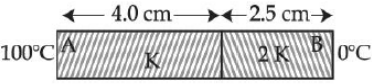
The elongation of a wire on the surface of the earth is \( 10^{-4} \, \text{m} \). The same wire of same dimensions is elongated by \( 6 \times 10^{-5} \, \text{m} \) on another planet. The acceleration due to gravity on the planet will be __________ \( \text{ms}^{-2} \). (Take acceleration due to gravity on the surface of earth = \( 10 \, \text{ms}^{-2} \))
A water drop of diameter \( 2 \, \text{cm} \) is broken into \( 64 \) equal droplets. The surface tension of water is \( 0.075 \, \text{N/m} \). In this process the gain in surface energy will be:
A \( 100 \,\text{g} \) of iron nail is hit by a \( 1.5 \,\text{kg} \) hammer striking at a velocity of \( 60 \,\text{m}\,\text{s}^{-1} \). What will be the rise in the temperature of the nail if one fourth of energy of the hammer goes into heating the nail? [Specific heat capacity of iron \( = 0.42 \,\text{J}\,\text{g}^{-1}\,{}^\circ\text{C}^{-1} \)]
A steam engine intakes \( 50 \, \text{g} \) of steam at \( 100^\circ \text{C} \) per minute and cools it down to \( 20^\circ \text{C} \). If latent heat of vaporization of steam is \( 540 \, \text{cal g}^{-1} \), then the heat rejected by the steam engine per minute is ________ \( \times 10^{3} \, \text{cal} \).
(Given : specific heat capacity of water : \( 1 \, \text{cal g}^{-1} \, {}^\circ\text{C}^{-1} \) )
At what temperature a gold ring of diameter \( 6.230 \, \text{cm} \) be heated so that it can be fitted on a wooden bangle of diameter \( 6.241 \, \text{cm} \)? Both the diameters have been measured at room temperature \( 27^{\circ}\text{C} \).
(Given: coefficient of linear thermal expansion of gold \( \alpha_{L} = 1.4 \times 10^{-5} \, \text{K}^{-1} \).)
In an experiment to verify Newton’s law of cooling, a graph is plotted between, the temperature difference \( (\Delta T) \) of the water and surrounding and time as shown in figure. The initial temperature of water is taken as \( 80^\circ \text{C} \). The value of \( t_{2} \) as mentioned in the graph will be ________.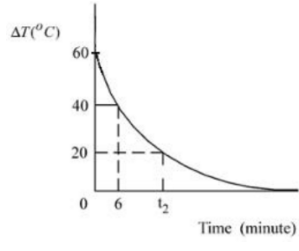
An ice cube of dimension \( 60 \, \text{cm} \times 50 \, \text{cm} \times 20 \, \text{cm} \) in placed in an insulation box of will thickness \( 1 \, \text{cm} \). The box keeping the ice cube at \( 0^\circ \text{C} \) of temperature is brought to a room of temperature \( 40^\circ \text{C} \). The rate of melting of ice is approximately: (Latent heat of fusion of ice is \( 3.4 \times 10^{5} \, \text{J kg}^{-1} \) and thermal conducting of insulation wall is \( 0.05 \, \text{W m}^{-1}\,\!\!^\circ\text{C}^{-1} \) )
The elastic behaviour of material for linear stress and linear strain, is shown in the figure. The energy density for a linear strain of \( 5 \times 10^{-4} \) is __________ \( \text{kJ} / \text{m}^{3} \). Assume that material is elastic upto the linear strain of \( 5 \times 10^{-4} \). 
The force required to stretch a wire of cross-section \( 1 \, \text{cm}^{2} \) to double its length will be:
(Given Young’s modulus of the wire \( = 2 \times 10^{11} \, \text{N}/\text{m}^{2} \) )
In an experiment to determine the Young’s modulus, steel wires of five different lengths \(( 1, 2, 3, 4 \) and \( 5 \, \text{m}) \) but of same cross section \(( 2 \, \text{mm}^2 )\) were taken and curves between extension and load were obtained. The slope (extension/load) of the curves were plotted with the wire length and the following graph is obtained. If the Young’s modulus of given steel wires is \( x \times 10^{11} \, \text{N m}^{-2} \), then the value of \( x \) is ______. 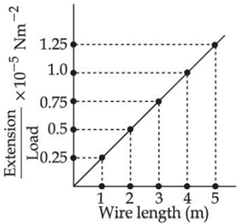
A geyser heats water flowing at a rate of 2.0 kg per minute from 30$^\circ$C to 70$^\circ$C. If geyser operates on a gas burner, the rate of combustion of fuel will be ______ g min$^{-1}$.
[Heat of combustion = 8 $\times$ 10$^3$ J g$^{-1}$, Specific heat of water = 4.2 J g$^{-1}$ $^\circ$C$^{-1}$]
A spherical soap bubble of radius \( 3 \, \text{cm} \) is formed inside another spherical soap bubble of radius of \( 6 \, \text{cm} \). If the internal pressure of the smaller bubble of radius \( 3 \, \text{cm} \) in the above system is equal to the internal pressure of the another single soap bubble of radius \( r \, \text{cm} \). The value of \( r \) is _____
A small spherical ball of radius \( 0.1 \, \text{mm} \) and density \( 10^{4} \, \text{kg m}^{-3} \) falls freely under gravity through a distance \( h \) before entering a tank of water. If, after entering the water the velocity of ball does not change and it continue to fall with same constant velocity inside water, then the value of \( h \) will be _______ \( \text{m} \).
(Given \( g = 10 \, \text{m s}^{-2} \), viscosity of water \( = 1.0 \times 10^{-5} \, \text{N -s m}^{-2} \).)
A unit scale is to be prepared whose length does not change with temperature and remains \( 20 \,\text{cm} \), using a bimetallic strip made of brass and iron each of different length. The length of both components would change in such a way that difference between their lengths remains constant. If length of brass is \( 40 \,\text{cm} \) and length of iron will be ______ \( \text{cm} \).
(\( \alpha_{\text{iron}} = 1.2 \times 10^{-5} \,\text{K}^{-1} \) & \( \alpha_{\text{brass}} = 1.8 \times 10^{-5} \,\text{K}^{-1} \)).
The area of cross section of the rope used to lift a load by a crane is \( 2.5 \times 10^{-4} \, \text{m}^2 \). The maximum lifting capacity of the crane is \( 10 \) metric tons. To increase the lifting capacity of the crane to \( 25 \) metric tons, the required area of cross section of the rope should be: (take \( g = 10 \, \text{ms}^{-2} \))
