Surface tension of a soap bubble is \( 2.0 \times 10^{-2} \, \text{N m}^{-1} \). Work done to increase the radius of soap bubble from \( 3.5 \, \text{cm} \) to \( 7 \, \text{cm} \) will be: Take \( \left[ \pi = \frac{22}{7} \right] \)
\( 5.76 \times 10^{-4} \, \text{J} \)
\( 18.48 \times 10^{-4} \, \text{J} \)
\( 0.72 \times 10^{-4} \, \text{J} \)
\( 9.24 \times 10^{-4} \, \text{J} \)
The surface of water in a water tank of cross section area \( 750 \,\text{cm}^2 \) on the top of a house is \( h \,\text{m} \) above the tap level. The speed of water coming out through the tap of cross section area \( 500 \,\text{mm}^2 \) is \( 30 \,\text{cm/s} \). At that instant, \( \frac{dh}{dt} \) is \( x \times 10^{-3} \,\text{m/s} \). The value of \( x \) will be _______.
A thin rod having a length of \( 1 \, \text{m} \) and area of cross–section \( 3 \times 10^{-6} \, \text{m}^2 \) is suspended vertically from one end. The rod is cooled from \( 210^{\circ}\text{C} \) to \( 160^{\circ}\text{C} \). After cooling, a mass \( M \) is attached at the lower end of the rod such that the length of rod again becomes \( 1 \, \text{m} \). Young's modulus and coefficient of linear expansion of the rod are \( 2 \times 10^{11} \, \text{N m}^{-2} \) and \( 2 \times 10^{-5} \, \text{K}^{-1} \), respectively. The value of \( M \) is _____ \( \text{kg} \). (Take \( g = 10 \, \text{m s}^{-2} \))
Choose the correct relationship between Poisson ratio \( (\sigma) \), bulk modulus \( (K) \) and modulus of rigidity \( (\eta) \) of a given solid object.
A wire of length '\( L \)' and radius '\( r \)' is clamped rigidly at one end. When the other end of the wire is pulled by a force \( f \), its length increases by '\( l \)'. Another wire of same material of length '\( 2L \)' and radius '\( 2r \)' is pulled by a force '\( 2f \)'. Then the increase in its length will be:
Glycerin of density \( 1.25 \times 10^{3}\,\text{kg}\,\text{m}^{-3} \) is flowing through the conical section of pipe. The area of cross-section of the pipe at its ends are \( 10\,\text{cm}^{2} \) and \( 5\,\text{cm}^{2} \) and pressure drop across its length is \( 3\,\text{N}\,\text{m}^{-2} \). The rate of flow of glycerin through the pipe is \( x \times 10^{-5}\,\text{m}^{3}\,\text{s}^{-1} \). The value of \( x \) is ______.
A \( 100 \, \text{m} \) long wire having cross-sectional area \( 6.25 \times 10^{-4} \, \text{m}^{2} \) and Young’s modulus is \( 10^{10} \, \text{N m}^{-2} \) is subjected to a load of \( 250 \, \text{N} \), then the elongation in the wire will be:
Young’s moduli of the material of wires \( A \) and \( B \) are in the ratio of \( 1:4 \), while its area of cross sections are in the ratio of \( 1:3 \). If the same amount of load is applied to both the wires, the amount of elongation produced in the wires \( A \) and \( B \) will be in the ratio of:[Assume length of wires \( A \) and \( B \) are same].
A certain pressure ‘\( P \)’ is applied to \( 1 \, \text{litre} \) of water and \( 2 \, \text{litre} \) of a liquid separately. Water gets compressed to \( 0.01\% \) whereas the liquid gets compressed to \( 0.03\% \). the ratio of Bulk modulus of water to that of the liquid is \( \frac{3}{x} \). The value of \( x \) is \( \_\_\_\_\_\_\_ \).
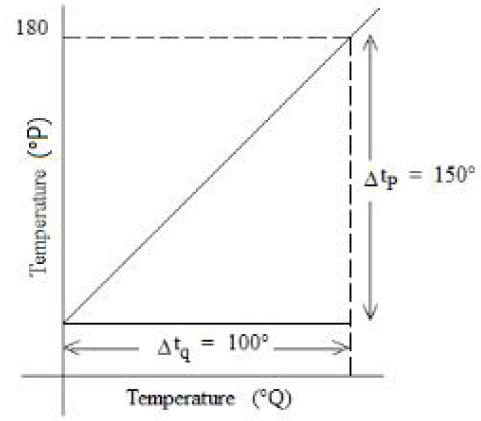
The graph between two temperature scales \( P \) and \( Q \) is shown in the figure, between upper fixed point and lower fixed point there are \( 150 \) equal divisions of scale \( P \) and \( 100 \) divisions on scale \( Q \). The relationship for conversion between the two scales is given by:
A metal block of mass \( m \) is suspended from a rigid support through a metal wire of diameter \( 14 \, \text{mm} \). The tensile stress developed in the wire under equilibrium state is \( 7 \times 10^{5} \, \text{N m}^{-2} \). The value of mass \( m \) is _________ \( \text{kg} \). (Take, \( g = 9.8 \, \text{m s}^{-2} \) and \( \pi = \dfrac{22}{7} \))
A hydraulic automobile lift is designed to lift vehicles of mass \( 5000 \, \text{kg} \). The area of cross section of the cylinder carrying the load is \( 250 \, \text{cm}^2 \). The maximum pressure the smaller piston would have to bear is: [Assume \( g = 10 \, \text{m/s}^2 \)]
The length of a wire becomes \( l_1 \) and \( l_2 \) when \( 100 \, \text{N} \) and \( 120 \, \text{N} \) tensions are applied respectively. If \( 10 l_2 = 11 l_1 \), the natural length of wire will be \( \dfrac{1}{x} l_1 \). Here the value of \( x \) is ________.
Eight equal drops of water are falling through air with a steady speed of \( 10 \, \text{cm/s} \). If the drops coalesce, the new velocity is:
Under the same load, wire \( A \) having length \( 5.0 \, \text{m} \) and cross section \( 2.5 \times 10^{-5} \, \text{m}^{2} \) stretches uniformly by the same amount as another wire \( B \) of length \( 6.0 \, \text{m} \) and a cross section of \( 3.0 \times 10^{-5} \, \text{m}^{2} \) stretches. The ratio of the Young’s modulus of wire \( A \) to that of wire \( B \) will be:
A water heater of power \( 2000 \, \text{W} \) is used to heat water. The specific heat capacity of water \( 4200 \, \text{J kg}^{-1}\text{K}^{-1} \). The efficiency of heater is \( 70\% \). Time required to heat \( 2 \, \text{kg} \) of water from \( 10^\circ\text{C} \) to \( 60^\circ\text{C} \) is ______ s. (Assume that the specific heat capacity of water remains constant over the temperature range of the water)
A faulty thermometer reads \( 5^{\circ} \text{C} \) in melting ice and \( 95^{\circ} \text{C} \) in stream. The correct temperature on absolute scale will be ________ \( \text{K} \) when the faulty thermometer reads \( 41^{\circ} \text{C} \).
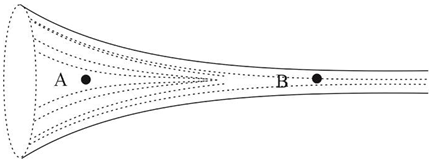
The figure shows a liquid of given density flowing steadily in horizontal tube of varying cross-section. Cross sectional areas at \(A\) is \(1.5\,\text{cm}^{2}\), and \(B\) is \(25\,\text{mm}^{2}\), if the speed of liquid at \(B\) is \(60\,\text{cm/s}\) then \( (P_{A}-P_{B}) \) is: (Given \(P_{A}\) and \(P_{B}\) are liquid pressures at \(A\) and \(B\) points.Density \( \rho =1000\,\text{kg m}^{-3} \)A and B are on the axis of tube.)
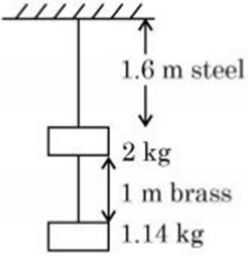
Two wires each of radius \( 0.2 \, \text{cm} \) and negligible mass, one made of steel and the other made of brass are loaded as shown in the figure. The elongation of the steel wire is ______ \( \times 10^{-6} \, \text{m} \). [Young’s modulus for steel \( = 2 \times 10^{11} \, \text{N m}^{-2} \) and \( g = 10 \, \text{m s}^{-2} \)]
Given below are two statements: one is labelled as Assertion A and the other is labelled as Reason R.Assertion A: Steel is used in the construction of building and bridges.Reason R: Steel is more elastic and its elastic limit is high.In the light of above statements, choose the most appropriate answer from the options given below
The surface tension of soap solution is \( 3.5 \times 10^{-2} \, \text{N m}^{-1} .\) The amount of work done required to increase the radius of soap bubble from \( 10 \, \text{cm} \) to \( 20 \, \text{cm} \) is ________ \( \times 10^{-4} \, \text{J} .\) (take \( \pi = {22}/{7} \))
A steel rod of length \( 1 \, \text{m} \) and cross sectional area \( 10^{-4} \, \text{m}^{2} \) is heated from \( 0^\circ \text{C} \) to \( 200^\circ \text{C} \) without being allowed to extend or bend. The compressive tension produced in the rod is \( \_\_\_\_\_\_\_\_\_ \times 10^{4} \, \text{N} \)(Given Young’s modulus of steel \( = 2 \times 10^{11} \, \text{N m}^{-2} \), coefficient of linear expansion \( = 10^{-5} \, \text{K}^{-1} \))
A hole is drilled in a metal sheet. At \( 27^{\circ}\mathrm{C} \), the diameter of hole is \( 5 \, \mathrm{cm} \). When the sheet is heated to \( 177^{\circ}\mathrm{C} \) the change in the diameter of hole is \( d \times 10^{-3} \, \mathrm{cm} \). The value of \( d \) will be ______ if coefficient of linear expansion of the metal is \( 1.6 \times 10^{-5} \,/ {^{\circ}}\mathrm{C}^{} \).
A steel rod has a radius of \( 20 \, \text{mm} \) and a length of \( 2.0 \, \text{m} \). A force of \( 62.8 \, \text{kN} \) stretches it along its length. Young's modulus of steel is \( 2.0 \times 10^{11} \, \text{N/m}^{2} \). The longitudinal strain produced in the wire is __________ \( \times 10^{-5} \).
The Young’s modulus of a steel wire of length \( 6 \, \text{m} \) and cross-sectional area \( 3 \, \text{mm}^2 \), is \( 2 \times 10^{11} \, \text{N/m}^2 \). The wire is suspended from its support on a given planet. A block of mass \( 4 \, \text{kg} \) is attached to the free end of the wire. The acceleration due to gravity on the planet is \( \tfrac{1}{4} \) of its value on the earth. The elongation of wire is: (Take \( g \) on the earth \( = 10 \, \text{m/s}^2 \))
Two plates \( A \) and \( B \) have thermal conductivities \( 84 \, \text{W m}^{-1} \text{K}^{-1} \) and \( 126 \, \text{W m}^{-1} \text{K}^{-1} \) respectively. They have same surface area and same thickness. They are placed in contact along their surfaces. If the temperatures of the outer surfaces of \( A \) and \( B \) are kept at \( 100^{\circ}\text{C} \) and \( 0^{\circ}\text{C} \) respectively, then the temperature of the surface of contact in steady state is ________ \( ^{\circ}\text{C} \).