34 questions from 2026
A particle moves along a straight line. The relation between the position of particle and time is:
\( x^2=(8t^2+8t+4)\, \text{m}^2 \)
Find acceleration of particle (in \( \text{m s}^{-2} \)) at \( x=2\, \text{m} \).
A balloon rises from rest with a constant acceleration \( \frac{g}{8} \). A stone is released from it when it has risen to height \( h \). The time taken by the stone to reach the ground is:
The velocity \( (v) \) versus time \( (t) \) plot of a particle is shown in the figure, for a time interval of \( 40\,\mathrm{s} \). The total distance travelled by the particle and the average velocity during this period are, respectively ________.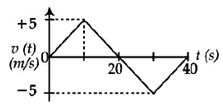
At \( t=0 \, \text{s} \), a ball is projected upward with an initial velocity of \( 60 \, \text{m/s} \). At \( t=2 \, \text{s} \), another ball is projected vertically upward with same velocity. The second ball will meet the first ball at \( t = ? \)
(Take \( g=10 \, \text{m/s}^2 \))
A particle is thrown horizontally from the top of a tower of height \( H \). The angle made by velocity of particle just before hitting the ground is \( 45^\circ \) with the horizontal. What is the horizontal range of particle?
A car moving on a straight road with constant velocity \( 72 \, \text{km/hr} \) sees an old lady crossing the road at \( 42 \, \text{m} \) ahead of the car. If reaction time (time lag between information received and action taken) of car driver is \( 0.1 \, \text{sec} \). Find minimum retardation (in \( \text{m/s}^2 \)) of car so as to avoid accident:
A particle starting from rest undergoes motion in straight line such that product of magnitude of acceleration and velocity is constant i.e. \( av=k \)
Then its displacement \( (x) \) in time \( t \) follows:
You are on the roof of your school building \( 60 \,\text{m} \) high. You see your physics teacher walking directly towards the building at \( 2 \,\text{m/sec} \). You wish to throw a ball vertically down at a speed \( 5 \,\text{m/sec} \), so that your teacher may catch it (when teacher is directly below the line of motion of the ball). At what distance (in \( \text{m} \)) from the bottom the building, should your teacher be when you throw the ball? Neglect air resistance and height of the teacher. Take \( g = 10 \,\text{m/sec}^{2} \).
A body starts from rest and travels a distance \( D \) with uniform acceleration, then moves uniformly a distance \( 5D \) and finally comes to rest after moving further distance \( 2D \) under uniform retardation. The ratio of the average velocity to maximum velocity is:
Water drops fall from a tap on the floor, \( 5 \, \text{m} \) below, at regular intervals of time, the first drop strikes the floor when the sixth drop begins to fall. The height at which the fourth drop will be from ground, at the instant when the first drop strikes the ground is ________ \( \text{m} \). \( (g = 10 \, \text{m} / \text{s}^2) \)
The position of a particle as a function of time ‘\( t \)’, is given by \( x(t)=at+bt^2-ct^3 \), where \( a \), \( b \) and \( c \) are constants. Then velocity of particle when acceleration becomes zero is:
An airplane is flying horizontally at constant velocity of \( 60 \, \text{m/s} \) at a height \( 540 \, \text{m} \). A box is released from the airplane. If the velocity (in m/s) with which the box lands on the ground is \( 20X \), then \( X \) is ________. (\( g = 10 \, \text{m/s}^2 \))
The velocity of a particle is given as \( \vec{v}=-x\,\hat{\imath}+2y\,\hat{\jmath}-z\,\hat{k}\ \text{m}/\text{s} \). The magnitude of acceleration at point \( (1,2,4) \) is ______ \( \text{m}/\text{s}^{2} \).
Two cars \( A \) and \( B \) are moving in the same direction along a straight line with speeds \( 100 \, \text{km/h} \) and \( 80 \, \text{km/h} \), respectively such that car \( A \) is moving ahead of car \( B \). A person in car \( B \) throws a stone with a speed \( v \) so that it hits the car \( A \) with a speed of \( 5 \, \text{m/s} \). The value of \( v \) is ________ \( \text{km/h} \).
A body of mass \( 1\,\text{kg} \) moves along a straight line with a velocity \( v = 2x^{2} \). The work done by the body during displacement from \( x = 0 \) to \( 5\,\text{m} \) is ______ \( \text{J} \).
A gas balloon is going up with a constant velocity of \( 10 \,\text{m/s} \). When this balloon reached a height of \( 75 \,\text{m} \), a stone is dropped from it and balloon keeps moving up with the same velocity. The height of the balloon when the stone hits the ground is ______ \( \text{m} \). \([ \text{Take } g=10 \,\text{m/s}^{2} ]\)
A body starts from rest and travels a distance \( D \) with uniform acceleration, then moves uniformly a distance \( 5D \) and finally comes to rest after moving further distance \( 2D \) under uniform retardation. The ratio of the average velocity to maximum velocity is:
If the velocity of a body is related to its displacement \( x \) as given by \( v=\sqrt{100+12x} \, \text{m/s} \), then the acceleration of the body is:
A paratrooper jumps from an aero plane and opens a parachute after \( 2 \, \text{s} \) of free fall and starts deaccelerating with \( 3 \, \text{m/s}^2 \). At \( 10 \, \text{m} \) height from ground, while descending with the help of parachute, the speed of paratrooper is \( 5 \, \text{m/s} \). The initial height of the airplane is _____ \( \text{m} \). \( (g = 10 \, \text{m/s}^2) \)
A particle of mass \( m \) falls from rest though a resistive medium having resistive force, \( F = -kv \), where \( v \) is the velocity of the particle and \( k \) is a constant. Which of the following graphs represents velocity \( (v) \) versus time \( (t) \)?
Figure shows the acceleration-time graph of a particle moving along a straight line. After what time (in seconds) the particle acquires its initial velocity? (Particle keeps on moving as per graph beyond \( t=2 \, \text{sec} \))
You are on the roof of your school building \( 60 \, \text{m} \). High. You see your physics teacher walking directly towards the building at \( 2 \, \text{m/sec} \). You wish to throw a ball vertically down at a speed \( 5 \, \text{m/sec} \), so that your teacher may catch it (when teacher is directly below the line of motion of the ball). At what distance (in \( \text{m} \)) from the bottom the building, should your teacher be when you throw the ball? Neglect air resistance and height of the teacher. Take \( g=10 \, \text{m/sec}^2 \).
The x-coordinate of a particles moving along x-axis is given by \( x = 8t - t^2 \), where \( x \) is in meters and \( t \) is time in seconds. The distance traveled by the particle from \( t = 0 \) to \( t = 8 \) seconds is:
A balloon rises from rest with a constant acceleration \( \dfrac{g}{8} \). A stone is released from it when it has risen to height \( h \). The time taken by the stone to reach the ground is:
A car moving on a straight road with constant velocity \( 72 \,\text{km/hr} \) sees an old lady crossing the road at \( 42 \,\text{m} \) ahead of the car. If reaction time (time lag between information received and action taken) of car driver is \( 0.1 \,\text{sec} \), find minimum retardation (in \( \text{m/s}^{2} \)) of car so as to avoid accident.
Figure shows the acceleration-time graph of a particle moving along a straight line. After what time (in seconds) the particle acquires its initial velocity? (Particle keeps on moving as per graph beyond \( t = 2 \, \text{s} \))
Two masses of \( 3.4 \, \mathrm{kg} \) and \( 2.5 \, \mathrm{kg} \) are accelerated from an initial speed of \( 5 \, \mathrm{m\, /s} \) and \( 12 \, \mathrm{m\, /s} \), respectively. The distances traversed by the masses in the \( 5^{\text{th}} \) second are \( 104 \, \mathrm{m} \) and \( 129 \, \mathrm{m} \), respectively. The ratio of their momenta after \( 10 \, \mathrm{s} \) is \( \dfrac{x}{8} \). The value of \( x \) is ______.
Graph of \( \left(\frac{1}{v}\right) \) vs \( x \) for a particle under rectilinear motion is as shown, where \( v \) is velocity and \( x \) is position. The time taken by the particle to move from \( x = 4 \, \text{m} \) to \( x = 12 \, \text{m} \) is: 
The velocity-time graph of a bus is shown in figure. Its displacement-time graph is: 
If the velocity of a body is related to its displacement \( x \) as given by \( v = \sqrt{100+12x} \, \text{m/s} \), then the acceleration of the body is:
The velocity \( (v) \) – Distance \( (x) \) graph is shown in figure. Which graph represents acceleration \( (a) \) versus distance \( (x) \) variation of this system.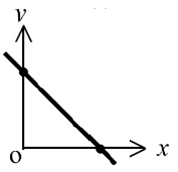
The x-coordinate of a particle moving along x-axis is given by \( x = 8t - t^2 \), where \( x \) is in meters and \( t \) is time in seconds. The distance traveled by the particle from \( t = 0 \) to \( t = 8 \) seconds is:
The velocity-time graph of a bus is shown in figure. Its displacement-time graph is: 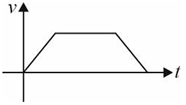
From \( 18 \, \text{m} \) height above the ground a ball is dropped from rest. The height above the ground at which the magnitude of velocity equal to the magnitude of acceleration (in the same set of units) due to gravity is ____ \( \text{m} \).
(Take \( g = 10 \, \text{m}/\text{s}^{2} \) and neglect the air resistance)
