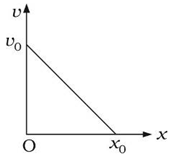
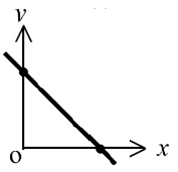
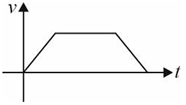
The velocity-displacement graph of a particle is shown in the figure. The acceleration-displacement graph of the same particle is represented by:
Water drops are falling from a nozzle of a shower onto the floor, from a height of \( 9.8 \, \text{m} \). The drops fall at a regular interval of time. When the first drop strikes the floor, at that instant, the third drop begins to fall. Locate the position of second drop from the floor when the first drop strikes the floor.
A car is moving with speed of \( 150 \,\text{km/h} \) and after applying the break it will move \( 27 \,\text{m} \) before it stops. If the same car is moving with a speed of one third the reported speed then it will stop after travelling ______ \( \text{m} \) distance.
A particle moves along a straight line. The relation between the position of particle and time is:\( x^2=(8t^2+8t+4)\, \text{m}^2 \)Find acceleration of particle (in \( \text{m s}^{-2} \)) at \( x=2\, \text{m} \).
A particle is moving in a straight line such that its velocity is increasing at \( 5 \, \text{ms}^{-1} \) per meter. The acceleration of the particle is _______ \( \text{ms}^{-2} \) at a point where its velocity is \( 20 \, \text{ms}^{-1} \).
A NCC parade is going to a uniform speed of \( 9 \, \text{km}/\text{h} \) under a mango tree on which a monkey is sitting at a height of \( 19.6 \, \text{m} \). At any particular instant, the monkey drops a mango. A cadet will receive the mango whose distance form the tree at time of drop is: (Given \( g = 9.8 \, \text{m}/\text{s}^{2} \) )
A particle is moving in a straight line. The variation of position ‘\( x \)’ as a function of time ‘\( t \)’ is given as \( x = (t^{3} - 6 t^{2} - 20 t + 15 )\, \text{m} \). The velocity of the body when its acceleration becomes zero is:
A train starting from rest first accelerates uniformly up to a speed of \( 80 \, \text{km/h} \) for time \( t \), then it moves with a constant speed for time \( 3t \). The average speed for the train for the duration of journey will be (in \( \text{km/h} \)):
A balloon was moving upwards with a uniform velocity of \( 10 \, \text{m/s} \). An object of finite mass is dropped from the balloon when it was at a height of \( 75 \, \text{m} \) from the ground level. The height of the balloon from the ground when object strikes the ground was around: (takes the value of \( g \) as \( 10 \, \text{m/s}^2 \))
To maintain a speed of \( 80 \, \text{km/h} \) by a bus of mass \( 500 \, \text{kg} \) on a plane rough road for \( 4 \, \text{km} \) distance, the work done by the engine of the bus will be _____ \( \text{KJ} \). (The coefficient of friction between tyre of bus and road is \( 0.04 \).)
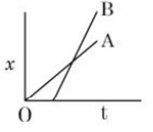
The position-time graphs for two students A and B returning from the school to their homes are shown in figure: (A) A lives closer to the school (B) B lives closer to the school (C) A takes lesser time to reach home (D) A travles faster than B (E) B travel faster than AChoose the correct answer from the options given below:
A balloon rises from rest with a constant acceleration \( \frac{g}{8} \). A stone is released from it when it has risen to height \( h \). The time taken by the stone to reach the ground is:
A person travelling on a straight line moves with a uniform velocity \( v_{1} \) for a distance \( x \) and with a uniform velocity \( v_{2} \) for the next \( \dfrac{3}{2} x \) distance. The average velocity in this motion is \( \dfrac{50}{7} \, \text{m / s} \). If \( v_{1} \) is \( 5 \, \text{m/ s} \) then \( v_{2} = \underline{\hspace{1cm}} \, \text{m / s} \).
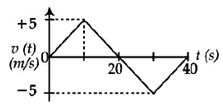
The velocity \( (v) \) versus time \( (t) \) plot of a particle is shown in the figure, for a time interval of \( 40\,\mathrm{s} \). The total distance travelled by the particle and the average velocity during this period are, respectively ________.
Given below are two statements:Statement I : A truck and a car moving with same kinetic energy are brought to rest by applying breaks which provide equal retarding forces. Both come to rest in equal distance.Statement II : A car moving towards east takes a turn and moves towards north, the speed remains unchanged. The acceleration of the car is zero.In the light of given statements, choose the most appropriate answer from the options given below
At \( t=0 \, \text{s} \), a ball is projected upward with an initial velocity of \( 60 \, \text{m/s} \). At \( t=2 \, \text{s} \), another ball is projected vertically upward with same velocity. The second ball will meet the first ball at \( t = ? \) (Take \( g=10 \, \text{m/s}^2 \))
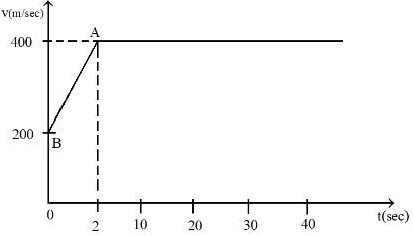
The motion of an airplane is represented by velocity-time graph as shown below. The distance covered by airplane in the first \( 30.5 \) second is ______ km.
For a particle in uniform circular motion, the acceleration \( \vec{a} \) at any point \( P(R, \theta) \) on the circular path of radius \( R \) is (when \( \theta \) is measured from the positive \( x \)-axis and \( v \) is uniform speed) :
Given below are two statements:Statement I: Area under velocity-time graph gives the distance travelled by the body in a given time.Statement II: Area under acceleration- time graph is equal to the change in velocity-in the given time.In the light of given statements, choose the correct answer from the options given below:
A car travels a distance of \( 'x' \) with speed \( v_{1} \) and then same distance \( 'x' \) with speed \( v_{2} \) in the same direction. The average speed of the car is:
A mosquito is moving with a velocity \( \vec{v} = 0.5 \, t^{2} \, \hat{i} + 3 t \, \hat{j} + 9 \hat{k} \, \text{m/s} \) and accelerating in uniform conditions. What will be the direction of mosquito after \( 2 \, \text{s} \)?
A particle initially at rest starts moving from reference point \( x = 0 \) along x-axis, with velocity \( v \) that varies as \( v = 4\sqrt{x}\,\text{m/s} \). The acceleration of the particle is _______ \( \text{m s}^{-2} \).
Two buses \( P \) and \( Q \) start from a point at the same time and move in a straight line and their positions are represented by \( X_P(t)=\alpha t+\beta t^2 \) and \( X_Q(t)= f t - t^2 \). At what time, both the buses have same velocity?
Two spherical balls having equal masses with radius of \( 5 \, \text{cm} \) each are thrown upwards along the same vertical direction at an interval of \( 3 \, \text{s} \) with the same initial velocity of \( 35 \, \text{m /s}^{} \), then these balls collide at a height of _________ \( \text{m} \). (take \( g = 10 \, \text{m /s}^{2} \))
A particle is moving in one dimension (along \( x \) axis) under the action of a variable force. It’s initial position was \( 16 \, \text{m} \) right of origin. The variation of its position \( (x) \) with time \( (t) \) is given as \( x = -3t^3 + 18t^2 + 16t \), where \( x \) is in \( \text{m} \) and \( t \) is in \( \text{s} \). The velocity of the particle when its acceleration becomes zero is ______ \( \text{m/s} \).
A particle is thrown horizontally from the top of a tower of height \( H \). The angle made by velocity of particle just before hitting the ground is \( 45^\circ \) with the horizontal. What is the horizontal range of particle?
A small toy starts moving from the position of rest under a constant acceleration. If it travels a distance of \( 10 \, \text{m} \) in \( t \, \text{s} \), the distance travelled by the toy in the next \( t \, \text{s} \) will be:
A car moving on a straight road with constant velocity \( 72 \, \text{km/hr} \) sees an old lady crossing the road at \( 42 \, \text{m} \) ahead of the car. If reaction time (time lag between information received and action taken) of car driver is \( 0.1 \, \text{sec} \). Find minimum retardation (in \( \text{m/s}^2 \)) of car so as to avoid accident:
A particle moves in a straight line so that its displacement \( x \) at any time \( t \) is given by \( x^2 = 1 + t^2 \). Its acceleration at any time \( t \) is \( x^{-n} \) where \( n = \) ________.
The position, velocity and acceleration of a particle moving with a constant acceleration can be represented by:
A ball is released from a height \( h \). If \( t_1 \) and \( t_2 \) be the time required to complete first half and second half of the distance respectively. Then, choose the correct relation between \( t_1 \) and \( t_2 \).
A vehicle travels \( 4 \, \text{km} \) with speed of \( 3 \, \text{km/h} \) and another \( 4 \, \text{km} \) with speed of \( 5 \, \text{km/h} \), then its average speed is :
From the top of a tower, a ball is thrown vertically upward which reaches the ground in \( 6 \, \text{s} \). A second ball thrown vertically downward from the same position with the same speed reaches the ground in \( 1.5 \, \text{s} \). A third ball released, from the rest from the same location, will reach the ground in _________ \( \text{s} \).
If \( t=\sqrt{x}+4 \), then \( \left(\dfrac{dx}{dt}\right)_{t=4} \) is:
A particle starting from rest undergoes motion in straight line such that product of magnitude of acceleration and velocity is constant i.e. \( av=k \)Then its displacement \( (x) \) in time \( t \) follows:
A horse rider covers half the distance with \(5 \, \text{m/s}\) speed. The remaining part of the distance was travelled with speed \(10 \, \text{m/s}\) for half the time and with \(15 \, \text{m/s}\) for other half of the time. The mean speed of the rider averaged over the whole time of motion is \( \frac{x}{7} \, \text{m/s} \). The value of \( x \) is _______.
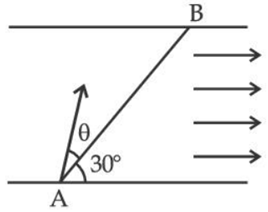
1.A swimmer wants to cross a river from point A to point B. Line AB makes an angle of \( 30^\circ \) with flow of river. Magnitude of velocity of the swimmer is same as that of the river. The angle \( \theta \) with the line AB should be ______\( ^\circ \), so that the swimmer reaches point B.
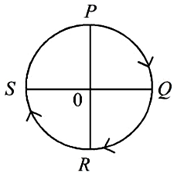
A cyclist starts from the point \( P \) of a circular ground of radius \( 2 \, \text{km} \) and travels along its circumference to the point \( S \). The displacement of a cyclist is:
The distance travelled by an object in time \( t \) is given by \( s = (2.5)t^{2} \). The instantaneous speed of the object at \( t = 5 \, \text{s} \) will be:
A ball is thrown up with a certain velocity so that it reaches a height '\( h \)'. Find the ratio of the two different times of the ball reaching \( \dfrac{h}{3} \) in both the directions.
You are on the roof of your school building \( 60 \,\text{m} \) high. You see your physics teacher walking directly towards the building at \( 2 \,\text{m/sec} \). You wish to throw a ball vertically down at a speed \( 5 \,\text{m/sec} \), so that your teacher may catch it (when teacher is directly below the line of motion of the ball). At what distance (in \( \text{m} \)) from the bottom the building, should your teacher be when you throw the ball? Neglect air resistance and height of the teacher. Take \( g = 10 \,\text{m/sec}^{2} \).
A particle moves along the \( x \)-axis and has its displacement \( x \) varying with time \( t \) according to the equation:\( x = c_{0}\left( t^{2} - 2 \right) + c (t - 2)^{2} \)where \( c_{0} \) and \( c \) are constants of appropriate dimensions. Then, which of the following statements is correct?
A body starts from rest and travels a distance \( D \) with uniform acceleration, then moves uniformly a distance \( 5D \) and finally comes to rest after moving further distance \( 2D \) under uniform retardation. The ratio of the average velocity to maximum velocity is:
The relation between time \( 't' \) and distance \( 'x' \) is \( t = \alpha x^{2} + \beta x \), where \( \alpha \) and \( \beta \) are constants. The relation between acceleration \( (a) \) and velocity \( (v) \) is:
A light unstretchable string passing over a smooth light pulley connects two blocks of masses \( m_{1} \) and \( m_{2} \). If the acceleration of the system is \( \dfrac{g}{8} \), then the ratio of the masses \( \dfrac{m_{2}}{m_{1}} \) is:
A particle moving in a straight line covers half the distance with speed \( 6 \, \text{m/s} \). The other half is covered in two equal time intervals with speeds \( 9 \, \text{m/s} \) and \( 15 \, \text{m/s} \) respectively. The average speed of the particle during the motion is:
Water drops fall from a tap on the floor, \( 5 \, \text{m} \) below, at regular intervals of time, the first drop strikes the floor when the sixth drop begins to fall. The height at which the fourth drop will be from ground, at the instant when the first drop strikes the ground is ________ \( \text{m} \). \( (g = 10 \, \text{m} / \text{s}^2) \)
Two cars \( P \) and \( Q \) are moving on a road in the same direction. Acceleration of car \( P \) increases linearly with time whereas car \( Q \) moves with a constant acceleration. Both cars cross each other at time \( t = 0 \), for the first time. The maximum possible number of crossing(s) (including the crossing at \( t = 0 \)) is _______.
A body projected vertically upwards with a certain speed from the top of a tower reaches the ground in \( t_{1} \). If it is projected vertically downwards from the same point with the same speed, it reaches the ground in \( t_{2} \). Time required to reach the ground, if it is dropped from the top of the tower, is:
A bullet is shot vertically downwards with an initial velocity of \( 100 \, \text{m/s} \) from a certain height. Within \( 10 \, \text{s} \), the bullet reaches the ground and instantaneously comes to rest due to the perfectly inelastic collision. The velocity-time curve for total time \( t = 20 \, \text{s} \) will be: (Take \( g = 10 \, \text{m/s}^{2} \)).
Match Column-I with Column-II. Choose the correct answer from the options given below:
A juggler throws balls vertically upwards with same initial velocity in air. When the first ball reaches its highest position, he throws the next ball. Assuming the juggler throws \( n \) balls per second, the maximum height the balls can reach is
The distance travelled by a particle is related to time \( t \) as \( x = 4 t^2 \). The velocity of the particle at \( t = 5 \, \text{s} \) is:
A car accelerates from rest at a constant rate \( \alpha \) for some time after which it decelerates at a constant rate \( \beta \) to come rest. If the total time elapsed is \( t \) seconds, the total distance travelled is:
The position of a particle as a function of time ‘\( t \)’, is given by \( x(t)=at+bt^2-ct^3 \), where \( a \), \( b \) and \( c \) are constants. Then velocity of particle when acceleration becomes zero is:
An airplane is flying horizontally at constant velocity of \( 60 \, \text{m/s} \) at a height \( 540 \, \text{m} \). A box is released from the airplane. If the velocity (in m/s) with which the box lands on the ground is \( 20X \), then \( X \) is ________. (\( g = 10 \, \text{m/s}^2 \))
The velocity of a particle is given as \( \vec{v}=-x\,\hat{\imath}+2y\,\hat{\jmath}-z\,\hat{k}\ \text{m}/\text{s} \). The magnitude of acceleration at point \( (1,2,4) \) is ______ \( \text{m}/\text{s}^{2} \).
A ball is thrown up vertically with a certain velocity so that, it reaches a maximum height \( h \). Find the ratio of the times in which it is at height \( \dfrac{h}{3} \) while going up and coming down respectively.
Two cars \( A \) and \( B \) are moving in the same direction along a straight line with speeds \( 100 \, \text{km/h} \) and \( 80 \, \text{km/h} \), respectively such that car \( A \) is moving ahead of car \( B \). A person in car \( B \) throws a stone with a speed \( v \) so that it hits the car \( A \) with a speed of \( 5 \, \text{m/s} \). The value of \( v \) is ________ \( \text{km/h} \).
A ball is thrown vertically upwards with a velocity of \( 19.6 \, \text{m s}^{-1} \) from the top of a tower. The ball strikes the ground after \( 6 \, \text{s} \). The height from the ground up to which the ball can rise will be \( \left(\dfrac{k}{5}\right) \, \text{m} \). The value of \( k \) is _______ (use \( g = 9.8 \, \text{m/s}^2 \) ).
The velocity of the bullet becomes one third after it penetrates \( 4 \, \text{cm} \) in a wooden block. Assuming that bullet is facing a constant resistance during its motion in the block. The bullet stops completely after travelling at \( (4 + x) \, \text{cm} \) inside the block. The value of \( x \) is:
A butterfly is flying with a velocity \( 4\sqrt{2} \, \text{m/s} \) in North-East direction. Wind is slowly blowing at \( 1 \, \text{m/s} \) from North to South. The resultant displacement of the butterfly in \( 3 \) second is:
The position of a particle related to time is given by \( x = (5t^2 - 4t + 5) \, \text{m} \). The magnitude of velocity of the particle at \( t = 2 \, \text{s} \) will be:
A body of mass \( 1\,\text{kg} \) moves along a straight line with a velocity \( v = 2x^{2} \). The work done by the body during displacement from \( x = 0 \) to \( 5\,\text{m} \) is ______ \( \text{J} \).
A gas balloon is going up with a constant velocity of \( 10 \,\text{m/s} \). When this balloon reached a height of \( 75 \,\text{m} \), a stone is dropped from it and balloon keeps moving up with the same velocity. The height of the balloon when the stone hits the ground is ______ \( \text{m} \). \([ \text{Take } g=10 \,\text{m/s}^{2} ]\)
Given below are two statements: Statement (I): The mean free path of gas molecules in inversely proportional to square of molecular diameter. Statement (II): Average kinetic energy of gas molecules is directly proportional to absolute temperature of gas. In the light of the above statements, choose the correct answer from the options given below:
Position of an ant ($S$ in metres) moving in Y-Z plane is given by $S = 2t^2 \hat{j} + 5\hat{k}$ (where $t$ is in second). The magnitude and direction of velocity of the ant at $t = 1\text{ s}$ will be :
If the velocity of a body is related to its displacement \( x \) as given by \( v=\sqrt{100+12x} \, \text{m/s} \), then the acceleration of the body is:
The instantaneous velocity of a particle moving in a straight line is given as \( v = \alpha t + \beta t^{2} \), where \( \alpha \) and \( \beta \) are constants. The distance travelled by the particle between \( 1 \, \text{s} \) and \( 2 \, \text{s} \) is:
A body travels \( 102.5 \, \text{m} \) in \( n^{\text{th}} \) second and \( 115.0 \, \text{m} \) in \( (n + 2)^{\text{th}} \) second. The acceleration is:
A paratrooper jumps from an aero plane and opens a parachute after \( 2 \, \text{s} \) of free fall and starts deaccelerating with \( 3 \, \text{m/s}^2 \). At \( 10 \, \text{m} \) height from ground, while descending with the help of parachute, the speed of paratrooper is \( 5 \, \text{m/s} \). The initial height of the airplane is _____ \( \text{m} \). \( (g = 10 \, \text{m/s}^2) \)
A projectile is projected at \( 30^\circ \) from horizontal with initial velocity \( 40 \, \text{m} \, \text{s}^{-1} \). The velocity of the projectile at \( t = 2 \, \text{s} \) from the start will be:
An object of mass \( 5 \, \text{kg} \) is thrown vertically upwards from the ground. The air resistance produces a constant retarding force of \( 10 \, \text{N} \) throughout the motion. The ratio of time of ascent to the time of descent will be equal to: [Use \( g=10 \, \text{ms}^{-2} \)].
The displacement and the increase in the velocity of a moving particle in the time interval of \( t \) to \( (t+1) \, \text{s} \) are \( 125 \, \text{m} \) and \( 50 \, \text{m/s} \), respectively. The distance travelled by the particle in \( (t+2)^{\text{th}} \, \text{s} \) is________ \( \text{m} \).
At time \( t = 0 \) a particle starts travelling from a height \( 7\hat{z}\,\text{cm} \) in a plane keeping \( z \) coordinate constant. At any instant of time it’s position along the \( \hat{x} \) and \( \hat{y} \) directions are defined as \( 3t \) and \( 5t^{3} \) respectively. At \( t = 1\,\text{s} \) acceleration of the particle will be:
A particle of mass \( m \) falls from rest though a resistive medium having resistive force, \( F = -kv \), where \( v \) is the velocity of the particle and \( k \) is a constant. Which of the following graphs represents velocity \( (v) \) versus time \( (t) \)?
Figure shows the acceleration-time graph of a particle moving along a straight line. After what time (in seconds) the particle acquires its initial velocity? (Particle keeps on moving as per graph beyond \( t=2 \, \text{sec} \))
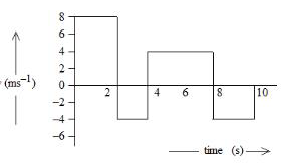
The velocity time graph of a body moving in a straight line is shown in figure.The ratio of displacement to distance travelled by the body in time \( 0 \) to \( 10 \, \text{s} \) is:
You are on the roof of your school building \( 60 \, \text{m} \). High. You see your physics teacher walking directly towards the building at \( 2 \, \text{m/sec} \). You wish to throw a ball vertically down at a speed \( 5 \, \text{m/sec} \), so that your teacher may catch it (when teacher is directly below the line of motion of the ball). At what distance (in \( \text{m} \)) from the bottom the building, should your teacher be when you throw the ball? Neglect air resistance and height of the teacher. Take \( g=10 \, \text{m/sec}^2 \).
A river is flowing from west to east direction with speed of \( 9 \, \text{km h}^{-1} \). If a boat capable of moving at a maximum speed of \( 27 \, \text{km h}^{-1} \) in still water, crosses the river in half a minute, while moving with maximum speed at an angle of \( 150^\circ \) to direction of river flow, then the width of the river is:
A rubber ball is released from a height of \( 5 \, \text{m} \) above the floor. It bounces back repeatedly, always rising to \( \dfrac{81}{100} \) of the height through which it falls. Find the average speed of the ball. (Take \( g = 10 \, \text{m s}^{-2} \))
A particle of mass \( 10 \, \text{g} \) moves in a straight line with retardation \( 2x \), where \( x \) is the displacement in SI units. Its loss of kinetic energy for above displacement is \( \left( \dfrac{10}{x} \right)^{-n} \, \text{J} \). The value of \( n \) will be _________.
An object moves with speed \( v_{1} \), \( v_{2} \) and \( v_{3} \) along a line segment \( AB \), \( BC \) and \( CD \) respectively as shown in figure. Where \( AB = BC \) and \( AD = 3AB \), then average speed of the object will be:
The x-coordinate of a particles moving along x-axis is given by \( x = 8t - t^2 \), where \( x \) is in meters and \( t \) is time in seconds. The distance traveled by the particle from \( t = 0 \) to \( t = 8 \) seconds is:
A balloon rises from rest with a constant acceleration \( \dfrac{g}{8} \). A stone is released from it when it has risen to height \( h \). The time taken by the stone to reach the ground is:
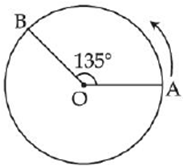
A person moved from A to B on a circular path as shown in figure. If the distance travelled by him is \( 60 \, \text{m} \), then the magnitude of displacement would be: (Given \( \cos 135^{\circ}=-0.7 \))
A car moving on a straight road with constant velocity \( 72 \,\text{km/hr} \) sees an old lady crossing the road at \( 42 \,\text{m} \) ahead of the car. If reaction time (time lag between information received and action taken) of car driver is \( 0.1 \,\text{sec} \), find minimum retardation (in \( \text{m/s}^{2} \)) of car so as to avoid accident.
Two balls A and B are placed at the top of \( 180 \, \text{m} \) tall tower. Ball A is released from the top at \( t = 0 \, \text{s} \). Ball B is thrown vertically down with an initial velocity \( u \) at \( t = 2 \, \text{s} \). After a certain time, both balls meet \( 100 \, \text{m} \) above the ground. Find the value of \( u \) in \( \text{m s}^{-1} \). [use \( g = 10 \, \text{m s}^{-2} \) ] :
Figure shows the acceleration-time graph of a particle moving along a straight line. After what time (in seconds) the particle acquires its initial velocity? (Particle keeps on moving as per graph beyond \( t = 2 \, \text{s} \))
An object with mass \( 500 \, \text{g} \) moves along \( x \)-axis with speed \( v = 4\sqrt{x} \, \text{m}/\text{s} \). The force acting on the object is:
Two masses of \( 3.4 \, \mathrm{kg} \) and \( 2.5 \, \mathrm{kg} \) are accelerated from an initial speed of \( 5 \, \mathrm{m\, /s} \) and \( 12 \, \mathrm{m\, /s} \), respectively. The distances traversed by the masses in the \( 5^{\text{th}} \) second are \( 104 \, \mathrm{m} \) and \( 129 \, \mathrm{m} \), respectively. The ratio of their momenta after \( 10 \, \mathrm{s} \) is \( \dfrac{x}{8} \). The value of \( x \) is ______.
An object moves at a constant speed along a circular path in a horizontal plane with centre at the origin. When the object its velocity is \( -4\hat{j}\ \text{m/s} \). The object’s velocity \( (v) \) and acceleration \( (A) \) at \( x = -2\ \text{m} \) will be:
A body of mass \( 2 \, \text{kg} \) moves under a force of \( (2\hat{i} + 3\hat{j} + 5\hat{k} )\, \text{N} \). It starts from rest and was at the origin initially. After \( 4 \, \text{s} \), its new coordinates are \( (8, b, 20) \). The value of \( b \) is ______. (Round off to the Nearest Integer)
A body starts moving from rest with constant acceleration covers displacement \( S_{1} \) in first \( (p-1) \) seconds and \( S_{2} \) in first \( p \) seconds. The displacement \( S_{1} + S_{2} \) will be made in time:
The relation between time \( t \) and distance \( x \) for a moving body is given as \( t = m x^2 + n x \), where \( m \) and \( n \) are constants. The retardation of the motion is: (Where \( v \) stands for velocity)
A car is moving on a circular path of radius \( 600\,\text{m} \) such that the magnitudes of the tangential acceleration and centripetal acceleration are equal. The time taken by the car to complete first quarter of revolution, if it is moving with an initial speed of \( 54\,\text{km/hr} \) \( t(1-e^{-\pi/2})\,\text{s} \). The value of \( t \) is __________.
A force \( \vec{F} = (40\hat{i} + 10\hat{j}) \, \text{N} \) acts on a body of mass \( 5 \, \text{kg} \). If the body starts from rest, its position vector \( \vec{r} \) at time \( t = 10 \, \text{s} \), will be:
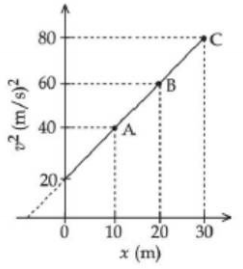
A particle is moving with constant acceleration ‘\( a \)’. Following graph shows \( v^2 \) versus \( x \) (displacement) plot. The acceleration of the particle is ______ \( \mathrm{m/s^2} \).
Graph of \( \left(\frac{1}{v}\right) \) vs \( x \) for a particle under rectilinear motion is as shown, where \( v \) is velocity and \( x \) is position. The time taken by the particle to move from \( x = 4 \, \text{m} \) to \( x = 12 \, \text{m} \) is:
A ball rolls off the top of a stairway with horizontal velocity \( u \). The steps are \( 0.1 \, \text{m} \) high and \( 0.1 \, \text{m} \) wide. The minimum velocity \( u \) with which that ball just hits the step \( 5 \) of the stairway will be \( \sqrt{x} \, \text{m s}^{-1} \) where \( x = \) ________________ [use \( g = 10 \, \text{m/ s}^{2} \) ].
If a rubber ball falls from a height \( h \) and rebounds upto the height of \( \frac{h}{2} \). The percentage loss of total energy of the initial system as well as velocity ball before it strikes the ground, respectively, are:
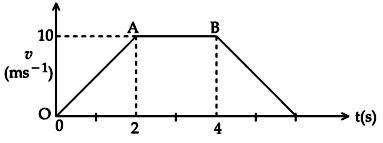
The velocity-time graph of a bus is shown in figure. Its displacement-time graph is:
The velocity-time graph of an object moving along a straight line is shown in figure. What is the distance covered by the object between \( t = 0 \) to \( t = 4 \,\text{s} \)?
If the velocity of a body is related to its displacement \( x \) as given by \( v = \sqrt{100+12x} \, \text{m/s} \), then the acceleration of the body is:
The velocity \( (v) \) – Distance \( (x) \) graph is shown in figure. Which graph represents acceleration \( (a) \) versus distance \( (x) \) variation of this system.
Given below are two statements. One is labeled as Assertion A and the other is labeled as Reason R.Assertion A: two identical balls \( A \) and \( B \) thrown with same velocity \( u \) at two different angles with horizontal attained the same range \( R \). If \( A \) and \( B \) reached the maximum height \( h_1 \) and \( h_2 \) respectively, then \( R = 4\sqrt{h_1 h_2} \)Reason R: Product of said height. \( h_1 h_2 = \left( \dfrac{u^2 \sin^2 \theta}{2g} \right)\left( \dfrac{u^2 \cos^2 \theta}{2g} \right) \)Choose the correct answer :
The position vector of a moving body at any instant of time is given as \( \vec{r} = (5 t^{2}\hat{i} - 5 t \hat{j}) \,\text{m} \). The magnitude and direction of velocity at \( t = 2 \,\text{s} \) is:
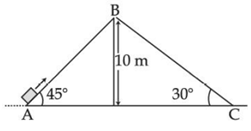
Two inclined planes are placed as shown in figure. A block is projected from the point \( A \) of inclined plane \( AB \) along its surface with a velocity just sufficient to carry it to the top point \( B \) at a height \( 10 \, \text{m} \). After reaching the Point \( B \) the block slides down on inclined plane \( BC \). Time it takes to reach to the point \( C \) from point \( A \) is \( t(\sqrt{2}+1) \, \text{s} \). The value of \( t \) is _______. (use \( g = 10 \, \text{m/s}^{2} \)).
A player kicks a football with an initial speed of \( 25 \, \text{ms}^{-1} \) at an angle of \( 45^\circ \) from the ground. What are the maximum height and the time taken by the football to reach at the highest point during motion?(Take : \( g = 10 \, \text{ms}^{-2} \))
If the velocity of a body related to displacement \( x \) given by \( v=\sqrt{5000+24x} \, \mathrm{m/s} \), then the acceleration of the body is __________ \( \mathrm{m/s^2} \).
A ball is projected vertically upward with an initial velocity of \( 50 \, \text{m s}^{-1} \) at \( t = 0 \, \text{s} \). At \( t = 2 \, \text{s} \), another ball is projected vertically with same velocity. At \( t = \_\_\_\_ \, \text{s} \), second ball will meet the first ball \( (g = 10 \, \text{m s}^{-2}) \).
The x-coordinate of a particle moving along x-axis is given by \( x = 8t - t^2 \), where \( x \) is in meters and \( t \) is time in seconds. The distance traveled by the particle from \( t = 0 \) to \( t = 8 \) seconds is:
A body moves on a frictionless plane starting from rest. If \( S_n \) is distance moved between \( t = n - 1 \) and \( t = n \) and \( S_{n-1} \) is distance moved between \( t = n - 2 \) and \( t = n - 1 \), the ratio \( \frac{S_{n-1}}{S_n} \) is \( \left(1 - \frac{2}{x}\right) \) for \( n = 10 \). The value of \( x \) is __________.
Water droplets are coming from an open tap at a particular rate, The spacing between a droplet observed at \( 4^{\text{th}} \) second after its fall to the next droplet is \( 34.3 \ \text{m} \). At what rate the droplets are coming from the tap? (Take \( g=9.8 \ \text{m}/\text{s}^{2} \))
A body starts falling freely from height \( H \) hits an inclined plane in its path at height \( h \). As a result of this perfectly elastic impact, the direction of the velocity of the body becomes horizontal. The value of \( \frac{H}{h} \) for which the body will take the maximum time to reach the ground is \( \_\_\_\_\_\_\_\_ \).
A ball is thrown vertically upward with an initial velocity of \( 150 \, \text{m/s} \). The ratio of velocity after \( 3 \, \text{s} \) and \( 5 \, \text{s} \) is \( \dfrac{x+1}{x} \). The value of \( x \) is_____. (take, \( g = 10 \, \text{m/s}^{2} \))
When a ball is dropped into a lake from a height \( 4.9 \, \text{m} \) above the water level, it hits the water with a velocity \( v \) and then sinks to the bottom with the constant velocity \( v \). It reaches the bottom of the lake \( 4.0 \, \text{s} \) after it is dropped. The approximate depth of the lake is:
A girl standing on road holds her umbrella at \( 45^\circ \) with the vertical to keep the rain away. If she starts running without umbrella with a speed of \( 15 \sqrt{2} \, \text{km h}^{-1} \), the rain drops hit her head vertically. The speed of rain drops with respect to the moving girl is:
A ball of mass \( 0.5 \, \text{kg} \) is dropped from the height of \( 10 \, \text{m} \). The height, at which the magnitude of velocity becomes equal to the magnitude of acceleration due to gravity, is __________ \( \text{m} \). [Use \( g = 10 \, \text{m} / \text{s}^{2} \)]
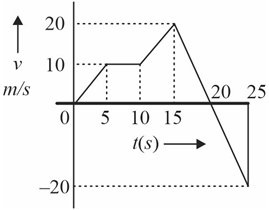
From the \( v\text{-}t \) graph shown, the ratio of distance to displacement in \( 25 \, \text{s} \) of motion is:
A clock has \( 75 \, \text{cm} \), \( 60 \, \text{cm} \) long second hand and minute hand respectively. In \( 30 \) minutes duration the tip of second hand will travel \( x \) distance more than the tip of minute hand. The value of \( x \) in meter is nearly. [Take : \( \pi = 3.14 \)]
A body falling under gravity covers two points A and B separated by \( 80 \, \text{m} \) in \( 2 \, \text{s} \). The distance of upper point A from the starting point is __________ m (use \( g = 10 \, \text{m s}^{-2} \)).
From \( 18 \, \text{m} \) height above the ground a ball is dropped from rest. The height above the ground at which the magnitude of velocity equal to the magnitude of acceleration (in the same set of units) due to gravity is ____ \( \text{m} \).(Take \( g = 10 \, \text{m}/\text{s}^{2} \) and neglect the air resistance)