28 questions from 2024
A body of mass \( 1000 \, \mathrm{kg} \) is moving horizontally with a velocity \( 6 \, \mathrm{m/s} \). If \( 200 \, \mathrm{kg} \) extra mass is added, the final velocity (in \( \mathrm{m/s} \)) is:
When kinetic energy of a body becomes \( 36 \) times of its original value, the percentage increase in the momentum of the body will be:
A bullet of mass \( 50 \, \text{g} \) is fired with a speed \( 100 \, \text{m/s} \) on a plywood and emerges with \( 40 \, \text{m/s} \). The percentage loss of kinetic energy is:
A body is moving unidirectionally under the influence of a constant power source. Its displacement in time \( t \) is proportional to:
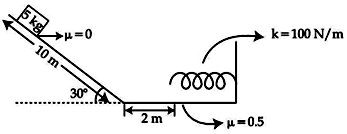
A block is simply released from the top of an inclined plane as shown in the figure above. The maximum compression in the spring when the block hits the spring is:
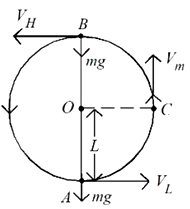
A stone of mass \( 900 \, \text{g} \) is tied to a string and moved in a vertical circle of radius \(1 \, \text{m} \) making \( 10 \, \text{rpm} \). The tension in the string, when the stone is at the lowest point is (\( \text{if } \pi^{2} = 9.8 \text{ and } g = 9.8 \, \text{m}/{ s}^{2} \)):
The identical spheres each of mass \( 2M \) are placed at the corners of a right angled triangle with mutually perpendicular sides equal to \( 4 \, \text{m} \) each. Taking point of intersection of these two sides as origin, the magnitude of position vector of the centre of mass of the system is \( \frac{4\sqrt{2}}{x} \), where the value of \( x \) is ______.
A uniform thin metal plate of mass \( 10 \, \text{kg} \) with dimensions is shown. The ratio of x and y coordinates of center of mass of plate is \( \frac{n}{9} \). The value of \( n \) is ______.
The potential energy function (in \( \text{J} \)) of a particle in a region of space is given as \( U = (2x^{2} + 3y^{3} + 2z) \). Here \( x \), \( y \) and \( z \) are in meter. The magnitude of x-component of force (in \( \text{N} \)) acting on the particle at point \( P(1,2,3) \, \text{m} \) is:
A simple pendulum of length \( 1 \, \text{m} \) has a wooden bob of mass \( 1 \, \text{kg} \). It is struck by a bullet of mass \( 10^{-2} \, \text{kg} \) moving with a speed of \( 2 \times 10^{2} \, \text{m s}^{-1} \). The bullet gets embedded into the bob. The height to which the bob rises before swinging back is: \( [ \text{Use} : \ g = 10 \, \text{m/s}^{2} ] \)
An artillery piece of mass \( M_1 \) fires a shell of mass \( M_2 \) horizontally. Instantaneously after the firing, the ratio of kinetic energy of the artillery and that of the shell is:
A bullet is fired into a fixed target looses one third of its velocity after travelling \(4\,\text{cm}\). It penetrates further \(D \times 10^{-3}\,\text{m}\) before coming to rest. The value of \(D\) is:
A particle of mass \( m \) moves on a straight line with its velocity increasing with distance according to the equation \( v = \alpha \sqrt{x} \), where \( \alpha \) is a constant. The total work done by all the forces applied on the particle during its displacement from \( x = 0 \) to \( x = d \), will be:
In a system two particles of masses \( m_{1} = 3 \, \text{kg} \) and \( m_{2} = 2 \, \text{kg} \) are placed at certain distance from each other. The particle of mass \( m_{1} \) is moved towards the center of mass of the system through a distance \( 2 \, \text{cm} \). In order to keep the center of mass of the system at the original position, the particle of mass \( m_{2} \) should move towards the center of mass by the distance ____________ \( \text{cm} \).
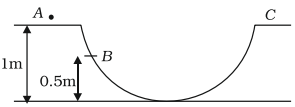
A particle is placed at the point A of a frictionless track \( ABC \) as shown in figure. It is gently pushed towards right. The speed of the particle when it reaches the point \( B \) is: (Take \( g = 10 \, \text{m} / \text{s}^{2} \)).
A block of mass \( 100 \, \text{kg} \) slides over a distance of \( 10 \, \text{m} \) on a horizontal surface. If the co-efficient of friction between the surfaces is \( 0.4 \), then the work done against friction (in \( \text{J} \)) is:
A spherical body of mass \( 100 \, \text{g} \) is dropped from a height of \( 10 \, \text{m} \) from the ground. After hitting the ground, the body rebounds to a height of \( 5 \, \text{m} \). The impulse of force impaired by the ground to the body is given by: (given, \( g = 9.8 \, \text{m/s}^2 \))
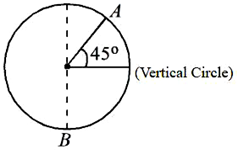
A body of \( m \, \text{kg} \) slides from rest along the curve of vertical circle from point \( A \) to \( B \) in friction less path. The velocity of the body at \( B \) is: (given, \( R = 14 \, \text{m} \), \( g = 10 \, \text{m s}^{-2} \) and \( \sqrt{2} = 1.4 \) )
A ball suspended by a thread swings in a vertical plane so that its magnitude of acceleration in the extreme position and lowest position are equal. The angle \(( \theta) \) of thread deflection in the extreme position will be:
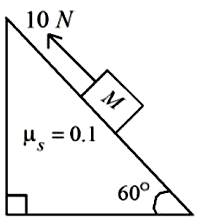
A block of mass \( 1 \, \text{kg} \) is pushed up a surface inclined to horizontal at an angle of \( 60^\circ \) by a force of \( 10 \, \text{N} \) parallel to the inclined surface as shown in figure. When the block is pushed up by \( 10 \, \text{m} \) along inclined surface, the work done against frictional force is:[ \( g = 10 \, \text{m} /\, \text{s}^{-2} \) ]
Three bodies \( A \), \( B \) and \( C \) have equal kinetic energies and their masses are \( 400 \, \text{g} \), \( 1.2 \, \text{kg} \) and \( 1.6 \, \text{kg} \) respectively. The ratio of their linear momenta is:
Two bodies of mass \( 4 \, \text{g} \) and \( 25 \, \text{g} \) are moving with equal kinetic energies. The ratio of magnitude of their linear momentum is :
Four particles \( A, B, C, D \) of mass \( \dfrac{m}{2}, m, 2m, 4m \), have same momentum, respectively. The particle with maximum kinetic energy is:
A stationary particle breaks into two parts of masses \( m_A \) and \( m_B \) which move with velocities \( v_A \) and \( v_B \) respectively. The ratio of their kinetic energies \( (K_B : K_A) \) is:
The bob of a pendulum was released from a horizontal position. The length of the pendulum is \( 10 \, \text{m} \). If it dissipates \( 10\% \) of its initial energy against air resistance, the speed with which the bob arrives at the lowest point is: [\( \text{Use }, g : 10 \, \text{m s}^{-2} \)]
A body of mass \( 2 \, \text{kg} \) begins to move under the action of a time dependent force given by \( \vec{F} =( 6 t \, \hat{i} + 6 t^{2} \, \hat{j} )\, \text{N} \). The power developed by the force at the time \( t \) is given by:
A bob of mass ‘\( m \)’ is suspended by a light string of length ‘\( L \)’. It is imparted a minimum horizontal velocity at the lowest point A such that it just completes half circle reaching the top most position B. The ratio of kinetic energies \( \dfrac{(K.E.)_A} {(K.E.)_B} \) is:
A force \( (3x^{2}+2x-5)\, \text{N} \) displaces a body from \( x = 2 \, \text{m} \) to \( x = 4 \, \text{m} \). Work done by this force is ......\( \text{J} \).