A bullet of mass \( 50 \, \text{g} \) is fired with a speed \( 100 \, \text{m/s} \) on a plywood and emerges with \( 40 \, \text{m/s} \). The percentage loss of kinetic energy is:
\( 16\% \)
\( 44\% \)
\( 32\% \)
\( 84\% \)
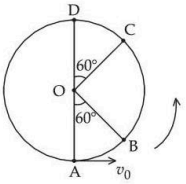
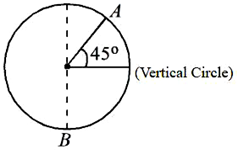
A bob of mass \( m \) is suspended at a point \( O \) by a light string of length \( l \) and left to perform vertical motion (circular) as shown in figure. Initially, by applying horizontal velocity \( v_0 \) at the point \( 'A' \), the string becomes slack when, the bob reaches at the point \( 'D' \). The ratio of the kinetic energy of the bob at the points \( B \) and \( C \) is __________.
A block of mass \( 2 \, \text{kg} \) is attached to one end of a massless spring whose other end is fixed at a wall. The spring-mass system moves on a frictionless horizontal table. The spring's natural length is \( 2 \, \text{m} \) and spring constant is \( 200 \, \text{N/m} \). The block is pushed such that the length of the spring becomes \( 1 \, \text{m} \) and then released. At distance \( x \, \text{m} \) (\( x < 2 \)) from the wall, the speed of the block will be:
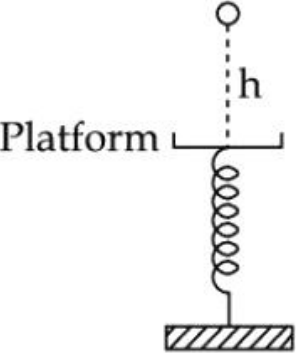
A ball of mass \( 100 \, \text{g} \) is dropped from a height \( h = 10 \, \text{cm} \) on a platform fixed at the top of a vertical spring (as shown in figure). The ball stays on the platform and the platform is depressed by a distance \( \frac{h}{2} \). The spring constant is ______________ \( \text{N m}^{-1} \). (Use \( g = 10 \, \text{m s}^{-2} \))
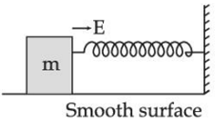
A block of mass 'm' (as shown in figure) moving with kinetic energy \( E \) compresses a spring through a distance \( 25 \, \text{cm} \) when, its speed is halved. The value of spring constant of used spring will be \( nE \, \text{N m}^{-1} \) for \( n = \) __________.
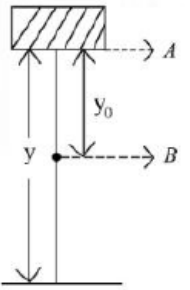
In the given figure, the block of mass \( m \) is dropped from the point ‘A’. The expression for kinetic energy of block when it reaches point ‘B’ is:
A body of mass \( 1000 \, \mathrm{kg} \) is moving horizontally with a velocity \( 6 \, \mathrm{m/s} \). If \( 200 \, \mathrm{kg} \) extra mass is added, the final velocity (in \( \mathrm{m/s} \)) is:
When kinetic energy of a body becomes \( 36 \) times of its original value, the percentage increase in the momentum of the body will be:
Two bodies are having kinetic energies in the ratio \(16:9\). If they have same linear momentum, the ratio of their masses respectively is:
An average force of \( 125 \, \text{N} \) is applied on a machine gun firing bullets each of mass \( 10 \, \text{g} \) at the speed of \( 250 \, \text{m/s} \) to keep it in position. The number of bullets fired per second by the machine gun is:
A body is rolling a \( 0.5 \, \text{kg} \) ball on the frictionless floor with the speed of \( 20 \, \text{ms}^{-1} \). The ball gets deflected by an obstacle on the way. After deflection it moves with \( 5\% \) of its initial kinetic energy. What is the speed of the ball now?
A body is moving unidirectionally under the influence of a constant power source. Its displacement in time \( t \) is proportional to:
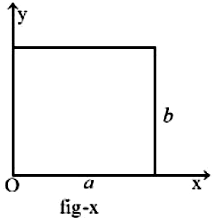
The center of mass of a thin rectangular plate (fig - $x$) with sides of length $a$ and $b$, whose mass per unit area ($\sigma$) varies as $\sigma = \frac{\sigma_0 x}{ab}$ (where $\sigma_0$ is a constant), would be __________.
A \( 1 \, \text{kg} \) block subjected to two simultaneous forces \( (2\hat{i}+3\hat{j}+4\hat{k}) \, \text{N} \) and \( (3\hat{i}-\hat{j}-2\hat{k}) \, \text{N} \) is moved a distance of \( 25 \, \text{m} \) along \( (3\hat{i}-4\hat{j}) \) direction. The work done in this process is ______ \( \text{J} \).
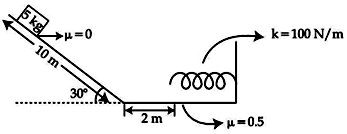
A block is simply released from the top of an inclined plane as shown in the figure above. The maximum compression in the spring when the block hits the spring is:
A mass \( 0.9 \, \text{kg} \), attached to a horizontal spring, executes SHM with an amplitude \( A_{1} \). When this mass passes through its mean position, then a smaller mass of \( 124 \, \text{g} \) is placed over it and both masses move together with amplitude \( A_{2} \). If the ratio \( {A_{1}}/{A_{2}} \) is \( \dfrac{\alpha}{\alpha - 1} \), then the value of \( \alpha \) will be ______.
A stone of mass \( 900 \, \text{g} \) is tied to a string and moved in a vertical circle of radius \(1 \, \text{m} \) making \( 10 \, \text{rpm} \). The tension in the string, when the stone is at the lowest point is (\( \text{if } \pi^{2} = 9.8 \text{ and } g = 9.8 \, \text{m}/{ s}^{2} \)):
A body of mass \( 14 \, \text{kg} \) initially at rest explodes and breaks into three fragments of masses in the ratio \( 2:2:3 \). The two pieces of equal masses fly off perpendicular to each other with a speed of \( 18 \, \text{m/s} \) each. The velocity of the heavier fragment is ______ \( \text{m/s} \).
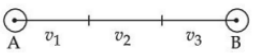
A car covers AB distance with first one-third at velocity \( v_1 \, \text{ms}^{-1} \), second one-third at \( v_2 \, \text{ms}^{-1} \) and last one-third at \( v_3 \, \text{ms}^{-1} \). If \( v_3 = 3v_1 \), \( v_2 = 2v_1 \) and \( v_1 = 11 \, \text{ms}^{-1} \) then the average velocity of the car is ________ \( \text{ms}^{-1} \).
A car accelerates from rest to \( u \, \text{m /s} \). The energy spent in this process is \( E \, \text{J} \). The energy required to accelerate the car from \( u \, \text{m /s} \) to \( 2u \, \text{m /s}\) is in \( E \, \text{J} \). The value of \( n \) is __________.
The identical spheres each of mass \( 2M \) are placed at the corners of a right angled triangle with mutually perpendicular sides equal to \( 4 \, \text{m} \) each. Taking point of intersection of these two sides as origin, the magnitude of position vector of the centre of mass of the system is \( \frac{4\sqrt{2}}{x} \), where the value of \( x \) is ______.
A body of mass \( 2 \, \text{kg} \) begins to move under the influence of time dependent force \( \\vec{F} = (2 \, \\hat{i} \, t + 6 \, t^2 \, \\hat{j}) \, \text{N} \), where \( \\hat{i} \) and \( \\hat{j} \) are unit vectors along x and y-axis respectively. The power produced by the force at \( t = 2 \, \text{s} \) is _______ \( \text{W} \).
Consider a circular disc of radius \( 20 \, \text{cm} \) with centre located at the origin. A circular hole of radius \( 5 \, \text{cm} \) is cut from this disc in such a way that the edge of the hole touches the edge of the disc. The distance of centre of mass of residual or remaining disc from the origin will be:
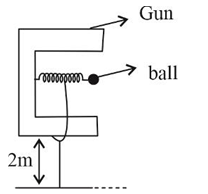
In a spring gun having spring constant \( 100 \, \text{N/m} \) a small ball ‘B’ of mass \( 100 \, \text{g} \) is put in its barrel (as shown in figure) by compressing the spring through \( 0.05 \, \text{m} \). There should be a box placed at a distance '\( d \)' on the ground so that the ball falls in it. If the ball leaves the gun horizontally at a height of \( 2 \, \text{m} \) above the ground. The value of \( d \) is __________ \( \text{m} \). \( ( g = 10 \, \text{m/s}^{2} ) \).
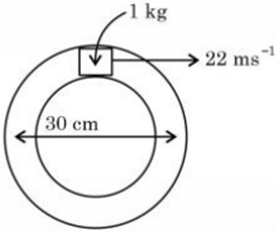
A closed circular tube of average radius \( 15 \, \text{cm} \), whose inner walls are rough, is kept in vertical plane. A block of mass \( 1 \, \text{kg} \) just fit inside the tube. The speed of block is \( 22 \, \text{m/s} \), when it is introduced at the top of tube. After completing five oscillations, the block stops at the bottom region of tube. The work done by the tube on the block is ________ \( \text{J} \). (Given \( g = 10 \, \text{m/s}^2 \)).
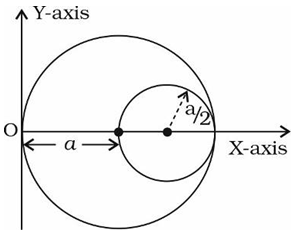
A circular hole of radius \( \left(\frac{a}{2}\right) \) is cut out of a circular disc of radius ‘\( a \)’ as shown in figure. The centroid of the remaining circular portion with respect to point ‘\( O \)’ will be:
A ball is dropped from a height of \( 20 \, \text{m} \). If the coefficient of restitution for the collision between ball and floor is \( 0.5 \), after hitting the floor, the ball rebounds to a height of ______ m.
The identical spheres each of mass \( M \) are placed at the corners of a right angled triangle with mutually perpendicular sides equal to \( 3 \, \text{m} \) each. Taking point of intersection of mutually perpendicular sides as origin, the magnitude of position vector of centre of mass of the system will be \( \sqrt{x} \, \text{m} \). The value of the \( x \) is:
A body of mass \( 4 \, \text{kg} \) is placed on a plane at a point \( P \) having coordinate \( (3, 4) \, \text{m} \). Under the action of force \( \, \vec{F} = (2\hat{i} + 3\hat{j}) \, \text{N} \, \), it moves to a new point \(\underline Q \) having coordinates \( (6, 10) \, \text{m} \) in \( 4 \, \text{sec} \). The average power and instantaneous power at the end of \( 4 \, \text{sec} \) are in the ratio of:
A force \( \mathbf{f} = x^{2}y\,\hat{i} + y^{2}\,\hat{j} \) acts on a particle in a plane \( x + y = 10 \). The work done by this force during a displacement from \( (0, 0) \) to \( (4\,\text{m}, 2\,\text{m}) \) is __________ \( \text{Joule} \) (round off to the nearest integer).
A bullet of mass \( 200\,\text{g} \) having initial kinetic energy \( 90\,\text{J} \) is shot inside a long swimming pool as shown in the figure. If it’s kinetic energy reduces to \( 40\,\text{J} \) within \( 1\,\text{s} \), the minimum length of the pool, the bullet has to travel so that it completely comes to rest is:
A particle of mass \( 500 \, \text{gm} \) is moving in a straight line with velocity \( v = b x^{5/2} \). The work done by the net force during its displacement from \( x = 0 \) to \( x = 4 \, \text{m} \) is: (Take \( b = 0.25 \, \text{m}^{-3/2}\, \text{s}^{-1} \))
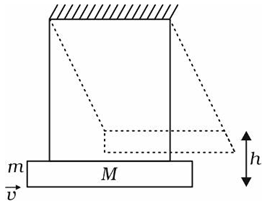
A large block of wood of mass \( M = 5.99 \, \text{kg} \) is hanging from two long massless cords. A bullet of mass \( m = 10 \, \text{g} \) is fired into the block and gets embedded in it. The (block + bullet) then swing upwards, their centre of mass rising a vertical distance \( h = 9.8 \, \text{cm} \) before the (block + bullet) pendulum comes momentarily to rest at the end of its arc. The speed of the bullet just before collision is: (Take \( g = 9.8 \, \text{m s}^{-2} \)).
A uniform chain of length \( 3 \, \text{meter} \) and mass \( 3 \, \text{kg} \) overhangs a smooth table with \( 2 \, \text{meter} \) laying on the table. If \( k \) is the kinetic energy of the chain in joule as it completely slips off the table, then the value of \( k \) is ________. (Take \( g = 10 \, \text{m/s}^{2} \))
A uniform thin metal plate of mass \( 10 \, \text{kg} \) with dimensions is shown. The ratio of x and y coordinates of center of mass of plate is \( \frac{n}{9} \). The value of \( n \) is ______.
The potential energy function (in \( \text{J} \)) of a particle in a region of space is given as \( U = (2x^{2} + 3y^{3} + 2z) \). Here \( x \), \( y \) and \( z \) are in meter. The magnitude of x-component of force (in \( \text{N} \)) acting on the particle at point \( P(1,2,3) \, \text{m} \) is:
A body of mass \( 2 \, \text{kg} \) moving with a speed of \( 4 \, \text{m/s} \), makes an elastic collision with another body at rest and continues to move in the original direction but with one fourth of its initial speed. The speed of the two body centre of mass is \( \dfrac{x}{10} \, \text{m/s} \). Then the value of \( x \) is ________________ .
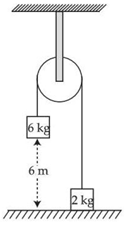
The velocity at which \( 6 \, \text{kg} \) mass (shown in figure) strikes the ground when it is released from a height of \( 6 \, \text{m} \) above the ground is _____ \( \text{m/s} \). Assume pulley is massless and string is light and inextensible. (Take \( g = 10 \, \text{m/s}^2 \))
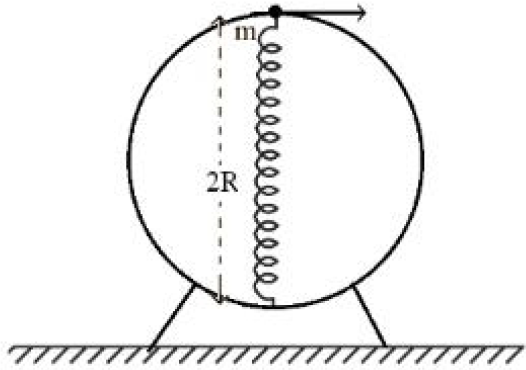
A bead of mass '\( m \)'slides without friction on the wall of a vertical circular hoop of radius '\( R \)' as shown in figure. The bead moves under the combined action of gravity and a massless spring \( (k) \) attached to the bottom of the hoop. The equilibrium length of the spring is '\( R \)'. If the bead is released from top of the hoop with (negligible) zero initial speed, velocity of bead, when the length of spring becomes '\( R \)', would be (spring constant is '\( k \)', \( g \) is acceleration due to gravity).
A machine gun of mass \( 10 \, \text{kg} \) fires \( 20 \, \text{g} \) bullets at the rate of \( 180 \) bullets per minute with a speed of \( 100 \, \text{m s}^{-1} \) each. The recoil velocity of the gun is :
Potential energy \( (V) \) versus distance \( (x) \) is given by the graph. Rank various regions as per the magnitudes of the force \( (F) \) acting on a particle from high to low.
Given below are two statements: one is labelled as Assertion A and the other is labelled as Reason R.Assertion A : In a central force field, the work done is independent of the path chosen.Reason R : Every force encountered in mechanics does not have an associated potential energy.In the light of the above statements, choose the most appropriate answer from the options given below:
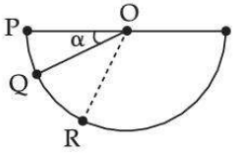
A ball is released from rest from point \( P \) of a smooth semi-spherical vessel as shown in figure. The ratio of the centripetal force and normal reaction on the ball at point \( Q \) is \( A \) while angular position of point \( Q \) is \( \alpha \) with respect to point \( P \). Which of the following graphs represent the correct relation between \( A \) and \( \alpha \) when ball goes from \( Q \) to \( R \)?
A force \( \vec{F} = 2\hat{i} + b\hat{j} + \hat{k} \) applied on a particle and it undergoes a displacement \( \hat{i} - 2\hat{j} - \hat{k} \). What will be the value of \( b \), if work done on the particle is \( 0 \).
A stone tide to a string of length \( L \) is whirled in a vertical circle with the other end of the string at the centre. At a certain instant of time, the stone is at its lowest position and has a speed \( u \). The magnitude of change in its velocity, as it reaches a position where the string is horizontal, is \( \sqrt{ \, x \left( u^{2} - g L \right) } \). The value of \( x \) is-
A small bob \( A \) of mass \( m \) is attached to a massless rigid rod of length \( 1 \, \text{m} \) pivoted at point \( P \) and kept at an angle of \( 60^\circ \) with vertical as shown in figure. At distance of \( 1 \, \text{m} \) below point \( P \), an identical bob \( B \) is kept at rest on a smooth horizontal surface that extends to a circular track of radius \( R \) as shown in figure. If bob \( B \) just manages to complete the circular path of radius \( R \) upto a point \( Q \) after being hit elastically by bob \( A \), then radius \( R \) is ______ \( \text{m} \).
A simple pendulum of length \( 1 \, \text{m} \) has a wooden bob of mass \( 1 \, \text{kg} \). It is struck by a bullet of mass \( 10^{-2} \, \text{kg} \) moving with a speed of \( 2 \times 10^{2} \, \text{m s}^{-1} \). The bullet gets embedded into the bob. The height to which the bob rises before swinging back is: \( [ \text{Use} : \ g = 10 \, \text{m/s}^{2} ] \)
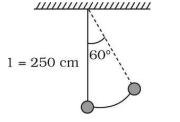
A pendulum is suspended by a string of length \( 250 \, \text{cm} \). The mass of the bob of the pendulum is \( 200 \, \text{g} \). The bob is pulled aside until the string is at \( 60^\circ \) with Vertical as shown in the figure. After releasing the bob, the maximum velocity attained by the bob will be ________ \( \text{m s}^{-1} \). (if \( g = 10 \, \text{m /s}^{2} \))
A block of metal weighing \( 2 \, \text{kg} \) is resting on a frictionless plane (as shown in figure). It is struck by a jet releasing water at a rate of \( 1 \, \text{kg s}^{-1} \) and at a speed of \( 10 \, \text{m s}^{-1} \). Then, the initial acceleration of the block, in \( \text{m s}^{-2} \), will be:
An artillery piece of mass \( M_1 \) fires a shell of mass \( M_2 \) horizontally. Instantaneously after the firing, the ratio of kinetic energy of the artillery and that of the shell is:
The distance of centre of mass from end A of a one dimensional rod (AB) having mass density \( \rho = \rho_0 \left(1 - \dfrac{x^2}{L^2}\right) \, \text{kg/m} \) and length \( L \) (in meter) is \( \dfrac{3L}{\alpha} \, \text{m} \). The value of \( \alpha \) is ________. (where \( x \) is the distance from end A)
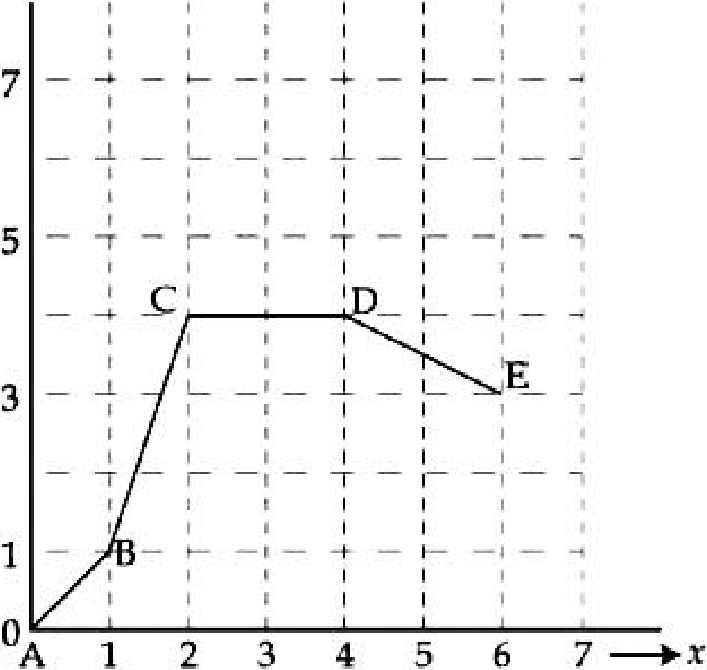
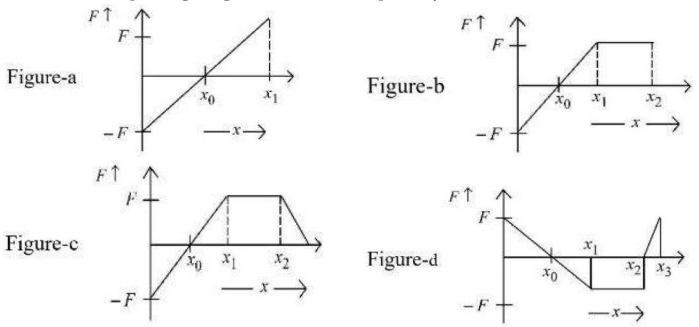
Arrange the four graphs in descending order of total work done; where \( W_1 \), \( W_2 \), \( W_3 \) and \( W_4 \) are the work done corresponding to figure a, b, c and d respectively.
A force \( F = (5 + 3 y^{2}) \) acts on a particle in the \( y \)-direction, where \( F \) is in newton and \( y \) is in meter. The work done by the force during a displacement from \( y = 2 \, \text{m} \) to \( y = 5 \, \text{m} \) is _______ \( \text{J} \).
A bullet is fired into a fixed target looses one third of its velocity after travelling \(4\,\text{cm}\). It penetrates further \(D \times 10^{-3}\,\text{m}\) before coming to rest. The value of \(D\) is:
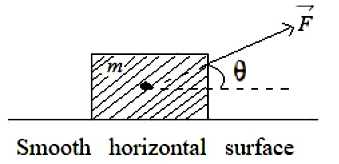
An object of mass \( 'm' \) initially at rest on a smooth horizontal plane starts moving under the action of force \( F = 2 \, N \). In the process of its linear motion, the angle \( \theta \) (as shown in figure) between the direction of force and horizontal varies as \( \theta = kx \), where \( k \) is a constant and \( x \) is the distance covered by the object from its initial position. The expression of kinetic energy of the object will be \( E = \dfrac{n}{k} \sin \theta \). The value of \( n \) is ___________.
A bag of sand of mass \( 9.8 \, \text{kg} \) is suspended by a rope. A bullet of \( 200 \, \text{g} \) travelling with speed \( 10 \, \text{ms}^{-1} \) gets embedded in it, then loss of kinetic energy will be:
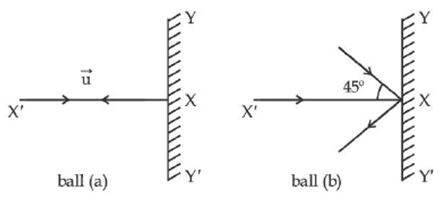
Two billiard of equal mass \(30 g\) strike a rigid wall with same speed of \(108\,\text{ kmph}\) (as shown) but at different angles. if the balls get reflected with the same speed then the ratio of the magnitude of impulses imparted to ball 'a' and ball ‘b’ by the wall along 'X' direction is :
A small particle moves to position \( 5\hat{i} - 2\hat{j} + \hat{k} \) from its initial position \( 2\hat{i} + 3\hat{j} - 4\hat{k} \) under the action of force \( 5\hat{i} + 2\hat{j} + 7\hat{k} \, \text{N} \). The value of work done will be \( \_\_\_\_\_\_\_ \) \( \text{J} \).
A particle experiences a variable force \( \vec{F} = \left( 4x \, \hat{i} + 3y^{2} \, \hat{j} \right) \) in a horizontal \( x\text{-}y \) plane. Assume distance in meters and force is newton. If the particle moves from point \( (1, 2) \) to point \( (2, 3) \) in the \( x\text{-}y \) plane, then Kinetic Energy changes by:
The ratio of powers of two motors is \( \dfrac{3\sqrt{x}}{\sqrt{x}+1} \), that are capable of raising \( 300 \, \text{kg} \) water in \( 5 \, \text{minutes} \) and \( 50 \, \text{kg} \) water in \( 2 \, \text{minutes} \) respectively from a well of \( 100 \, \text{m} \) deep. The value of \( x \) will be:
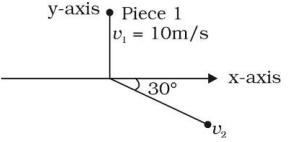
A ball of mass \( 10 \, \text{kg} \) moving with a velocity \( 10\sqrt{3} \, \text{m}\!/\!\text{s} \) along the x-axis, hits another ball of mass \( 20 \, \text{kg} \) which is at rest. After this collision, first ball comes to rest while the second ball disintegrates into two equal pieces. One piece starts moving along y-axis with a speed of \( 10 \, \text{m}\!/\!\text{s} \). The second piece starts moving at an angle of \( 30^\circ \) with respect to the x-axis. The velocity of the ball moving at \( 30^\circ \) with x-axis is \( x \, \text{m}\!/\!\text{s} \). The configuration of pieces after collision is shown in the figure below. The value of \( x \) to the nearest integer is ____________.
A body is dropped on ground from a height \( 'h_1' \) and after hitting the ground, it rebounds to a height \( 'h_2' \). If the ratio of velocities of the body just before and after hitting ground is \( 4 \), then percentage loss in kinetic energy of the body is \( \dfrac{x}{4} \). The value of \( x \) is __________.
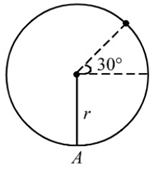
In case of vertical circular motion of a particle by a thread of length \( r \) if the tension in the thread is zero at an angle \( 30^{\circ} \) shown in figure, the velocity at the bottom point \( (A) \) of the circular path is: \( (g = \text{gravitational acceleration}) \).
Given below are two statements:Statement I: For a mechanical system of many particles total kinetic energy is the sum of kinetic energies of all the particles.Statement II: The total kinetic energy can be the sum of kinetic energy of the center of mass w.r.t to the origin and the kinetic energy of all the particles w.r.t. the centre of mass as the reference.In the light of the above statements, choose the correct answer from the options given below:
A force \( \vec{F} = (2 + 3x)\hat{i} \) acts on a particle in the \( x \) direction where \( F \) is in newton and \( x \) is in meter. The work done by this force during a displacement from \( x = 0 \) to \( x = 4 \, \text{m} \), is _______ \( \text{J} \).
A particle of mass \( m \) moves on a straight line with its velocity increasing with distance according to the equation \( v = \alpha \sqrt{x} \), where \( \alpha \) is a constant. The total work done by all the forces applied on the particle during its displacement from \( x = 0 \) to \( x = d \), will be:
A body of mass \( 1 \, \text{kg} \) collides head on elastically with a stationary body of mass \( 3 \, \text{kg} \). After collision, the smaller body reverses its direction of motion and moves with a speed of \( 2 \, \text{m/s} \). The initial speed of the smaller body before collision is ________ \( \text{ms}^{-1} \).
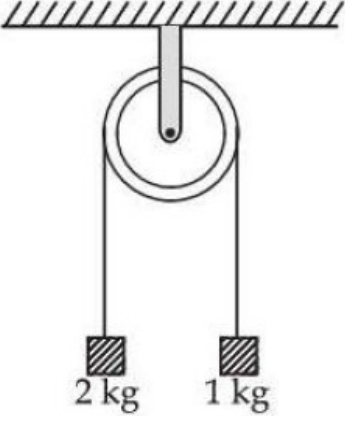
Two blocks of masses \( 2 \, \text{kg} \) and \( 1 \, \text{kg} \) respectively, are tied to the ends of a string which passes over a light frictionless pulley as shown in the figure below. The masses are held at rest at the same horizontal level and then released. The distance traversed by the centre of mass in \( 2 \, \text{s} \) is _______ \( \text{m} \). (Take \( g=10 \, \text{m/s}^{2} \))
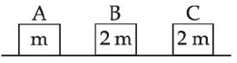
These objects \( A \), \( B \) and \( C \) are kept in a straight line on a frictionless horizontal surface. The masses of \( A \), \( B \) and \( C \) are \( m \), \( 2m \) and \( 2m \) respectively. \( A \) moves towards \( B \) with a speed of \( 9 \, \text{m}/\text{s} \) and makes an elastic collision with it. Thereafter \( B \) makes completely inelastic collision with \( C \). All motions occurs along same straight line. The final speed of \( C \) is:
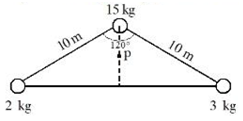
The position of center of mass of three masses \( 2 \, \text{kg} \), \( 3 \, \text{kg} \) and \( 15 \, \text{kg} \) placed with respect to mid point \( (p) \) of normal bisector, as shown in the figure is ______.
A body of mass \( 8 \, \text{kg} \) and another of mass \( 2 \, \text{kg} \) are moving with equal kinetic energy. The ratio of their respectively momenta will be:
In a system two particles of masses \( m_{1} = 3 \, \text{kg} \) and \( m_{2} = 2 \, \text{kg} \) are placed at certain distance from each other. The particle of mass \( m_{1} \) is moved towards the center of mass of the system through a distance \( 2 \, \text{cm} \). In order to keep the center of mass of the system at the original position, the particle of mass \( m_{2} \) should move towards the center of mass by the distance ____________ \( \text{cm} \).
An object of mass \( 1000\,\text{g} \) experiences a time dependent force \( \vec{F} = \left(2t\,\hat{i} + 3t^{2}\,\hat{j}\right)\ \text{N} \). The power generated by the force at time \( t \) is:
A force of \( {F} = (5y + 20)\hat{j} \, \text{N} \) acts on a particle. The work done by this force when the particle is moved from \( y = 0 \, \text{m} \) to \( y = 10 \, \text{m} \) is ______ \( \text{J} \).
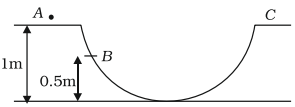
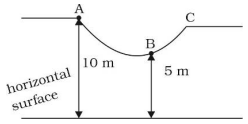
A particle is placed at the point A of a frictionless track \( ABC \) as shown in figure. It is gently pushed towards right. The speed of the particle when it reaches the point \( B \) is: (Take \( g = 10 \, \text{m} / \text{s}^{2} \)).
A block of mass \( 100 \, \text{kg} \) slides over a distance of \( 10 \, \text{m} \) on a horizontal surface. If the co-efficient of friction between the surfaces is \( 0.4 \), then the work done against friction (in \( \text{J} \)) is:
A block of mass \( 2 \, \text{kg} \) moving on a horizontal surface with speed of \( 4 \, \text{m s}^{-1} \) enters a rough surface ranging from \( x = 0.5 \, \text{m} \) to \( x = 1.5 \, \text{m} \). The retarding force in this range of rough surface is related to distance by \( F = -kx \) where \( k = 12 \, \text{N m}^{-1} \). The speed of the block as it just crosses the rough surface will be:
A spherical body of mass \( 100 \, \text{g} \) is dropped from a height of \( 10 \, \text{m} \) from the ground. After hitting the ground, the body rebounds to a height of \( 5 \, \text{m} \). The impulse of force impaired by the ground to the body is given by: (given, \( g = 9.8 \, \text{m/s}^2 \))
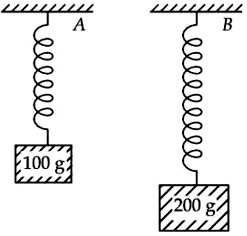
Two blocks with masses \( 100 \, \text{g} \) and \( 200 \, \text{g} \) are attached to the ends of springs A and B as shown in figure. The energy stored in A is \( E \). The energy stored in B, when spring constants \( k_A \), \( k_B \) of A and B, respectively satisfy the relation \( 4k_A = 3k_B \), is:
A body of mass \( 2 \, \text{kg} \) is moving along \( x \)-direction such that its displacement as function of time is given by \( x(t)=(\alpha t^{2}+\beta t+\gamma )\), where \( \alpha = 1 \, \text{m/s}^{2} \), \( \beta = 1 \, \text{m/s} \) and \( \gamma = 1 \, \text{m} \). The work done on the body during the time interval \( t=2 \, \text{s} \) to \( t=3 \, \text{s} \), is ________ \( \text{J} \).
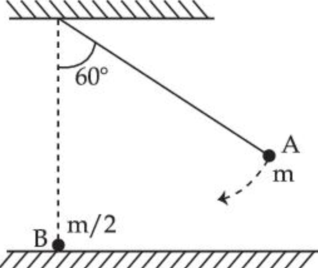
As shown below, bob \( A \) of a pendulum having massless string of length \( 'R' \) is released from \( 60^\circ \) to the vertical. It hits another bob \( B \) of half the mass that is at rest on a frictionless table in the center. Assuming elastic collision, the magnitude of the velocity of bob \( A \) after the collision will be (take \( g \) as acceleration due to gravity.)
A batsmen hits back a ball of mass \( 0.4 \, \text{kg} \) straight in the direction of the bowler without changing its initial speed of \( 15 \, \text{m s}^{-1} \). The impulse imparted to the ball is \( \_\_\_\_\_ \, \text{N s} \).
A ball of mass \( 4 \, \text{kg} \), moving with a velocity of \( 10 \, \text{m s}^{-1} \), collides with a spring of length \( 8 \, \text{m} \) and force constant \( 100 \, \text{N m}^{-1} \). The length of the compressed spring is \( x \, \text{m} \). The value of \( x \), to the nearest integer is:
A constant power delivering machine has towed a box, which was initially at rest, along a horizontal straight line. The distance moved by the box in time \( t \) is proportional to:
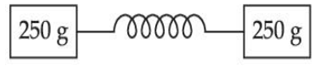
As per the given figure, two blocks each of mass \( 250 \, \text{g} \) are connected to a spring of spring constant \( 2 \, \text{N} \, \text{m}^{-1} \). If both are given velocity \( v \) in opposite directions, then maximum elongation of the spring is:
Two solids A and B of mass \( 1 \, \text{kg} \) and \( 2 \, \text{kg} \) respectively are moving with equal linear momentum. The ratio of their kinetic energies \( \text{(K.E.)}_A : \text{(K.E.)}_B \) will be \( \frac{A}{1} \), so the value of A will be ______.
A body of \( m \, \text{kg} \) slides from rest along the curve of vertical circle from point \( A \) to \( B \) in friction less path. The velocity of the body at \( B \) is: (given, \( R = 14 \, \text{m} \), \( g = 10 \, \text{m s}^{-2} \) and \( \sqrt{2} = 1.4 \) )
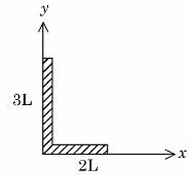
A rod of length \( 5L \) is bent right angle keeping one side length as \( 2L \).The position of the centre of mass of the system:(Consider \( L = 10\,\text{cm} \)).
A ball suspended by a thread swings in a vertical plane so that its magnitude of acceleration in the extreme position and lowest position are equal. The angle \(( \theta) \) of thread deflection in the extreme position will be:
A particle of mass \( m \) moves in a circular orbit under the central potential field, \( U(r) = -\dfrac{C}{r} \), where \( C \) is a positive constant. The correct radius - velocity graph of the particle’s motion is:
A \( 0.5 \, \text{kg} \) block moving at a speed of \( 12 \, \text{m s}^{-1} \) compresses a spring through a distance \( 30 \, \text{cm} \) when its speed is halved. The spring constant of the spring will be ________ \( \text{N m}^{-1} \).
A body of mass \( M \) at rest explodes into three pieces, in the ratio of masses \( 1:1:2 \). Two smaller pieces fly off perpendicular to each other with velocities of \( 30 \, \text{m s}^{-1} \) and \( 40 \, \text{m s}^{-1} \) respectively. The velocity of the third piece will be:
Two person A and B perform same amount of work in moving a body through a certain distance \( d \) with application of forces acting at angle \( 45^\circ \) and \( 60^\circ \) with the direction of displacement respectively. The ratio of force applied by person A to the force applied by person B is \( \dfrac{1}{\sqrt{x}} \). The value of \( x \) is ______.
Potential energy as a function of \( r \) is given by \( U=\frac{A}{r^{10}}-\frac{B}{r^{5}} \), where \( r \) is the interatomic distance, \( A \) and \( B \) are positive constants. The equilibrium distance between the two atoms will be:
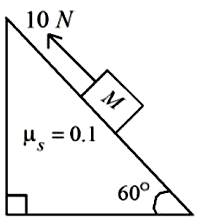
A block of mass \( 1 \, \text{kg} \) is pushed up a surface inclined to horizontal at an angle of \( 60^\circ \) by a force of \( 10 \, \text{N} \) parallel to the inclined surface as shown in figure. When the block is pushed up by \( 10 \, \text{m} \) along inclined surface, the work done against frictional force is:[ \( g = 10 \, \text{m} /\, \text{s}^{-2} \) ]
Two bodies of mass \( 1\,\text{kg} \) and \( 3\,\text{kg} \) have position vectors \( \hat{i}+2\hat{j}+\hat{k} \) and \( -3\hat{i}-2\hat{j}+\hat{k} \) respectively. The magnitude of position vector of centre of mass of this system will be similar to the magnitude of vector:
A block of mass \( 10 \, \text{kg} \) is moving along x-axis under the action of force \( F = 5x \, \text{N} \). The work done by the force in moving the block from \( x = 2 \, \text{m} \) to \( 4 \, \text{m} \) will be __________ \( \text{J} \).
A mass of \( 1 \, \text{kg} \) is kept on an inclined plane with \( 30^\circ \) inclination with respect to horizontal plane and it is at rest initially. Then the whole assembly is moved up with constant velocity of \( 4 \, \text{m/s} \). The work done by the frictional force in time \( 2 \, \text{s} \) is __________ \( \text{J} \). (Take \( g=10 \, \text{m/s}^2 \))
A bullet of \( 4 \, \text{g} \) mass is fired from a gun of mass \( 4 \, \text{kg} \). If the bullet moves with the muzzle speed of \( 50 \, \text{m s}^{-1} \), the impulse imparted to the gun and velocity of recoil of gun are:
A particle of mass \( m \) is moving in a circular path of constant radius \( r \) such that its centripetal acceleration \( a \) is varying with time \( t \) as \( a = k^{2} r t^{2} \), where \( k \) is a constant. The power delivered to the particle by the force acting on it is given as:
Which one of the following forces cannot be expressed in terms of potential energy?
A pendulum of length \( 2 \, \text{m} \) consists of a wooden bob of mass \( 50 \, \text{g} \). A bullet of mass \( 75 \, \text{g} \) is fired towards the stationary bob with a speed \( v \). The bullet emerges out of the bob with a speed \( \dfrac{v}{3} \) and the bob just completes the vertical circle. The value of \( v \) is ______ \( \text{m s}^{-1} \). (if \( g = 10 \, \text{m} / \text{s}^{2} \) ).
If momentum of a body is increased by \( 20\% \), then its kinetic energy increases by
A porter lifts a heavy suitcase of mass \( 80 \, \text{kg} \) and at the destination lowers it down by a distance of \( 80 \, \text{cm} \) with a constant velocity. Calculate the workdone by the porter in lowering the suitcase. (Take \( g = 9.8 \, \text{m s}^{-2} \) )
In two different experiments, an object of mass \( 5 \, \text{kg} \) moving with a speed of \( 25 \, \text{m s}^{-1} \) hits two different walls and comes to rest within (i) \( 3 \) second, (ii) \( 5 \) seconds, respectively.Choose the correct option out of the following:
A block moving horizontally on a smooth surface with a speed of \( 40 \,\text{m/s} \) splits into two parts with masses in the ratio of \( 1:2 \). If the smaller part moves at \( 60 \,\text{m/s} \) in the same direction, then the fractional change in kinetic energy is:
A stone of mass \( m \), tied to a string is being whirled in a vertical circle with a uniform speed. The tension in the string is:
Three bodies \( A \), \( B \) and \( C \) have equal kinetic energies and their masses are \( 400 \, \text{g} \), \( 1.2 \, \text{kg} \) and \( 1.6 \, \text{kg} \) respectively. The ratio of their linear momenta is:
Two bodies of mass \( 4 \, \text{g} \) and \( 25 \, \text{g} \) are moving with equal kinetic energies. The ratio of magnitude of their linear momentum is :
In a perfectly inelastic collision, two spheres made of the same material with masses \( 15 \, \text{kg} \) and \( 25 \, \text{kg} \), moving in opposite directions with speeds of \( 10 \, \text{m/s} \) and \( 30 \, \text{m/s} \), respectively, strike each other and stick together. The rise in temperature (in \( ^\circ \text{C} \)), if all the heat produced during the collision is retained by these spheres, is: [Specific heat of sphere material \( 31 \, \text{cal/(kg} \cdot ^\circ\text{C)} \) and \( 1 \, \text{cal} = 4.2 \, \text{J} \)]
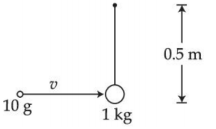
A bullet of \( 10 \, \text{g} \), moving with velocity \( v \), collided head-on with the stationary bob of a pendulum and recoils with velocity \( 100 \, \text{m/s} \). The length of the pendulum is \( 0.5 \, \text{m} \) and mass of the bob is \( 1 \, \text{kg} \). The minimum value of \( v = \) ______ \( \text{m/s} \) so that the pendulum describes a circle. (Assume the string to be inextensible and \( g = 10 \, \text{m/s}^{2} \))
Four particles \( A, B, C, D \) of mass \( \dfrac{m}{2}, m, 2m, 4m \), have same momentum, respectively. The particle with maximum kinetic energy is:
A body at rest is moved along a horizontal straight line by a machine delivering a constant power. The distance moved by the body in time ‘\( t \)’ is proportional to:
Two blocks of masses \( 10 \, \text{kg} \) and \( 30 \, \text{kg} \) are placed on the same straight line with coordinates \( (0, 0) \, \text{cm} \) and \( (x, 0) \, \text{cm} \) respectively. The block of \( 10 \, \text{kg} \) is moved on the same line through a distance of \( 6 \, \text{cm} \) towards the other block. The distance through which the block of \( 30 \, \text{kg} \) must be moved to keep the position of centre of mass of the system unchanged is:
An object mass of \( M_1 \) collides with another object of mass \( M_2 \), which is at rest. After the collision the objects move with equal speeds in opposite direction. The ratio of the masses \( M_2 : M_1 \) is:
A balloon has mass of \( 10 \, \text{g} \) in air. The air escapes from the balloon at a uniform rate with velocity \( 4.5 \, \text{cm}/\text{s} \). if the balloon shrinks in \( 5 \, \text{s} \) completely. Then, the average force acting on that balloon will be (in dyne).
A body of mass \( 'm' \) connected to a massless and unstretchable string goes in vertical circle of radius \( 'R' \) under gravity \( g \). The other end of the string is fixed at the center of circle. If velocity at top of circular path is \( n\sqrt{gR} \), where, \( n \ge 1 \), then ratio of kinetic energy of the body at bottom to that at top of the circle is:
A bullet of mass \( 0.1 \, \text{kg} \) is fired on a wooden block to pierce through it, but it stops after moving a distance of \( 50 \, \text{cm} \) into it. If the velocity of bullet before hitting the wood is \( 10 \, \text{m/s} \) and it slows down with uniform deceleration, then the magnitude of effective retarding force on the bullet is \( 'x' \, \text{N} \).The value of \( 'x' \) to the nearest integer is __________ .
Two identical blocks \( A \) and \( B \) each of mass \( m \) resting on the smooth horizontal floor are connected by a light spring of natural length \( L \) and spring constant \( K \). A third block \( C \) of mass \( m \) moving with a speed \( v \) along the line joining \( A \) and \( B \) collides with \( A \). The maximum compression in the spring is:
A body of mass \( M \) moving at speed \( V_{0} \) collides elastically with a mass ‘\( m \)’ at rest. After the collision, the two masses move at angles \( \theta_{1} \) and \( \theta_{2} \) with respect to the initial direction of motion of the body of mass \( M \). The largest possible value of the ratio \( \dfrac{M}{m} \), for which the angles \( \theta_{1} \) and \( \theta_{2} \) will be equal, is:
A body of mass \( 1 \, \text{kg} \) begins to move under the action of a time dependent force \( \vec{F} = (t\,\hat{i} + 3t^2\,\hat{j}) \, \text{N} \), where \( \hat{i} \) and \( \hat{j} \) are the unit vectors along \( x \) and \( y \) axis. The power developed by above force, at the time \( t = 2 \, \text{s} \), will be ________ \( \text{W} \).
An object is thrown vertically upwards. At its maximum height, which of the following quantity becomes zero?
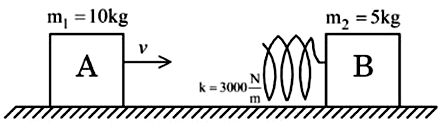
Consider two blocks A and B of masses \( m_1 = 10 \, \text{kg} \) and \( m_2 = 5 \, \text{kg} \) that are placed on a frictionless table. The block A moves with a constant speed \( v = 3 \, \text{m/s} \) towards the block B kept at rest. A spring with spring constant \( k = 3000 \, \text{N/m} \) is attached with the block B as shown in the figure. After the collision, suppose that the blocks A and B, along with the spring in constant compression state, move together, then the compression in the spring is, (Neglect the mass of the spring)
A body of mass \( 0.5 \, \text{kg} \) travels on straight line path with velocity \( v=(3x^{2}+4)\, \text{m/s} \). The net workdone by the force during its displacement from \( x=0 \) to \( x=2\, \text{m} \) is:
The position of the centre of mass of a uniform semi-circular wire of radius ‘\( R \)’ placed in x–y plane with its centre at the origin and the line joining its ends as x-axis is given by \( \left( 0, \dfrac{xR}{\pi} \right) \). Then, the value of \( |x| \) is ______.
A stationary particle breaks into two parts of masses \( m_A \) and \( m_B \) which move with velocities \( v_A \) and \( v_B \) respectively. The ratio of their kinetic energies \( (K_B : K_A) \) is:
The bob of a pendulum was released from a horizontal position. The length of the pendulum is \( 10 \, \text{m} \). If it dissipates \( 10\% \) of its initial energy against air resistance, the speed with which the bob arrives at the lowest point is: [\( \text{Use }, g : 10 \, \text{m s}^{-2} \)]
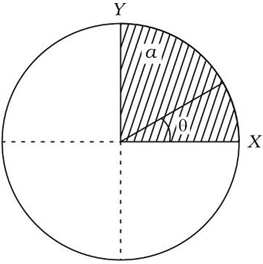
The disc of mass \( M \) with uniform surface mass density \( \sigma \) is shown in the figure. The centre of mass of the quarter disc (the shaded area) is at the position \( \displaystyle \frac{x}{3} \frac{a}{\pi}, \frac{x}{3} \frac{a}{\pi} \) where \( x \) is _______. (Round off to the Nearest Integer) [\( a \) is an area as shown in the figure]
A body of mass \( 2 \, \text{kg} \) begins to move under the action of a time dependent force given by \( \vec{F} =( 6 t \, \hat{i} + 6 t^{2} \, \hat{j} )\, \text{N} \). The power developed by the force at the time \( t \) is given by:
A spherical ball of mass \( 2 \, \text{kg} \) falls from a height of \( 10 \, \text{m} \) and is brought to rest after penetrating \( 10 \, \text{cm} \) into sand. The average force exerted by sand on the ball is ________ \( \text{N} \). (Take \( g = 10 \, \text{m/s}^2 \))
A force \( F = \alpha + \beta x^2 \) acts on an object in the x-direction. The work done by the force is \( 5 \, \text{J} \) when the object is displaced by \( 1 \, \text{m} \). If the constant \( \alpha = 1 \, \text{N} \) then \( \beta \) will be:
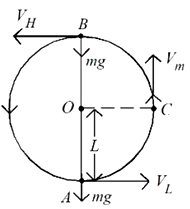
A bob of mass ‘\( m \)’ is suspended by a light string of length ‘\( L \)’. It is imparted a minimum horizontal velocity at the lowest point A such that it just completes half circle reaching the top most position B. The ratio of kinetic energies \( \dfrac{(K.E.)_A} {(K.E.)_B} \) is:
A force \( (3x^{2}+2x-5)\, \text{N} \) displaces a body from \( x = 2 \, \text{m} \) to \( x = 4 \, \text{m} \). Work done by this force is ......\( \text{J} \).
A block moving horizontally on a smooth surface with a speed of \( 40 \, \text{m s}^{-1} \) splits into two equal parts. If one of the parts moves at \( 60 \, \text{m s}^{-1} \) in the same direction, then the fractional change in the kinetic energy will be \( x : 4 \) where \( x = \) ________.
The rain drop of mass \( 1\,\text{g} \) starts with zero velocity from a height of \( 1 \,\text{km} \). It hits the ground with a speed of \( 5\,\text{m/s} \). The work done by the unknown resistive force is ______ \( \text{J} \). (Take \( g=10\,\text{m/s}^2 \))
A particle of mass \( m \) moving with velocity \( v \) collides with a stationary particle of mass \( 2m \). After collision, they stick together and continue to move together with velocity.
A sand dropper drops sand of mass \( m(t) \) on a conveyer belt at a rate proportional to the square root of speed \( (v) \) of the belt, i.e. \( \dfrac{dm}{dt} \propto \sqrt{v} \). If \( P \) is the power delivered to run the belt at constant speed then which of the following relationship is true?
What percentage of kinetic energy of a moving particle is transferred to a stationary particle when it strikes the stationary particle of \( 5 \) times its mass? (Assumes the collision to be head-on elastic collision)
A man of \( 60 \, \text{kg} \) is running on the road and suddenly jumps into a stationary trolly car of mass \( 120 \, \text{kg} \). Then, the trolly car starts moving with velocity \( 2 \, \text{m}\,\text{s}^{-1} \). The velocity of the running man was ________ \( \text{m}\,\text{s}^{-1} \), when he jumps into the car.
A rod of mass \(M\) and length \(L\) is lying on a horizontal frictionless surface. A particle of mass ‘\(m\)’ travelling along the surface hits at one end of the rod with a velocity ‘\(u\)’ in a direction perpendicular to the rod. The collision is completely elastic. After collision, particle comes to rest. The ratio of masses \(\left(\dfrac{m}{M}\right)\) is \(\dfrac{1}{x}\). The value of ‘\(x\)’ will be _____________.
A body of mass \( 5 \, \text{kg} \) is moving with a momentum of \( 10 \, \text{kg m s}^{-1} \). Now a force of \( 2 \, \text{N} \) acts on the body in the direction of its motion for \( 5 \, \text{s} \). The increase in the Kinetic energy of the body is __________ \( \text{J} \).
As shown in the figure, a particle of mass \( 10 \, \text{kg} \) is placed at a point A. When the particle is slightly displaced to its right, it starts moving and reaches the point B. The speed of the particle at B is \( x \, \text{m}\!/\!\text{s} \). (Take \( g = 10 \, \text{m}\,/\text{s}^{2} \)) The value of \( x \) to the nearest integer is _____________.