When \( \mathrm{MnO_2} \) and \( \mathrm{H_2SO_4} \) is added to a salt (A), the greenish yellow gas liberated as salt (A) is:
\( \mathrm{CaI_2} \)
\( \mathrm{NH_4Cl} \)
\( \mathrm{KNO_3} \)
\( \mathrm{NaBr} \)
The most stable trihalide of nitrogen is:
\( \mathrm{PCl_5} \) is well known, but \( \mathrm{NCl_5} \) is not. Because,
Choose the correct stability order of group \( 13 \) elements in their \( +1 \) oxidation state.
The correct order of melting points of hydrides of group \( 16 \) elements is:
Polar stratospheric clouds facilitate the formation of:
Consider the following reaction:\( A + \text{alkali} \rightarrow B \) (Major product)If \( B \) is an oxoacid of phosphorus with no \( \mathrm{P\!-\!H} \) bond, then \( A \) is:
The oxide which contains an odd electron at the nitrogen atom is:
Which of the following elements is considered as a metalloid?
Which of the following will have maximum stabilization due to crystal field?
The gas produced by treating an aqueous solution of ammonium chloride with sodium nitrite is
Identify the incorrect statement for \( \mathrm{PCl_5} \) from the following.
On the surface of polar stratospheric clouds, hydrolysis of chlorine nitrate gives A and B while its reaction with HCl produces B and C. A, B and C are, respectively.
Given below are two statements: one is labelled as Assertion A and the other is labelled as Reason R.Assertion A : Flourine forms one oxoacid.Reason R : Flourine has smallest size amongst all halogens and is highly electronegative.In the light of the above statements, choose the most appropriate answer from the options given below.
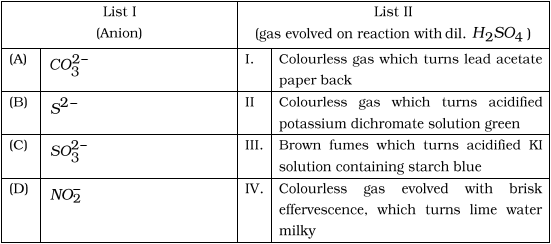
Match List I with List II.
Choose the correct answer from the options given below:
Among the given oxides of nitrogen; \( \mathrm{N_2O} \), \( \mathrm{N_2O_3} \), \( \mathrm{N_2O_4} \) and \( \mathrm{N_2O_5} \), the number of compound/(s) having \( \mathrm{N-N} \) bond is:
Which of the following oxoacids of sulphur contains "S" in two different oxidation states?
The oxoacid of phosphorus that is easily obtained from a reaction of alkali and white phosphorus and has two \( \mathrm{P-\!H} \) bonds, is:
The interhalogen compound formed from the reaction of bromine with excess of fluorine is a:
Which oxoacid of phosphorous has the highest number of oxygen atoms present in its chemical formula?
White phosphorus reacts with thionyl chloride to give.
Consider the following sulphur based oxoacids.\( \mathrm{H}_2\mathrm{SO}_3, \mathrm{H}_2\mathrm{SO}_4, \mathrm{H}_2\mathrm{S}_2\mathrm{O}_8 \) and \( \mathrm{H}_2\mathrm{S}_2\mathrm{O}_7 \)Amongst these oxoacids, the number of those with peroxo \( (\text{O–O}) \) bond is __________.
Which of the Phosphorus oxoacid can create silver mirror from \( \mathrm{AgNO_3} \) solution?
Sum of $\pi-$ bond present in peroxodisulphuric acid and pyrosulphuric acid is:
Reaction of thionyl chloride with white phosphorus forms a compound [A], which on hydrolysis gives [B], a dibasic acid. [A] and [B] are respectively.
“A” obtained by Ostwald’s method involving air oxidation of \( \mathrm{NH_3} \), upon further air oxidation produces “B”. “B” on hydration forms an oxoacid of Nitrogen along with evolution of “A”. The oxoacid also produces “A” and gives positive brown ring test. Identify A and B, respectively.
Given below are two statements:Statement I : Nickle is being used as the catalyst for producing syn gas and edible fats.Statement II : Silicon forms both electron rich and electron deficient hydrides.In the light of the above statements, choose the most appropriate answer from the options given below :
Total number of acidic oxides among \( \mathrm{N_2O_3}, \mathrm{NO_2}, \mathrm{N_2O}, \mathrm{Cl_2O_7}, \mathrm{SO_2}, \mathrm{CO}, \mathrm{CaO}, \mathrm{Na_2O} \) and \( \mathrm{NO} \) is __________.
$\text{Bond dissociation energy of “E-H” bond of the “H}_2\text{E” hydrides of group 16 elements (given below), follows order.}$$\text{A. O} \quad \text{B. S} \quad \text{C. Se} \quad \text{D. Te}$
The oxidation state of phosphorus in hypophosphoric acid is \( +\_\_\_\_ \).
Given below are two statements:Statement I: Chlorine can easily combine with oxygen to form oxides: and the product has a tendency to explode.Statement II: Chemical reactivity of an element can be determined by its reaction with oxygen and halogens.In the light of the above statements, choose the correct answer from the options given below
The standard electrode potential of \( \mathrm{M}^+/\mathrm{M} \) in aqueous solution does not depend on.
Match List I with List II:
Element not present in Nessler’s reagent is:
The ratio of sigma and \( \pi \) bonds present in pyrophosphoric acid is______________.
The difference in the oxidation state of \( \mathrm{Xe} \) between the oxidized product of \( \mathrm{Xe} \) formed on complete hydrolysis of \( \mathrm{XeF_4} \) and \( \mathrm{XeF_4} \) is _______.
One mole of \( \text{P}_4 \) reacts with \( 8 \) moles of \( \text{SOCl}_2 \) to give \( 4 \) moles of \( A \), \( x \) mole of \( \text{SO}_2 \) and \( 2 \) moles of \( B \). \( A \), \( B \) and \( x \) respectively are:
\( \mathrm{ClF_5} \) at room temperature is a:
The correct group of halide ions which can be oxidised by oxygen in acidic medium is:
The number of \( \mathrm{P-O-P} \) bonds in \( \mathrm{H_4P_2O_7} \), \( \mathrm{(HPO_3)_3} \) and \( \mathrm{P_4O_{10}} \) are respectively
\( 1 \) mole of \( \mathrm{PbS} \) is oxidized by “\( X \)” moles of \( \mathrm{O_3} \) to get “\( Y \)” moles of \( \mathrm{O_2} \). \( X + Y = \) __________.
Given below are two statements: one is labelled as Assertion (A) and the other is labelled as Reason (R).Assertion (A): There is a considerable increase in covalent radius from \( \text{N} \) to \( \text{P} \). However from \( \text{As} \) to \( \text{Bi} \) only a small Increase in covalent radius is observed.Assertion (R): Covalent and ionic radii in a particular oxidation state increases down the group. In the light of the above statements, choose the most appropriate answer from the options given below:
Given below are two statements: One is labelled as Assertion A and the other is labelled as Reason R:Assertion A: \( \mathrm{H_2Te} \) is more acidic than \( \mathrm{H_2S} \).Reason R: Bond dissociation enthalpy of \( \mathrm{H_2Te} \) is lower than \( \mathrm{H_2S} \).In the light of the above statements, choose the most appropriate from the options given below:
Reduction potential of ion are given below:\( \mathrm{ClO_4^-} \) \( \mathrm{IO_4^-} \) \( \mathrm{BrO_4^-} \)\(E^\circ = 1.19 \ \mathrm{V} \) \(E^\circ = 1.65 \ \mathrm{V} \) \(E^\circ = 1.74 \ \mathrm{V} \)The correct order of their oxidizing power is:
Give below are two statements:Statement -I: Noble gases have very high boiling points.Statement -II: Noble gases are monoatomic gases. They are held together by strong dispersion forces. Because of this they are liquefied at very low temperature. Hence, they have very high boiling points.In the light of the above statements, choose the correct answer from the options given below:
Among the following oxides of p-block elements, number of oxides having amphoteric nature is ______. \( \mathrm{Cl_2O_7} \), \( \mathrm{CO} \), \( \mathrm{PbO_2} \), \( \mathrm{N_2O} \), \( \mathrm{NO} \), \( \mathrm{Al_2O_3} \), \( \mathrm{SiO_2} \), \( \mathrm{N_2O_5} \), \( \mathrm{SnO_2} \)
Given below are two statements : one is labelled as Assertion (A) and the other is labelled as Reason (R).Assertion (A) : \( \mathrm{PH_3} \) has lower boiling point the \( \mathrm{NH_3} \).Reason (R) : In liquid state \( \mathrm{NH_3} \) molecules are associated through vander Waal's forces, but \( \mathrm{PH_3} \) molecules are associated through hydrogen bonding.In the light of the above statements, choose the most appropriate answer from the options given below:
Given below are two statements:Statement (I): \( \mathrm{SiO_{2}} \) and \( \mathrm{GeO_{2}} \) are acidic while \( \mathrm{SnO} \) and \( \mathrm{PbO} \) are amphoteric in nature.Statement (II): Allotropic forms of carbon are due to property of catenation and \( p\pi - d\pi \) bond formation.In the light of the above statements, choose the most appropriate answer from the options given below:
The strongest reducing agent among the following is:
The number of ions from the following that are expected to behave as oxidizing agent is:\( \mathrm{Sn}^{4+}, \mathrm{Sn}^{2+}, \mathrm{Pb}^{2+}, \mathrm{Tl}^{3+}, \mathrm{Pb}^{4+}, \mathrm{Tl}^{+} \)
Number of oxygen atoms present in chemical formula of fuming sulphury acid is
The maximum covalency of a non-metallic group \( 15 \) element ‘\( E \)’ with weakest \( E{-}E \) bond is:
The large difference between the melting and boiling points of oxygen and sulphur may be explained on the basis of:
A molecule with the formula \( \text{AX}_4\text{Y} \) has all it's elements from p-block. Element A is rarest, monoatomic, non-radioactive from its group and has the lowest ionization enthalpy value among A, X and Y. Elements X and Y have first and second highest electronegativity values respectively among all the known elements. The shape of the molecule is:
The nature of oxide \( \mathrm({TeO_2} )\) and hydride \( \mathrm({TeH_2} )\) formed by \( \mathrm{Te} \), respectively are:
Given below are two statements:Statement I: Nitrogen forms oxides with \( +1 \) to \( +5 \) oxidation states due to the formation of \( p\pi - p\pi \) bond with oxygen.Statement II: Nitrogen does not form halides with \( +5 \) oxidation state due to the absence of d-orbital in it.In the light of given statements, choose the correct answer from the options given below:
Which of the following molecule(s) show/s paramagnetic behavior? A. \( \mathrm{O_2} \) B. \( \mathrm{N_2} \) C. \( \mathrm{F_2} \) D. \( \mathrm{S_2} \) E. \( \mathrm{Cl_2} \) Choose the correct answer from the options given below:
Given below are two statements: Statement I: The halogen that makes longest bond with hydrogen in HX, has the smallest covalent radius in its group. Statement II: A group \( 15 \) element's hydride \( \mathrm{EH} \) has the lowest boiling point among corresponding hydrides of other group \( 15 \) elements. The maximum covalency of that element \( \mathrm{E} \) is \( 4 \). In the light of the above statements, choose the correct answer from the options given below:
Given below are two statements:Statement I: Elements ‘\( X \)’ and ‘\( Y \)’ are the most and least electronegative elements, respectively among \( \mathrm{N} \), \( \mathrm{As} \), \( \mathrm{Sb} \) and \( \mathrm{P} \). The nature of the oxides \( X_2O_3 \) and \( Y_2O_3 \) is acidic and amphoteric, respectively.Statement II: \( \mathrm{BCl_3} \) is covalent in nature and gets hydrolysed in water. It produces \( [\mathrm{B \, (O H_4)}]^- \) and \( \mathrm[\text{B}(\text{H}_2\text{O})_6]^{3+} \) in aqueous medium.In the light of the above statements, choose the correct answer from the options given below:
Elements \( X \) and \( Y \) belong to Group \( 15 \). The difference between the electronegativity values of ‘\( X \)’ and phosphorus is higher than that of the difference between phosphorus and ‘\( Y \)’. ‘\( X \)’ and ‘\( Y \)’ are respectively
Given below are two statements:Statement (I): Oxidising power of halogens decreases in the order \( \mathrm{F_2 > Cl_2 > Br_2 > I_2} \), which is the basis of “Layer test”.Statement (II): “Layer test” to identify \( \mathrm{Br_2} \) and \( \mathrm{I_2} \) in aqueous solution involves the oxidation of bromide or iodide into \( \mathrm{Br_2} \) or \( \mathrm{I_2} \) respectively with \( \mathrm{Cl_2} \), which is a type of displacement redox reaction.\( \mathrm{O_2 > O_2^{+} > O_2^{-} > O_2^{2-}} \)In the light of the above statements, choose the correct answer from the options given below:
The electronegativity of a group \( 13 \) element 'E' is same as that of \( \mathrm{Ge} \) (on Pauling scale and upto one decimal point). The CORRECT statements about \( \mathrm{E^{3+}} \) are: A. It can act as a reducing agent. B. It can act as an oxidizing agent. C. \( \mathrm{E^{3+}} \) is more stable than \( \mathrm{E^{+}} \). D. The standard electrode potential value for \( \mathrm{E^{3+}/E} \) is positive. Choose the correct answer from the options given below:
Correct statements from the following are:A. Nitrogen in oxidation states from \( +1 \) to \( +4 \) disproportionates in acid medium.B. Nitrogen has the ability to form \( d\pi - p\pi \) multiple bonds with itself and other elements with small size and high electronegativity.C. \( \mathrm{N{-}N} \) single bond is stronger than \( \mathrm{P{-}P} \) single bond.D. Nitrogen has highest density in its group due to small size.E. The maximum covalency of nitrogen is four since it has only four valence orbitals for bonding.Choose the correct answer from the options given below:
Given below are two statements: Statement I: Aluminium upon reaction with \( \mathrm{NaOH} \) forms \( [\mathrm{Al(OH)_6}]^{3-} \) ion. Statement II: The geometry of \( \mathrm{ICl_4^-}, \mathrm{ClO_3^-} \) and \( \mathrm{IBr_2^-} \) is square planar, pyramidal and linear respectively. In the light of the above statements, choose the correct answer from the options given below: