The most stable trihalide of nitrogen is:
\( \mathrm{NF_3} \)
\( \mathrm{NCl_3} \)
\( \mathrm{NBr_3} \)
\( \mathrm{NI_3} \)
Identify the incorrect statement for \( \mathrm{PCl_5} \) from the following.
On the surface of polar stratospheric clouds, hydrolysis of chlorine nitrate gives A and B while its reaction with HCl produces B and C. A, B and C are, respectively.
Choose the correct stability order of group \( 13 \) elements in their \( +1 \) oxidation state.
\( \mathrm{PCl_5} \) is well known, but \( \mathrm{NCl_5} \) is not. Because,
Which of the following will have maximum stabilization due to crystal field?
Given below are two statements: one is labelled as Assertion A and the other is labelled as Reason R.Assertion A : Flourine forms one oxoacid.Reason R : Flourine has smallest size amongst all halogens and is highly electronegative.In the light of the above statements, choose the most appropriate answer from the options given below.
The correct order of melting points of hydrides of group \( 16 \) elements is:
The oxide which contains an odd electron at the nitrogen atom is:
Which of the following oxoacids of sulphur contains "S" in two different oxidation states?
Polar stratospheric clouds facilitate the formation of:
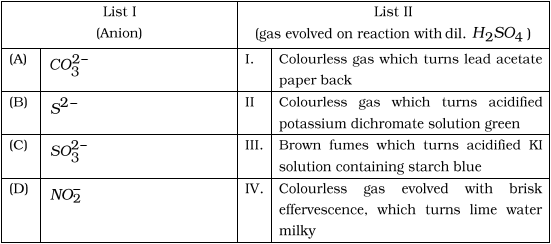
Match List I with List II.
Choose the correct answer from the options given below:
Which of the following elements is considered as a metalloid?
The interhalogen compound formed from the reaction of bromine with excess of fluorine is a:
Consider the following reaction:\( A + \text{alkali} \rightarrow B \) (Major product)If \( B \) is an oxoacid of phosphorus with no \( \mathrm{P\!-\!H} \) bond, then \( A \) is: