25 questions from 2026
Given below are two statements:
Statement I: Crystal Field Stabilization Energy (CFSE) of \( [\text{Cr}(\text{H}_2\text{O})_6]^{2+} \) is greater than that of \( [\text{Mn}(\text{H}_2\text{O})_6]^{2+}. \).
Statement II: Potassium ferricyanide has a greater spin-only magnetic moment than sodium ferrocyanide.
In the light of the above statements, choose the correct answer from the options given below:
The crystal field splitting energy of \( [Co(oxalate)_3]^{3-} \) complex is \( n \) times that of the \( [Cr(oxalate)_3]^{3-} \) complex. Here \( n \) is ______. [Assume \( \Delta_o \gg P \)]
Total number of unpaired electrons present in the central metal atom/ions of \( \text{Ni(CO)}_4 \), \( [\text{NiCl}_4]^{2-} \), \( \text{PtCl}_2(\text{NH}_3)_2 \), \( [\text{Ni(CN)}_4]^{2-} \) and \( [\text{Pt(CN)}_4]^{2-} \) is __________.
\( X \) is the number of geometrical isomers exhibited by \( [\mathrm{Pt(NH_3)(H_2O)BrCl}] \).
\( Y \) is the number of optically inactive isomer(s) exhibited by \( [\mathrm{CrCl_2(ox)_2}]^{3-} \).
\( Z \) is the number of geometrical isomers exhibited by \( [\mathrm{Co(NH_3)_3(NO_2)_3}] \).
The value of \( X + Y + Z \) is ____________.
Consider the transition metal ions \( \mathrm{Mn^{3+}} \), \( \mathrm{Cr^{3+}} \), \( \mathrm{Fe^{3+}} \) and \( \mathrm{Co^{3+}} \) and all form low spin octahedral complexes. The correct decreasing order of unpaired electrons in their respective \( d \)-orbitals of the complexes is:
Consider the metal complexes \( [\mathrm{Ni}(\mathrm{en})_{3}]^{2+} \) (\( A \)), \( [\mathrm{NiCl}_{4}]^{2-} \) (\( B \)) and \( [\mathrm{Ni}(\mathrm{NH}_{3})_{6}]^{2+} \) (\( C \)). Choose the CORRECT option by considering the number of unpaired electrons present in \( (A) \), \( (B) \) and \( (C) \) respectively and the order of frequency of absorption.
\( 5.33 \; \text{g} \) of \( \text{CrCl}_3\cdot 6\text{H}_2\text{O} \), which is a \( 1:3 \) electrolyte, is dissolved in water and is passed through a cation exchanger. The chloride ions in the eluted solution, on treatment with \( \text{AgNO}_3 \) results in \( 8.61 \; \text{g} \) of \( \text{AgCl} \). The ratio of moles of complex reacted and moles of \( \text{AgCl} \) formed is ________ \( \times 10^{-2} \). (Nearest integer)
[Molar mass in \( \text{g mol}^{-1} \) Cr: \( 52 \), Ag: \( 108 \), Cl: \( 35.5 \), H: \( 1 \), O: \( 16 \)]
Given below are two statements:
Statement I: Hybridisation, shape and spin only magnetic moment of \( \mathrm{K_3[Co(CO_3)_3]} \) is \( \mathrm{sp^3 d^2} \), octahedral and \( 4.9 \, \text{BM} \) respectively.
Statement II: Geometry, hybridisation and spin only magnetic moment values (BM) of the ions \( \left[ \mathrm{Ni(CN)_4} \right]^{2-} \), \( \left[ \mathrm{MnBr_4} \right]^{2-} \) and \( \left[ \mathrm{CoF_6} \right]^{3-} \) respectively are square planar, tetrahedral, octahedral; \( \mathrm{dsp^2} \), \( \mathrm{sp^3} \), \( \mathrm{sp^3 d^2} \) and \( 0 \), \( 5.9 \), \( 4.9 \).
In the light of the above statements, choose the correct answer from the options given below :
The correct statement among the following is:
An excess of \( \mathrm{AgNO_3} \) is added to \( 100 \, \mathrm{mL} \) of a \( 0.05 \, \mathrm{M} \) solution of tetraaquadichloridochromium(III) chloride. The number of moles of \( \mathrm{AgCl} \) precipitated will be ______ \( \times 10^{-3} \). (Nearest Integer)
Given below are two statements:
Statement-I: \([\mathrm{CoBr}_{4}]^{2-} \) ion will absorb light of lower energy than \([\mathrm{CoCl}_{4}]^{2-} \) ion.
Statement-II: In \([\mathrm{CoI}_{4}]^{2-} \) ion, the energy separation between the two set of d-orbitals is more than \([\mathrm{CoCl}_{4}]^{2-} \) ion.
In the light of the above statements, choose the correct answer from the options given below:
The correct statements about metal carbonyls are
A. The metal-carbon bonds in metal carbonyls possess both \( \sigma \) and \( \pi \)-character.
B. Due to synergic bonding interactions between metal and \( \mathrm{CO} \) ligand, the metal-carbon bond becomes weak.
C. The metal-carbon \( \sigma \) bond is formed by the donation of lone pair of electrons on the carbonyl carbon into a vacant orbital of metal.
D. The metal-carbon \( \pi \) bond is formed by the donation of electrons from filled d-orbital of metal into vacant \( \pi^* \) orbital of \( \mathrm{CO} \).
Choose the correct answer from the options given below:
Given below are two statements:
Statement I: Each electron in \( e_g \) orbitals destabilizes the orbitals by \( +0.6\Delta_o \) and each electron in the \( t_{2g} \) orbitals stabilizes the orbitals by \( -0.4\Delta_o \) in an octahedral field on the basis of crystal field theory.
Statement II: All the \( d \)-orbitals of the transition metals have the same energy in their free atomic state but when a complex is formed the ligands destroy the degeneracy of these orbitals on the basis of crystal field theory.
In the light of the above statements, choose the correct answer from the options given below
Match List-I with List-II.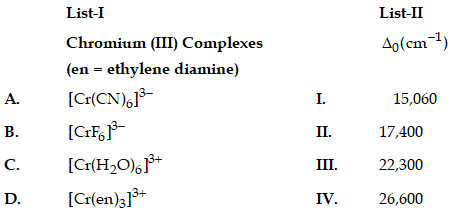
Choose the correct answer from the options given below:
Which of the following are true about the energy of the given d-orbital of a tetrahedral complex?
(A) \( d_{xy} = d_{xz} > d_{x^{2}-y^{2}} \)
(B) \( d_{xy} = d_{yz} > d_{z^{2}} \)
(C) \( d_{x^{2}-y^{2}} > d_{z^{2}} > d_{xz} \)
(D) \( d_{x^{2}-y^{2}} = d_{z^{2}} < d_{xz} \)
Choose the correct answer from the given below:
Consider a mixture 'X' which is made by dissolving \( 0.4 \) mol of \([\mathrm{Co(NH_3)_5SO_4}]Br\) and \( 0.4 \) mol of \([\mathrm{Co(NH_3)_5Br}]SO_4\) in water to make \( 4 \, \mathrm{L} \) of solution. When \( 2 \, \mathrm{L} \) of mixture 'X' is allowed to react with excess of \( \mathrm{AgNO_3} \), it forms precipitate 'Y'. The rest \( 2 \, \mathrm{L} \) of mixture 'X' reacts with excess \( \mathrm{BaCl_2} \) to form precipitate 'Z'. Which of the following statements is CORRECT?
Given below are two statements:
Statement I: The number of paramagnetic species among \( [\mathrm{CoF_6}]^{3-} \), \( [\mathrm{TiF_6}]^{3-} \), \( \mathrm{V_2O_5} \) and \( [\mathrm{Fe(CN)_6}]^{3-} \) is \( 3 \).
Statement II: \( \mathrm{K_4[Fe(CN)_6] < K_3[Fe(CN)_6] < (Fe(H_2O)_6)SO_4 \cdot H_2O < (Fe(H_2O)_6)Cl_3} \) is the correct order in terms of number of unpaired electron(s) present in the complexes.
In the light of the above statements, choose the correct answer from the options given below:
Match the List-I wit List-II
| List-I Complex ion |
List-II Calculated spin only magnetic moment (BM) |
|---|---|
| A. \( [\mathrm{Cr(H_2O)_6}]^{2+} \) | I. \( 3.87 \) |
| B. \( [\mathrm{Co(H_2O)_6}]^{2+} \) | II. \( 5.92 \) |
| C. \( [\mathrm{Cu(H_2O)_6}]^{2+} \) | III. \( 4.90 \) |
| D. \( [\mathrm{Mn(H_2O)_6}]^{2+} \) | IV. \( 1.73 \) |
Choose the correct answer from the options given below:
A chromium complex with a formula \( \mathrm{CrCl_3\cdot 6H_2O} \) has a spin only magnetic moment value of \( 3.87 \, \text{BM} \) and its solution conductivity corresponds to \( 1:2 \) electrolyte. \( 2.75 \, \text{g} \) of the complex solution was initially passed through a cation exchanger. The solution obtained after the process was reacted with excess of \( \mathrm{AgNO_3} \). The amount of \( \mathrm{AgCl} \) formed in the above process is __________ \( \text{g} \). (Nearest integer)
[Given: Molar mass in \( \text{g mol}^{-1} \) Cr : \( 52 \); Cl : \( 35.5, \) Ag: \( 108 \), O: \( 16 \), H: \( 1 \)]
Given below are two statements:
Statement I: Among \( \mathrm{Zn}, \mathrm{Mn}, \mathrm{Sc} \) and \( \mathrm{Cu} \), the energy required to remove the third valence electron is highest for \( \mathrm{Zn} \) and lowest for \( \mathrm{Sc} \).
Statement II: The correct order of the following complexes in terms of CFSE is \( [\mathrm{Co}(\mathrm{H_2O})_6]^{2+} < [\mathrm{Co}(\mathrm{H_2O})_6]^{3+} < [\mathrm{Co}(\mathrm{en})_3]^{3+} \).
In the light of the above statements, choose the correct answer from the options given below:
Number of paramagnetic complexes among the following is ______:
\( \left[\mathrm{MnBr_4}\right]^{2-},\ \left[\mathrm{NiCl_4}\right]^{2-},\ \left[\mathrm{Ni(CN)_4}\right]^{2-},\ \left[\mathrm{Ni(CO)_4}\right],\ \left[\mathrm{CoF_6}\right]^{3-},\ \left[\mathrm{Fe(CN)_6}\right]^{4-},\ \left[\mathrm{Mn(CN)_6}\right]^{3-},\ \left[\mathrm{Ti(CN)_6}\right]^{3-},\ \left[\mathrm{Cu(H_2O)_6}\right]^{2+},\ \left[\mathrm{Co(C_2O_4)_3}\right]^{3-} \)
Which of the following complexes will show coordination isomerism?
A. \( [\mathrm{Ag}(\mathrm{NH}_3)_2][\mathrm{Ag}(\mathrm{CN})_2] \)
B. \( [\mathrm{Co}(\mathrm{NH}_3)_6][\mathrm{Cr}(\mathrm{CN})_6] \)
C. \( [\mathrm{Co}(\mathrm{NH}_3)_6][\mathrm{Co}(\mathrm{CN})_6] \)
D. \( [\mathrm{Fe}(\mathrm{NH}_3)_6][\mathrm{Co}(\mathrm{CN})_6] \)
E. \( [\mathrm{Co}(\mathrm{NH}_3)_6][\mathrm{Fe}(\mathrm{CN})_6] \)
Choose the correct answer from the options given below:
Identify the CORRECT set of details from the following:
A. \( [\mathrm{Co}(\mathrm{NH}_3)_6]^{3+} \): Inner orbital complex; \( d^{2}sp^{3} \) hybridized
B. \( \mathrm[{MnCl}_6]^{3-} \): Outer orbital complex; \( sp^{3}d^{2} \) hybridized
C. \( [\mathrm{CoF}_6]^{3-} \): Outer orbital complex; \( d^{2}sp^{3} \) hybridized
D. \( [\mathrm{FeF}_6]^{3-} \): Outer orbital complex; \( sp^{3}d^{2} \) hybridized
E. \( [\mathrm{Ni}(\mathrm{CN})_4]^{2-} \): Inner orbital complex; \( sp^{3} \) hybridized
Choose the correct answer from the options given below:
Match the List-I with List-II.
| List-I Electronic configuration of tetrahedral metal ion |
List-II Crystal Field Stabilization Energy (\( \Delta_t \)) |
|---|---|
| A. \( d^{2} \) | I. \( -0.6 \) |
| B. \( d^{4} \) | II. \( -0.8 \) |
| C. \( d^{6} \) | III. \( -1.2 \) |
| D. \( d^{8} \) | IV. \( -0.4 \) |
Choose the correct answer from the options given below:
Given below are two statements:
Statement I : Among \( \left[\mathrm{Cu(NH_3)_4}\right]^{2+} \), \( \left[\mathrm{Ni(en)_3}\right]^{2+} \), \( \left[\mathrm{Ni(NH_3)_6}\right]^{2+} \) and \( \left[\mathrm{Mn(H_2O)_6}\right]^{2+} \),\( \left[\mathrm{Mn(H_2O)_6}\right]^{2+} \) has the maximum number of unpaired electrons.
Statement II : The number of pairs among \( \left\{ \left[\mathrm{NiCl_4}\right]^{2-}, \left[\mathrm{Ni(CO)_4}\right] \right\} \), \( \left\{ \left[\mathrm{NiCl_4}\right]^{2-}, \left[\mathrm{Ni(CN)_4}\right]^{2-} \right\} \) and \( \left\{ \left[\mathrm{Ni(CO)_4}\right], \left[\mathrm{Ni(CN)_4}\right]^{2-} \right\} \) that contain only diamagnetic species is two.
In the light of the above statements, choose the correct answer from the options given below:
