35 questions from 2024
Given below are two statements:Statement (I) : A solution of \( [\mathrm{Ni}(\mathrm{H_2O})_6]^{2+} \) is green in colour.Statement (II) : A solution of \( [\mathrm{Ni}(\mathrm{CN})_4]^{2-} \) is colourless.In the light of the above statements, choose the most appropriate answer from the options given below:
An octahedral complex with the formula \( \mathrm{CoCl_3} \cdot n\mathrm{NH_3} \) upon reaction with excess of \( \mathrm{AgNO_3} \) solution gives \( 2 \, \text{moles} \) of \( \mathrm{AgCl} \). Consider the oxidation state of Co in the complex is ‘\( x \)’. The value of ‘‘\( x + n \)’’ is ______.
Number of ambidentate ligands among the following is _______.\( \mathrm{NO_2^-} \), \( \mathrm{SCN^-} \), \( \mathrm{C_2O_4^{2-}} \), \( \mathrm{NH_3} \), \( \mathrm{CN^-} \), \( \mathrm{SO_4^{2-}} \), \( \mathrm{H_2O} \).
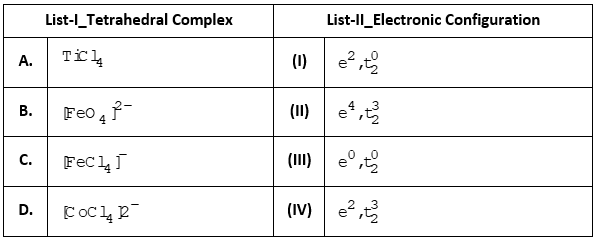
Match List – I with List – II
Choose the correct answer from the options given below :
The coordination geometry around the manganese in decacarbonyldimanganese \( (0) \) is:
Number of complexes from the following with even number of unpaired “\( d \)” electrons is ______.\( [\mathrm{V}(\mathrm{H_2O})_6]^{3+};\ [\mathrm{Cr}(\mathrm{H_2O})_6]^{2+};\ [\mathrm{Fe}(\mathrm{H_2O})_6]^{3+};\ [\mathrm{Ni}(\mathrm{H_2O})_6]^{3+};\ [\mathrm{Cu}(\mathrm{H_2O})_6]^{2+} \)[Given atomic numbers : \( \mathrm{V}=23 \), \( \mathrm{Cr}=24 \), \( \mathrm{Fe}=26 \), \( \mathrm{Ni}=28 \), \( \mathrm{Cu}=29 \)]
The spin only magnetic moment value of square planar complex \( [\mathrm{Pt}(\mathrm{NH}_3)_2\mathrm{Cl(NH_2CH_3})]\mathrm{Cl} \) is __________ B.M (Nearest integer)(Given atomic number for Pt = \( 78 \))
The number of unpaired \( d \)-electrons in \( [\mathrm{Co}(\mathrm{H}_2\mathrm{O})_6]^{3+} \) is __________.
Identify from the following species in which \( d^2sp^3 \) hybridization is shown by central atom:
Consider the following complexes \( [\mathrm{CoCl(NH_3)_5}]^{2+} \), \( [\mathrm{Co(CN)_6}]^{3-} \), \( [\mathrm{Co(NH_3)_5(H_2O)}]^{3+} \), \( [\mathrm{Cu(H_2O)_4}]^{2+} \).The correct order of \( A \), \( B \), \( C \) and \( D \) in terms of wavenumber of light absorbed is:
The number of complexes from the following with no electrons in the \( t_2 \) orbital is ________.\( \mathrm{TiCl_4, [ MnO_4]^{-}, [ FeO_4]^{2-}, [ FeCl_4]^{-}, [ CoCl_4]^{2-}} \)
The correct IUPAC name of \( [\mathrm{PtBr}_2(\mathrm{PMe}_3)_2] \) is:
\( [\mathrm{Co(NH_3)_6}]^{3+} \) and \( [\mathrm{CoF_6}]^{3-} \) are respectively known as:
Given below are two statements: one is labelled as Assertion (A) and the other is labelled as Reason (R).Assertion (A): The total number of geometrical isomers shown by \( [\text{Co(en)}_2 \text{Cl}_2]^+ \) complex ion is three.Reason (R): \( [\text{Co(en)}_2 \text{Cl}_2]^+ \) complex ion has an octahedral geometry.In the light of the above statements, choose the most appropriate answer from the options given below:
Number of complexes with even number of electrons in \( t_{2g} \) orbitals is:\( [\mathrm{Fe}(\mathrm{H}_2\mathrm{O})_6]^{2+} \), \( [\mathrm{Co}(\mathrm{H}_2\mathrm{O})_6]^{2+} \), \( [\mathrm{Co}(\mathrm{H}_2\mathrm{O})_6]^{3+} \), \( [\mathrm{Cu}(\mathrm{H}_2\mathrm{O})_6]^{2+} \), \( [\mathrm{Cr}(\mathrm{H}_2\mathrm{O})_6]^{2+} \)
The ‘Spin only’ Magnetic moment for \( [\text{Ni(NH}_3\text{)}_6]^{2+} \) is ______ \( \times 10^{-1} \, \text{BM} \). (given = Atomic number of Ni : \( 28 \))
The correct statements from following are:A. The strength of anionic ligands can be explained by crystal field theory.B. Valence bond theory does not give a quantitative interpretation of kinetic stability of coordination compounds.C. The hybridization involved in formation of \( \mathrm{[Ni(CN)_4]^{2-}} \) complex is \( dsp^2 \).D. The number of possible isomer(s) of cis-\( \mathrm{[PtCl_2(en)_2]^{2+}} \) is \( one \).Choose the correct answer from the options given below:
Number of complexes which show optical isomerism among the following is _______.\( \text{cis-}[\mathrm{Cr(ox)_2Cl_2}]^{3-},\ [\mathrm{Co(en)_3}]^{3+},\ \text{cis-}[\mathrm{Pt(en)_2Cl_2}]^{2+},\ \text{cis-}[\mathrm{Co(en)_2Cl_2}]^{+},\ \text{trans-}[\mathrm{Pt(en)_2Cl_2}]^{2+},\ \text{trans-}[\mathrm{Cr(ox)_2Cl_2}]^{3-} \)
Given below are two statements:Statement-I: \( \mathrm{N}(\mathrm{CH}_3)_3 \) and \( \mathrm{P}(\mathrm{CH}_3)_3 \) can act as ligands to form transition metal complexes.Statement-II: As \( \mathrm{N} \) and \( \mathrm{P} \) are from same group, the nature of bonding of \( \mathrm{N}(\mathrm{CH}_3)_3 \) and \( \mathrm{P}(\mathrm{CH}_3)_3 \) is always same with transition metals.In the light of the above statements, choose the most appropriate answer from the options given below:
Which of the following complex is homoleptic?
The metal atom present in the complex \( \mathrm{MABXL} \) (where \( A \), \( B \), \( X \) and \( L \) are unidentate ligands and \( M \) is metal) involves \( \mathrm{sp^3} \) hybridization. The number of geometrical isomers exhibited by the complex is:
Given below are two statements:Statement (I): Dimethyl glyoxime forms a six-membered covalent chelate when treated with \( \mathrm{NiCl_2} \) solution in presence of \( \mathrm{NH_4OH} \).Statement (II): Prussian blue precipitate contains ion both in \( (+2) \) and \( (+3) \) oxidation states.In the light of the above statements, choose the most appropriate answer from the options given below:
Given below are two statements:Statement I: \( \mathrm{PF}_{5} \) and \( \mathrm{BrF}_{5} \) both exhibit \( \mathrm{sp}^{3}\mathrm{d} \) hybridization.Statement II: Both \( \mathrm{SF}_{6} \) and \( [\mathrm{Co}(\mathrm{NH}_{3})_{6}]^{3+} \) exhibit \( \mathrm{sp}^{3}\mathrm{d}^{2} \) hybridization.In the light of the above statements, choose the correct answer from the options given below:
Match List-I with List-II.
Choose the correct answer from the options given below:
The coordination environment of \( \mathrm{Ca^{2+}} \) ion in its complex with \( \mathrm{EDTA^{4-}} \) is:
The correct IUPAC name of \( K_2MnO_4 \) is:
In which one of the following metal carbonyls, CO forms a bridge between metal atoms?
Match List I with List II
Choose the correct statements from the following:(A) Ethane-\( 1, 2 \)-diamine is a chelating ligand.(B) Metallic aluminium is produced by electrolysis of aluminium oxide in presence of cryolite.(C) Cyanide ion is used as ligand for leaching of silver.(D) Phosphine act as a ligand in Wilkinson catalyst.(E) The stability constants of \( \mathrm{Ca^{2+}} \) and \( \mathrm{Mg^{2+}} \) are similar with EDTA complexes.Choose the correct answer from the options given below:
Which one of the following complexes will exhibit the least paramagnetic behaviour? \([ \text{Atomic number, Cr} = 24, \text{ Mn} = 25, \text{ Fe} = 26, \text{ Co} = 27 ]\)
The correct sequence of ligands in the order of decreasing field strength is:
Select the option with correct property:
Total number of unpaired elecrons in the complex ions \( [\mathrm{Co(NH_3)_6}]^{3+} \) and \( [\mathrm{NiCl_4}]^{2-} \) is:
Consider the following complex ions\( P = [\text{FeF}_6]^{3-} \)\( Q = [\text{V}(\text{H}_2\text{O})_6]^{2+} \)\( R = [\text{Fe}(\text{H}_2\text{O})_6]^{2+} \)The correct order of the complex ions, according to their spin only magnetic moment values (in \( \text{B.M.} \)), is:
The correct order of ligands arranged in increasing field strength.