18 questions from 2026
Given at \( 298\,\mathrm{K} \):\( E^\ominus_{\mathrm{Fe^{2+}/Fe}} = X \) Volt
\( E^\ominus_{\mathrm{Fe^{3+}/Fe}} = Y \) Volt
The \( E^\ominus_{\mathrm{Fe^{3+}/Fe^{2+}}} \) in Volt at \( 298\,\mathrm{K} \) is given by:
Consider the following two half-cell reactions along with the standard reduction potential given:
\( \text{CO}_{2} + 6\text{H}^{+} + 6e^{-} \rightarrow \text{CH}_{3}\text{OH} + \text{H}_{2}\text{O} \quad E^{0}_{\text{red}} = 0.02 \, \text{V} \)
\( \dfrac{1}{2}\text{O}_{2} + 2\text{H}^{+} + 2e^{-} \rightarrow \text{H}_{2}\text{O} \quad E^{0}_{\text{red}} = 1.23 \, \text{V} \)
A fuel cell was set up using the above two reactions such that the cell operates under the standard condition of \( 1 \, \text{bar} \) pressure and \( 298 \, \text{K} \) temperature. The fuel cell works with \( 80\% \) efficiency. If the work derived from the cell using \( 1 \, \text{mol} \) of \( \text{CH}_{3}\text{OH} \) is used to compress an ideal gas isothermally against a constant pressure of \( 1 \, \text{kPa} \), then the change in the volume of the gas, \( \Delta V = \) _________ \( \text{m}^{3} \). (nearest integer)
Given : \( F = 96500 \, \text{C mol}^{-1} \)
At \( 298 \, \text{K} \), the molar conductivity of \( x\% \) (w/w) \( \text{MX} \) solution (aqueous) is \( 123.5 \, \text{cm}^2 \, \text{mol}^{-1} \). The conductance of same solution is \( 1.9 \times 10^{-3} \, \text{S} \). The value of \( x \) is __________ \( \times 10^{-2} \).
(Given: cell constant \( = 1.3 \, \text{cm}^{-1} \); molar mass of \( \text{MX} \) is \( 75 \, \text{g mol}^{-1} \), density of aqueous solution of \( \text{MX} \) at \( 298 \, \text{K} \) is \( 1.0 \, \text{g mL}^{-1} \))
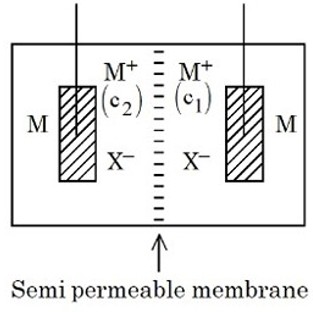
Consider the above electrochemical cell where a metal electrode (\( M \)) is undergoing redox reaction by forming \( \mathrm{M^+ (M \rightarrow M^+ + e^-)} \). The cation \( \mathrm{M^+} \) is present in two different concentrations \( c_1 \) and \( c_2 \) as shown above. Which of the following statement is correct for generating a positive cell potential?
For a closed circuit Daniell cell, which of the following plots is the accurate one at a given temperature?
In the given electrochemical cell, \( \mathrm{Ag(s) \, | \, AgCl(s) \, | \, FeCl_2(aq), \, FeCl_3(aq) \, | \, Pt(s)} \) at \( 298 \, \text{K} \), the cell potential (\( E_\text{cell} \)) will increase when:
A. Concentration of \( \mathrm{Fe^{2+}} \) is increased.
B. Concentration of \( \mathrm{Fe^{3+}} \) is decreased.
C. Concentration of \( \mathrm{Fe^{2+}} \) is decreased.
D. Concentration of \( \mathrm{Fe^{3+}} \) is increased.
E. Concentration of \( \mathrm{Cl^-} \) is increased.
Choose the correct answer from the options given below:
Molar conductivity of a weak acid \( \mathrm{HQ} \) of concentration \( 0.18 \, \mathrm{M} \) was found to be \( \dfrac{1}{30} \) of the molar conductivity of another weak acid \( \mathrm{HZ} \) with concentration of \( 0.02 \, \mathrm{M} \). If \( \lambda^{\circ}_{Q^-} \) happened to be equal with \( \lambda^{\circ}_{Z^-} \), then the difference of the \( \mathrm{p}K_a \) values of the two weak acids \( (\mathrm{p}K_a{(\mathrm{HQ})} - \mathrm{p}K_a{(\mathrm{HZ})}) \) is ______. (Nearest integer)
[Given: degree of dissociation (\( \alpha \)) \( \ll 1 \) for both weak acids, \( \lambda^{\circ} \) : limiting molar conductivity of ions]
MX is a sparingly soluble salt that follows the given solubility equilibrium at \( 298 \, \text{K} \).
\( \mathrm{MX (s)} \rightleftharpoons \mathrm{M^+ (aq)} + \mathrm{X^- (aq)} ; \quad K_{sp} = 10^{-10} \)
If the standard reduction potential for \( \text{M}^+(\text{aq}) \xrightarrow{+e^-} \text{M}(\text{s}) \) is \( \left( \text{E}^{\ominus}_{\text{M}^+/\text{M}} \right) = 0.79 \text{ V} \), then the value of the standard reduction potential for the metal/metal insoluble salt electrode \(\text{E}^{\ominus}_{\text{X}^-/\text{MX}(\text{s})/\text{M}} \). (nearest integer)
[Given: \( \frac{2.303 RT}{F} = 0.059 \, \text{V} \)]
Consider the following electrochemical cell at \( 298 \,\mathrm{K} \)
\( \mathrm{Pt} \,|\, \mathrm{HSnO_{2}^{-}} (\mathrm{aq}) \,|\, \mathrm{Sn(OH)_{6}^{2-}} (\mathrm{aq}) \,|\, \mathrm{OH^{-}} (\mathrm{aq}) \,|\, \mathrm{Bi_{2}O_{3}} (\mathrm{s}) \,|\, \mathrm{Bi} (\mathrm{s}) \). If the reaction quotient at a given time is \( 10^{6} \), then the cell EMF \( (E_{\text{cell}}) \) is _______ \( \times 10^{-1} \,\mathrm{V} \) (Nearest integer).
Given the standard half-cell reduction potential as \( E^{\circ}_{\mathrm{Bi_{2}O_{3}/Bi,OH^{-}}} = -0.44 \,\mathrm{V} \) and \( E^{\circ}_{\mathrm{Sn(OH)_{6}^{2-}/HSnO_{2}^{-},OH^{-}}} = -0.90 \,\mathrm{V} \)
Consider the following electrochemical cell:
Pt|\( \mathrm{O}_2 (\mathrm{g}) \)|bar|HCl(aq)||\( \mathrm{M}^{2+} \)(aq, \( 1.0 \) \( \mathrm{M} \))|M(s)
The pH above which, oxygen gas would start to evolve at anode is __________ (nearest integer)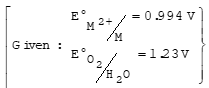
Stabdard reduction potential]
and \( \frac{RT}{F}(2.303) = 0.059 \) \( \mathrm{V} \) at the given condition]
Consider the following data.
| Electrolyte | \( \Lambda^{\circ}_{m} \) (\( \text{S cm}^2 \text{ mol}^{-1} \)) |
|---|---|
| BaCl\(_2\) | \( x1 \) |
| H\(_2\)SO\(_4\) | \( x2 \) |
| HCl | \( x3 \) |
BaSO\(_4\) is sparingly soluble in water. If the conductivity of the saturated BaSO\(_4\) solution is \( x \) \( \text{S cm}^{-1} \) then the solubility product of BaSO\(_4\) can be given as (Here \( \lambda_m = \Lambda^{\circ}_{m} \))
Given below are two statements:
Statement I: Aluminium is more electropositive than thallium as the standard electrode potential value of \( E^{\circ}_{\text{Al}^{3+}/\text{Al}} \) is negative and \( E^{\circ}_{\text{Tl}^{3+}/\text{Tl}} \) is positive.
Statement II: The sum of first three ionization enthalpies of boron is very high when compared to that of aluminium. Due to this reason boron forms covalent compounds only and aluminium forms \( \text{Al}^{3+} \) ion.
In the light of the above statements, choose the correct answer from the options given below
$
\text{Consider the following redox reaction taking place in acidic medium}
$
$
\text{BH}_4^-(aq) + \text{ClO}_3^-(aq) \longrightarrow \text{H}_2\text{BO}_3^-(aq) + \text{Cl}^-(aq)
$
$
\text{If the Nernst equation for the above balanced reaction is}
$
$
E_{\text{cell}} = E^\circ_{\text{cell}} - \frac{RT}{nF} \ln Q,
$
$
\text{then the value of } n \text{ is _____________. (Nearest integer)}
$
Electricity is passed through an acidic solution of \( Cu^{2+} \) till all the \( Cu^{2+} \) was exhausted, leading to the deposition of \( 300 \, \text{mg} \) of Cu metal. However, a current of \( 600 \, \text{mA} \) was continued to pass through the same solution for another \( 28 \) minutes by keeping the total volume of the solution fixed at \( 200 \, \text{mL} \). The total volume of oxygen evolved at STP during the entire process is _______ \( \text{mL} \). (Nearest integer)
[Given:
\( Cu^{2+}(aq) + 2e^- \rightarrow Cu(s) \quad E^\circ_{\text{red}} = +0.34 \, \text{V} \)
\( O_2(g) + 4H^+ + 4e^- \rightarrow 2H_2O \quad E^\circ_{\text{red}} = +1.23 \, \text{V} \)
Molar mass of Cu \( = 63.54 \, \text{g mol}^{-1} \)
Molar mass of \( O_2 = 32 \, \text{g mol}^{-1} \)
Faraday Constant \( = 96500 \, \text{C mol}^{-1} \)
Molar volume at STP \( = 22.4 \, \text{L} \)]
For a general redox reaction
Anode \( \text{Red}_1 \rightarrow \text{Ox}_1^{n_1^+} + n_1e^- \)
Cathode \( \text{Ox}_2 + n_2 e^- \rightarrow \text{Red}_2^{\,n_2-} \)
Which of the following statement is incorrect?
An electrochemical cell is constructed using half cells in the direction of spontaneous change
Which of the following option is correct?
The pH and conductance of a weak acid (HX) was found to be \( 5 \) and \( 4 \times 10^{-5} \, \text{S} \), respectively. The conductance was measured under standard condition using a cell where the electrode plates having a surface area of \( 1 \, \text{cm}^{2} \) were at a distance of \( 15 \, \text{cm} \) apart. The value of the limiting molar conductivity is ____________ \( \text{S m}^{2} \text{ mol}^{-1} \). (nearest integer)
(Given: degree of dissociation of the weak acid ( \( \alpha \) ) \( \ll 1 \))
An electrochemical cell, consist of the following two redox couples, \( \mathrm{M^{x+} (aq) / M(s)[E_{\text{red}}^{\circ} = +0.15 \, V]} \) and \( \mathrm{Fe^{3+}(aq) / Fe(s)[E_{\text{red}}^{\circ} = -0.036 \, V]} \). The cell EMF(\( E_{\text{cell}} \)) is recorded to be \( 0.2057 \, V \). If the reaction quotient of the electrochemical reaction is found to be \( 10^{-2} \), then the value of \( x \) is _______. (Nearest Integer)
[Given: M is a p-block metal and \( \dfrac{2.303RT}{F} = 0.059 \, V \) ]
