24 questions from 2023
Following figure shows dependence of molar conductance of two electrolytes on concentration. \( \Lambda_m^\circ \) is the limiting molar conductivity.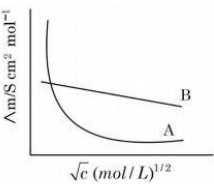
The number of incorrect statement(s) from the following is ______
(A) \( \Lambda_m^\circ \) for electrolyte A is obtained by extrapolation
(B) For electrolyte B, \( \Lambda_m \) vs \( \sqrt{c} \) graph is a straight line with intercept equal to \( \Lambda_m^\circ \)
(C) At infinite dilution, the value of degree of dissociation approaches zero for electrolyte B.
(D) \( \Lambda_m^\circ \) for any electrolyte A or B can be calculated using \( \lambda^\circ \) for individual ions
For lead storage battery pick the correct statements.
A. During charging of battery, \( \mathrm{PbSO_4} \) on anode is converted into \( \mathrm{PbO_2} \)
B. During charging of battery, \( \mathrm{PbSO_4} \) on cathode is converted into \( \mathrm{PbO_2} \)
C. Lead storage battery consists of grid of lead pack with \( \mathrm{PbO_2} \) as anode
D. Lead storage battery has \( \sim 38\% \) solution of sulphuric acid as an electrolyte
Choose the correct answer from the options given below:
$
\text{The electrode potential of the following half cell at } 298 \text{ K}
$
$
\text{X} \mid \text{X}^{2+}(0.001\text{M}) \parallel \text{Y}^{2+}(0.01\text{M}) \mid \text{Y is }\underline{\qquad\qquad} \times 10^{-2}\text{ V (Nearest integer).}
$
$
\text{Given : } E^\circ_{\text{X}^{2+} \mid \text{X}} = -2.36\text{ V}
$
$
E^\circ_{\text{Y}^{2+} \mid \text{Y}} = +0.36\text{ V}
$
$
\frac{2.303\text{RT}}{\text{F}} = 0.06\text{ V}
$
The logarithm of equilibrium constant for the reaction $\text{Pd}^{2+} + 4\text{Cl}^- \rightleftharpoons \text{PdCl}_4^{2-}$ is $\underline{\hspace{1cm}}$ (Nearest integer).
Given: $\frac{2.303\text{RT}}{\text{F}} = 0.06\text{V}$
$\text{Pd}^{2+}_{(\text{aq})} + 2\text{e}^- \rightleftharpoons \text{Pd(s)} \, \text{E}^\theta = 0.83\text{V}$
$\text{PdCl}_4^{2-}(\text{aq}) + 2\text{e}^- \rightleftharpoons \text{Pd(s)} + 4\text{Cl}^-(\text{aq}) \, \text{E}^\theta = 0.65\text{V}$
The number of incorrect statements from the following is__________
A The electrical work that a reaction can perform at constant pressure and temperature is equal to the reaction Gibbs energy
B \( E_\text{cell}^{\circ} \) is dependent on the pressure
C \( \displaystyle \dfrac{\text{d}E^\ominus_{\text{cell}}}{\text{dT}} = \dfrac{\Delta_r S^\ominus}{nF} \)
D A cell is operating reversibly if the cell potential is exactly balanced by an opposing source of potential difference.
The number of correct statements from the following is ________.
A. \( E_{cell} \) is an intensive parameter
B. A negative \( E^{\ominus} \) means that the redox couple is a stronger reducing agent than the \( \mathrm{H^{+}/H_2} \) couple
C. The amount of electricity required for oxidation or reduction depends on the stoichiometry of the electrode reaction
D. The amount of chemical reaction which occurs at any electrode during electrolysis by a current is proportional to the quantity of electricity passed through the electrolyte
In an electrochemical reaction of lead, at standard temperature, if \( E^\circ_{(\mathrm{Pb^{2+}/Pb)}} = m \) Volt and \( E^\circ_{(\mathrm{Pb^{4+}/Pb)}} = n \) Volt, then the value of \( E^\circ_{(\mathrm{Pb^{2+}/Pb^{4+}})} \) is given by \( m - xn \). The value of \( x \) is _______. (Nearest integer)
At what pH, given half cell \( \mathrm{MnO_4^-} \) \( (0.1\,\mathrm{M}) \) | \( \mathrm{Mn^{2+}} \) \( (0.001\,\mathrm{M}) \) will have electrode potential of \( 1.282\,\mathrm{V} \)? ______. (Nearest Integer)
Given \( E^\circ_{\mathrm{MnO_4/Mn^{2+}}} = 1.54\,\mathrm{V} \), \( \frac{2.303RT}{F} = 0.059\,\mathrm{V} \)
The product, which is not obtained during the electrolysis of brine solution is:
The reaction \( \dfrac{1}{2}\,\mathrm{H}_2(g) + \mathrm{AgCl}(s) \rightleftharpoons \mathrm{H}^+(aq) + \mathrm{Cl}^-(aq) + \mathrm{Ag}(s) \) occurs in which of the given galvanic cell.
\( \text{Pt(s)} \mid \text{H}_2 \text{(g)} (1\text{bar}) \mid\mid \text{H}^+ \text{(aq)} (1\text{M}) \mid\mid \text{M}^{3+} \text{(aq)}, \text{M}^+ \text{(aq)} \mid \text{Pt (s)} \).
The \( E_{\text{cell}} \) for the given cell is \( 0.1115 \, \text{V} \) at \( 298 \, \text{K} \) when \( \dfrac{[\text{M}^+ \, (\text{aq})]}{[\text{M}^{3+} \, (\text{aq})]} = 10^a \). The value of \( a \) is ______. Given:
$\text{Given: } E^\theta_{\text{M}^{3+}/\text{M}^+} = 0.2\text{V}$
$\frac{2.303\text{RT}}{\text{F}} = 0.059\text{V}$
A metal surface of \( 100 \, \text{cm}^2 \) area has to be coated with nickel layer of thickness \( 0.001 \, \text{mm} \). A current of \( 2 \, \text{A} \) was passed through a solution of \( \text{Ni(NO}_3)_2 \) for ‘\( x \)’ seconds to coat the desired layer. The value of \( x \) is ________. (nearest integer) \( (\rho_{\text{Ni}} \text{ (density of Nickel) is } 10 \, \text{g mL}^{-1} , \text{ Molar mass of Nickel is } 60 \, \text{g mol}^{-1} , \; F = 96500 \, \text{C mol}^{-1}) \)
\( \mathrm{FeO_4^{2-}} \xrightarrow{+2.2\,\mathrm{V}} \mathrm{Fe^{3+}} \xrightarrow{+0.70\,\mathrm{V}} \mathrm{Fe^{2+}} \xrightarrow{-0.45\,\mathrm{V}} \mathrm{Fe^{0}} \)
\( E^{0}_{\mathrm{FeO_4^{2-}/Fe^{2+}}} \) is \( x \times 10^{-3}\,\mathrm{V} \). The value of \( x \) is _________
Number of crystal from the following where body centred unit cell can be found, is __________ .
Cubic, tetragonal, orthorhombic, hexagonal, rhombohedral, monoclinic, triclinic.
At \(298 \, \text{K}\), the standard reduction potential for \(\mathrm{Cu^{2+}/Cu}\) electrode is \(0.34 \, \text{V}\).
Given: \(K_{sp}\,\mathrm{Cu(OH)_2} = 1 \times 10^{-20}\)
Take \( \dfrac{2.303\,RT}{F} = 0.059 \, \text{V} \)
The reduction potential at \(\mathrm{pH} = 14\) for the above couple is \((-) x \times 10^{-2} \, \text{V}\). The value of \( x \) is __________.
The resistivity of a \( 0.8 \, \mathrm{M} \) solution of an electrolyte is \( 5 \times 10^{-3} \, \Omega \, \mathrm{cm} \). Its conductivity is ________ \( \times 10^{4} \, \Omega^{-1} \, \mathrm{cm^{2}} \, \mathrm{mol^{-1}} \). (Nearest integer)
The equilibrium constant for the reaction
$\text{Zn(s)} + \text{Sn}^{2+}(\text{aq}) \rightleftharpoons \text{Zn}^{2+}(\text{aq}) + \text{Sn(s)}$ is $1 \times 10^{20}$ at $298\text{ K}$. The magnitude of standard electrode potential of $\text{Sn/Sn}^{2+}$ if $\text{E}_{\text{Zn}^{2+}/\text{Zn}}^{\ominus} = -0.76\text{ V}$ is _________ $\times 10^{-2}\text{ V}$. (Nearest integer)
Given : $\frac{2.303\text{RT}}{\text{F}} = 0.059\text{ V}$
\( 1 \times 10^{-5} \, \mathrm{M} \, \mathrm{AgNO_3} \) is added to \( 1 \, \mathrm{L} \) of saturated solution of \( \mathrm{AgBr} \). The conductivity of this solution at \( 298 \, \mathrm{K} \) is \( \_\_\_\_\_ \times 10^{-8} \, \mathrm{S\,m^{-1}} \).
[Given: \( K_{sp}(\mathrm{AgBr}) = 4.9 \times 10^{-13} \) at \( 298 \, \mathrm{K} \), \( \Lambda^{0}_{\mathrm{Ag^+}} = 6 \times 10^{-3} \, \mathrm{S\,m^{2}\,mol^{-1}} \), \( \Lambda^{0}_{\mathrm{Br^-}} = 8 \times 10^{-3} \, \mathrm{S\,m^{2}\,mol^{-1}} \), \( \Lambda^{0}_{\mathrm{NO_3^-}} = 7 \times 10^{-3} \, \mathrm{S\,m^{2}\,mol^{-1}} \).]
Choose the correct representation of conductometric titration of benzoic acid vs sodium hydroxide.
Consider the cell $\text{Pt(s)} \mid \text{H}_2(\text{g, 1atm}) \mid \text{H}^+(\text{aq, 1M}) \parallel \text{Fe}^{3+}(\text{aq}), \text{Fe}^{2+}(\text{aq}) \mid \text{Pt(s)}$.
When the potential of the cell is $0.712\text{ V}$ at $298\text{ K}$, the ratio $[\text{Fe}^{2+}]/[\text{Fe}^{3+}]$ is _______.
(Nearest integer) $\left[\text{Given : } \text{Fe}^{3+} + \text{e}^- \rightleftharpoons \text{Fe}^{2+}, E^{\theta}{\text{Fe}^{3+}, \text{Fe}^{2+} \mid \text{Pt}} = 0.771; \frac{2.303RT}{F} = 0.06\text{ V}\right]$
At \( 298 \, \text{K} \), a \( 1 \) litre solution containing \( 10 \, \text{mmol} \) of \( \mathrm{Cr_2O_7^{2-}} \) and \( 100 \, \text{mmol} \) of \( \mathrm{Cr^{3+}} \) shows a pH of \( 3.0 \).
Given : \( \mathrm{CrO_7^{2-} \rightarrow Cr^{3+}} \) ; \( E^\circ = 1.330 \, \text{V} \) and \( \frac{2.303 \, RT}{F} = 0.059 \, \text{V} \)
The potential for the half cell reaction is \( x \times 10^{-3} \, \text{V} \). The value of \( x \) is ________.
The specific conductance of \( 0.0025 \, \text{M} \) acetic acid is \( 5 \times 10^{-5} \, \text{S cm}^{-1} \) at a certain temperature. The dissociation constant of acetic acid is ______ \( \times 10^{-7} \). (Nearest integer) Consider limiting molar conductivity of \( \mathrm{CH_3COOH} \) as \( 400 \, \text{S cm}^2 \, \text{mol}^{-1} \).
Consider the cell
\( \mathrm{Pt(s)} \ | \ \mathrm{H_2(g)} \ (1 \ \mathrm{atm}) \ | \ \mathrm{H^+(aq}, [\mathrm{H^+}] = 1)\ \| \ \mathrm{Fe^{3+}(aq)}, \ \mathrm{Fe^{2+}(aq)} \ | \ \mathrm{Pt(s)} \)
Given \( E^\circ_{\mathrm{Fe^{3+}/Fe^{2+}}} = 0.771 \ \mathrm{V} \) and \( E^\circ_{\mathrm{H^+/ \tfrac{1}{2} H_2}} = 0.0 \ \mathrm{V} \), \( T = 298 \ \mathrm{K} \)
If the potential of the cell is \(0.712 \ \mathrm{V}\), the ratio of concentration of \( \mathrm{Fe^{2+}} \) to \( \mathrm{Fe^{3+}} \) is ______. (Nearest integer)
The number of correct statements from the following is __________.
(A) Conductivity always decreases with decrease in concentration for both strong and weak electrolytes.
(B) The number of ions per unit volume that carry current in a solution increases on dilution.
(C) Molar conductivity increases with decrease in concentration.
(D) The variation in molar conductivity is different for strong and weak electrolytes.
(E) For weak electrolytes, the change in molar conductivity with dilution is due to decrease in degree of dissociation.
