Consider the reaction \( a\mathrm{X} \rightarrow b\mathrm{Y} \), for which the rate constant at \( 30^\circ \text{C} \) is \( 1 \times 10^{-3} \, \text{mol}^{-1} \, \text{L} \, \text{s}^{-1} \). Which of the following statements are true?
A. When concentration of ‘\( \mathrm{X} \)’ is increased to four times, the rate of reaction becomes \( 16 \) times.
B. The reaction is a second order reaction.
C. The half-life period is independent of the concentration of \( \mathrm{X} \).
D. Decomposition of \( \mathrm{N}_2\mathrm{O}_5 \) is an example of the above reaction.
E. 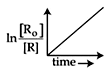 is valid for the above reaction versus time.
Choose the correct answer from the options given below:
