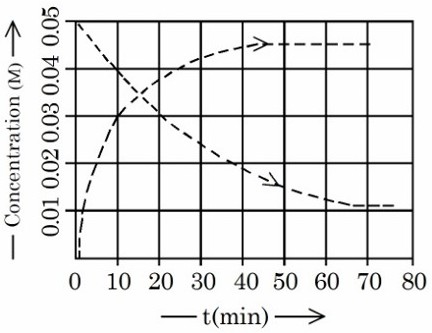
Consider \( \mathrm{A} \xrightarrow{k_1} \mathrm{B} \) and \( \mathrm{C} \xrightarrow{k_2} \mathrm{D} \) are two reactions. If the rate constant \( (k_1) \) of the \( \mathrm{A} \rightarrow \mathrm{B} \) reaction can be expressed by the following equation \( \log_{10} k = 14.34 - \frac{1.5 \times 10^{4}}{T/\mathrm{K}} \) and activation energy of \( \mathrm{C} \rightarrow \mathrm{D} \) reaction \( (E_{a_{2}}) \) is \( \tfrac{1}{5} \)th of the \( \mathrm{A} \rightarrow \mathrm{B} \) reaction \( (E_{a_{1}}) \), then the value of \( (E_{a_{2}}) \) is ________ \( \mathrm{kJ \, mol^{-1}} \). (Nearest Integer)