A radioactive element has a half life of \( 200 \) days. The percentage of original activity remaining after \( 83 \) days is __________. (Nearest integer) (Given : antilog \( 0.125 = 1.333 \), antilog \( 0.693 = 4.93 \) )
For kinetic study of the reaction of iodide ion with \( \mathrm{H_2O_2} \) at room temperature:(a) Always use freshly prepared starch solution(b) Always keep the concentration of sodium thiosulphate solution less than that of \( \mathrm{KI} \) solution(c) Record the time immediately after the appearance of blue colour.(d) Record the time immediately before the appearance of blue colour(e) Always keep the concentration of sodium thiosulphate solution more than that of \( \mathrm{KI} \) solution.Choose the correct answer from the options given below:
Assuming \( 1 \, \mu \text{g} \) of trace radioactive element X with a half life of \( 30 \, \text{years} \) is absorbed by a growing tree. The amount of X remaining in the tree after \( 100 \, \text{years} \) is __________ \( \times 10^{-1} \, \mu \text{g} \).[Given \( \ln 10 = 2.303 \) ; \( \log 2 = 0.30 \)]
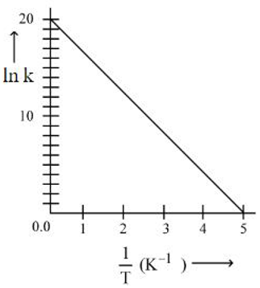
For a reaction, given below is the graph of \( \ln k \) vs \( \dfrac{1}{T} \). The activation energy for the reaction is equal to ________ \( \text{cal mol}^{-1} \). (nearest integer)(Given: \( R = 2 \, \text{cal K}^{-1} \text{ mol}^{-1} \))
For the given first order reaction\( \mathrm{A \to B} \)the half life of the reaction is \( 0.3010\,\text{min} \). The ratio of the initial concentration of reactant to the concentration of reactant at time \( 2.0\,\text{min} \) will be equal to ________. (Nearest integer)
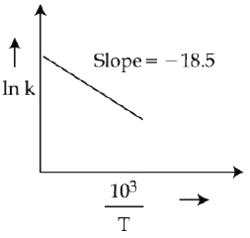
The rate constants for decomposition of acetaldehyde have been measured over the temperature range \( 700 \) — \( 1000 \) \( \mathrm{K} \). The data has been analysed by plotting \( \ln k \) vs \( \frac{10^3}{T} \) graph. The value of activation energy for the reaction is __________ \( \mathrm{kJ\ mol^{-1}} \). (Nearest integer) (Given: \( R = 8.31\ \mathrm{J\ K^{-1}\ mol^{-1}} \))
For a first reaction \( A \rightarrow B \) , the rate constant, \( k = 5.5 \times 10^{-14} \, \text{s}^{-1} \). The time required for \( 67\% \) completion of reaction is \( x \times 10^{-1} \) times the half life of reaction. The value of \( x \) is ______ (nearest integer) (Given : \( \log 3 = 0.4771 \) )
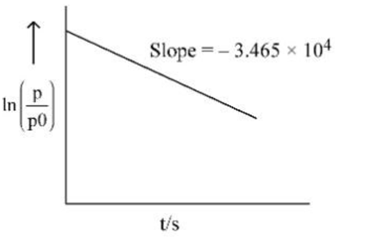
For the decomposition of azomethane, \( \mathrm{CH_3N_2CH_3(g) \rightarrow CH_3CH_3(g) + N_2(g)} \), a first order reaction, the variation in partial pressure with time at \( 600 \, \text{K} \) is given as: The half life of the reaction is ________ \( \times 10^{-5} \, \text{s} \). [Nearest intager]
The equation \( k = (6.5 \times 10^{12}\, \text{s}^{-1}) e^{-26000\, \text{K}/T} \) is followed for the decomposition of compound A.The activation energy for the reaction is ______ \( \text{kJ} \, \text{mol}^{-1} \). [Nearest integer](Given: \( R = 8.314 \, \text{J} \, \text{K}^{-1} \, \text{mol}^{-1} \) )
At \( 30^\circ \text{C} \), the half life for the decomposition of \( \mathrm{AB_2} \) is \( 200 \, \text{s} \) and is independent of the initial concentration of \( \mathrm{AB_2} \). The time required for \( 80\% \) of the \( \mathrm{AB_2} \) to decompose is: (Given: \( \log 2 = 0.30 \), \( \log 3 = 0.48 \))
For a given chemical reaction\( \gamma_{1} A + \gamma_{2} B \rightarrow \gamma_{3} C + \gamma_{4} D \)Concentration of \( C \) changes from \( 10 \, \text{mmol dm}^{-3} \) to \( 20 \, \text{mmol dm}^{-3} \) in \( 10 \, \text{s} \). Rate of appearance of \( D \) is \( 1.5 \) times the rate of disappearance of \( B \) which is twice the rate of disappearance of \( A \). The rate of appearance of \( D \) has been experimentally determined to be \( 9 \, \text{mmol dm}^{-3}\text{s}^{-1} \). Therefore the rate of reaction is __________ \( \text{mmol dm}^{-3}\text{s}^{-1} \). (Nearest Integer)
\( [A] \quad\rightarrow [B] \) Reactant Product If formation of compound \( [B] \) follows the first order of kinetics and after \( 70 \) minutes the concentration of \( [A] \) was found to be half of its initial concentration. Then the rate constant of the reaction is \( x \times 10^{-6} \ \text{s}^{-1} \). The value of \( x \) is _______. (Nearest Integer).
For a first order reaction, the time required for completion of \( 90 \% \) reaction is ‘\( x \)’ times the half life of the reaction. The value of \(' x' \) is : (Given : \( \ln 10 = 2.303 \) and \( \log 2 = 0.3010 \))
For a reaction \( \mathrm{A} \rightarrow 2\mathrm{B} + \mathrm{C} \) the half lives are \( 100 \, \text{s} \) and \( 50 \, \text{s} \) when the concentration of reactant \( \mathrm{A} \) is \( 0.5 \) and \( 1.0 \, \text{mol} \, \text{L}^{-1} \) respectively. The order of the reaction is ______________. (Nearest Integer)
A flask is filled with equal moles of \( A \) and \( B \). The half lives of \( A \) and \( B \) are \( 100 \, \text{s} \) and \( 50 \, \text{s} \) respectively and are independent of the initial concentration. The time required for the concentration of \( A \) to be four times that of \( B \) is ____________ \( \text{s} \). (Given: \( \ln 2 = 0.693 \))
The activation energy of one of the reactions in a biochemical process is \( 532611 \, \mathrm{J \, mol^{-1}} \). When the temperature falls from \( 310 \, \mathrm{K} \) to \( 300 \, \mathrm{K} \), the change in rate constant observed is \( k_{300} = x \times 10^{-3} k_{310} \). The value of \( x \) is ____________[Given: \( \ln 10 = 2.3 \) \( R = 8.3 \, \mathrm{J \, K^{-1} \, mol^{-1}} \) ]
It has been found that for a chemical reaction with rise in temperature by \( 9 \, \mathrm{K} \) the rate constant gets doubled. Assuming a reaction to be occurring at \( 300 \, \mathrm{K} \), the value of activation energy is found to be _______ \( \mathrm{kJ\,mol^{-1}} \). [nearest integer] (Given \( \ln 10 = 2.3 \), \( R = 8.3 \, \mathrm{J\,K^{-1}\,mol^{-1}} \) and \( \log 2 = 0.30 \) )