The statement \( \sim[p \lor (\sim(p \land q))] \) is equivalent to:
\( (p \land q) \land (\sim p) \)
\( \sim (p \lor q) \)
\( \sim (p \land q) \)
\( (\sim (p \land q)) \land q \)
Statement \( (P \Rightarrow Q) \land (R \Rightarrow Q) \) is logically equivalent to:
Let $p$ and $q$ be two statements. The $\sim(P \wedge (p \implies \sim q))$ is equivalent to:
If \( p, q \) and \( r \) are three propositions, then which of the following combination of truth values of \( p, q \) and \( r \) makes the logical expression \( \{(p \vee q) \wedge ((\sim p) \vee r)\} \rightarrow ((\sim q) \vee r) \) false?
A building construction work can be completed by two masons \( A \) and \( B \) together in \( 22.5 \, \text{days} \). Mason \( A \) alone can complete the construction work in \( 24 \, \text{days} \) less than mason \( B \) alone. Then mason \( A \) alone will complete the construction work in:
\( \text{The Boolean expression } \big(\sim (p \land q)\ \lor\ q\big) \text{ is equivalent to:} \)
If the truth value pf the statement \( (P \land (\sim R)) \rightarrow ((\sim R) \land Q) \) is \( F \), then the truth value of which of the following is \( F \)?
The negation of the statement \( \sim p \land (p \lor q) \) is:
Consider the following statements :\( P:\) I have fever \( \\ \\ Q:\) I will not take medicine \( \\ \\ R:\) I will take restThe statement “If I have fever, then I will take medicine and I will take rest” is equivalent to :
If the Boolean expression \( (p \Rightarrow q) \Leftrightarrow \big(q^* (\sim p)\big) \) is a tautology, then the Boolean expression \( p^* (\sim q) \) is equivalent to:
For the statements \( p \) and \( q \), consider the following compound statements: (a) \( (\sim q \land (p \to q)) \to \sim p \) (b) \( ((p \lor q) \land \sim p) \to q \) Then which of the following statements is correct?
The statement \( (p \land q) \Rightarrow (p \land r) \) is equivalent to:
Which of the following is the negation of the statement “for all \( M>0 \), there exists \( x\in S \) such that \( x\ge M \)”?
The statement \( \big(p \land (\sim q)\big) \lor \big((\sim p)\land q\big) \lor \big((\sim p)\land (\sim q)\big) \) is equivalent to ________.
The statement \( (p \land (\sim q)) \Rightarrow (p \Rightarrow (\sim q)) \) is:
Which of the following statement is a tautology?
Consider the statement "The match will he played only if the weather is good and ground is not wet". Select the correct negation from the following:
The maximum number of compound propositions, out $p \vee r \vee s, p \vee r \vee \sim s, p \vee \sim q \vee s, \sim p \vee \sim r \vee s, \sim p \vee \sim r \vee \sim s, \sim p \vee q \vee \sim s, q \vee r \vee \sim s, q \vee \sim r \vee \sim s, \sim p \vee \sim q \vee \sim s$ that can be made simultaneously true by an assignment of the truth values to $p, q, r$ and $s$, equal to _________________.
The negation of the statement \( (p \vee q)\wedge(q \vee (\sim r)) \) is:
The compound statement \( (\sim(P \land Q)) \lor ((\sim P) \land Q) \Rightarrow ((\sim P) \land (\sim Q)) \) is equivalent to:
Consider the two statements:\( \text{(S1)}: (p \to q) \vee (\sim q \to p) \) is a tautology.\( \text{(S2)}: (p \wedge \sim q) \wedge (\sim p \vee q) \) is a fallacy.Then:
Let \( \Delta \in \{\land, \lor, \Rightarrow, \Leftrightarrow\} \) be such that \( (p \land q)\ \Delta\ \big((p \lor q) \Rightarrow q\big) \) is a tautology. Then \( \Delta \) is equal to:
The number of values of $r \in \{p, q, \sim p, \sim q\}$ for which $((p \wedge q) \Rightarrow (r \vee q)) \wedge ((p \wedge r) \Rightarrow q)$ is a tautology, is:
If \( P \) and \( Q \) are two statements, then which of the following compound statement is a tautology?
The statement \( B \Rightarrow ((\sim A) \lor B) \) is equivalent to:
If the truth value of the Boolean expression $((p \vee q) \wedge (q \rightarrow r) \wedge (\sim r)) \rightarrow (p \wedge q)$ is false, then the truth values of the statements $p, q, r$ respectively can be:
Consider the following three statements:(A) If \( 3+3=7 \) then \( 4+3=8 \).(B) If \( 5+3=8 \) then earth is flat.(C) If both (A) and (B) are true then \( 5+6=17 \).Then, which of the following statements is correct?
Negation of the Boolean expression \( p \Leftrightarrow (q \Rightarrow p) \) is:
The Boolean expression \( (p \land q) \Rightarrow \big((r \land q) \land p\big) \) is equivalent to:
Let the operation \(\ast, \odot \in \{\land, \lor\}\). If \( (p * q)\\odot\ (p \odot \sim q) \) is a tautology, then the ordered pair \( (*,\ \odot) \) is:
Let \( p \): Ramesh listens to music \( q \): Ramesh is out of his village \( r \): It is Sunday \( s \): It is Saturday Then the statement “Ramesh listens to music only if he is in his village and it is Sunday or Saturday” can be expressed as:
Among the two statements \( (S1): (p \Rightarrow q) \land \left(p \land (\sim q)\right) \) is a contradiction and \( (S2): (p \land q) \lor \left((\sim p) \land q\right) \lor \left(p \land (\sim q)\right) \lor \left((\sim p) \land (\sim q)\right) \) is a tautology.
\( (p \lor r) \Leftrightarrow \big(p \land (\sim q)\big) \) is equivalent to \( (\sim p) \) when \( r \) is:
The negation of the statement \( ((A \wedge (B \vee C)) \Rightarrow (A \vee B)) \Rightarrow A \) is:
For the system of linear equations\( 2x - y + 3z = 5 \) \( 3x + 2y - z = 7 \) \( 4x + 5y + \alpha z = \beta \),Which of the following is NOT correct?
Negation of \( p \wedge (q \wedge \sim(p \wedge q)) \) is:
Consider the following statements:\( A \) : Rishi is a judge.\( B \) : Rishi is honest.\( C \) : Rishi is not arrogant.The negation of the statement “if Rishi is a judge and he is not arrogant, then he is honest” is:
The negation of the Boolean expression \( \big((\sim q)\land p\big)\Rightarrow \big((\sim p)\lor q\big) \) is logically equivalent to:
Negation of the Boolean statement \( (p \vee q) \Rightarrow ((\sim r) \vee p) \) is equivalent to:
The Boolean expression \( (p \land \sim q) \Rightarrow (q \lor \sim p) \) is equivalent to:
Among the statements:(\( S1 \)): \( (p \Rightarrow q) \vee ((\sim p) \wedge q) \) is a tautology.(\( S2 \)): \( (q \Rightarrow p) \Rightarrow ((\sim p) \wedge q) \) is a contradiction.
Which of the following Boolean expressions is not a tautology?
Let \( \Delta, \nabla \in \{\wedge, \vee\} \) be such that \( p \nabla q \Rightarrow ((p \Delta q)\nabla r) \) is a tautology. Then \( (p \nabla q)\Delta r \) is logically equivalent to:
Negation of \( (p \Rightarrow q) \Rightarrow (q \Rightarrow p) \) is:
The converse of \( ((\sim p)\wedge q) \Rightarrow r \) is:
Which of the following is equivalent to the Boolean expression \( p \land \sim q \)?
Which of the following statements is a tautology?
The number of choices for $\Delta \in \{\wedge, \vee, \Rightarrow, \Leftrightarrow\}$, such that $(p \Delta q) \Rightarrow ((p \Delta \sim q) \vee ((\sim p) \Delta q))$ is a tautology, is:
The mean and variance of the data \( 4, 5, 6, 6, 7, 8, x, y \), where \( x < y \), are \( 6 \) and \( \frac{9}{4} \) respectively. Then \( x^4 + y^2 \) is equal to
Among the statements:\( (S1) \; ((p \lor q) \Rightarrow r) \Leftrightarrow (p \Rightarrow r) \)\( (S2) \; ((p \lor q) \Rightarrow r) \Leftrightarrow ((p \Rightarrow r) \lor (q \Rightarrow r)) \)
Negation of the statement \( (p \lor r) \Rightarrow (q \lor r) \) is:
Let $r \in \{p, q, \sim p, \sim q\}$ be such that the logical statement $r \vee (\sim p) \Rightarrow (p \wedge q) \vee r$ is a tautology. Then $r$ is equal to:
Let \( \Delta,\nabla \in \{\land,\lor\} \) be such that \( (p \to q)\,\Delta\,(p \nabla q) \) is a tautology. Then
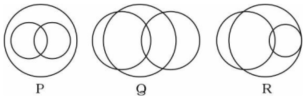
In a school, there are three types of games to be played. Some of the students play two types of games, but none play all the three games. Which Venn diagrams can justify the above statement?
The statement \( \big(\sim(p \Leftrightarrow\sim q)\big)\land q \) is:
The negation of \( \big(p\land(\sim q)\big)\lor(\sim p) \) is equivalent to:
The negation of the expression \( q \vee \big((\sim q) \wedge p\big) \) is equivalent to:
Let \( p,q,r \) be three logical statements. Consider the compound statements $S_1 : ((\sim p) \vee q) \vee ((\sim p) \vee r)$ and $S_2 : p \rightarrow (q \vee r)$Then, which of the following is NOT true?