If \( \sin \theta + \cos \theta = \frac{1}{2} \), then \( 16(\sin (2\theta) + \cos (4\theta) + \sin (6\theta)) \) is equal to:
\( -23 \)
\( 23 \)
\( -27 \)
\( 27 \)
\(\displaystyle \sin x + \sin^2 x = 1,\, x \in \left(0, \frac{\pi}{2}\right) \), then \( (\cos^{12} x + \tan^{12} x) + 3(\cos^{10} x + \tan^{10} x + \cos^{8} x + \tan^{8} x) + (\cos^{6} x + \tan^{6} x) \) is equal to:
\( 16\sin(20^\circ)\sin(40^\circ)\sin(80^\circ) \) is equal to:
Let a vertical tower \( AB \) of height \( 2h \) stands on a horizontal ground. Let from a point \( P \) on the ground a man can see upto height \( h \) of the tower with an angle of elevation \( 2\alpha \). When from \( P \), he moves a distance \( d \) in the direction of \( \overrightarrow{AP} \), he can see the top \( B \) of the tower with an angle of elevation \( \alpha \). If \( d = \sqrt{7}\,h \), then \( \tan \alpha \) is equal to:
If \( \cot x = \dfrac{5}{12} \) for some \( x \in \left({\pi}, \dfrac{3\pi}{2}\right) \), then \( \sin 7x \left( \cos \dfrac{13x}{2} + \sin \dfrac{13x}{2} \right) + \cos 7x \left( \cos \dfrac{13x}{2} - \sin \dfrac{13x}{2} \right) \) is equal to:
Let \( \dfrac{\pi}{2} < \theta < \pi \) and \( \cot\theta = -\dfrac{1}{2\sqrt{2}} \). Then the value of \( \sin\!\left(\dfrac{15\theta}{2}\right)(\cos 8 \theta+\sin{8} \theta)+\cos\!\left(\dfrac{15\theta}{2}\right)(\cos 8 \theta-\sin 8 \theta) \) is equal to:
The value of \( \cot \dfrac{\pi}{24} \) is:
If \( \displaystyle \sum_{r=1}^{13} \left\{ \frac{1}{\displaystyle \sin\!\left( \frac{\pi}{4} + (r-1)\frac{\pi}{6} \right)\,\sin\!\left( \frac{\pi}{4} + \frac{r\pi}{6} \right)} \right\} = a\sqrt{3} + b,\; a,b\in\mathbb{Z} \), then \( a^{2}+b^{2} \) is equal to:
For \( \alpha,\beta \in \left(0, \dfrac{\pi}{2}\right) \), let \( 3\sin(\alpha+\beta)=2\sin(\alpha-\beta) \) and a real number \( k \) be such that \( \tan \alpha = k \tan \beta \). Then, the value of \( k \) is equal to:
If the value of \(\displaystyle \frac{3\cos 36^\circ + 5\sin 18^\circ}{5\cos 36^\circ - 3\sin 18^\circ} \) is \(\displaystyle \frac{a\sqrt{5} - b}{c} \), where \( a \), \( b \), \( c \) are natural numbers and \( \gcd(a,c)=1 \), then \( a+b+c \) is equal to :
Let \( \alpha \) and \( \beta \) respectively be the maximum and the minimum values of the function \( f(\theta) = 4\left[\sin^{4}\!\left(\frac{7\pi}{2}-\theta\right) + \sin^{4}(11\pi+\theta)\right] - 2\left[\sin^{6}\!\left(\frac{3\pi}{2}-\theta\right) + \sin^{6}(9\pi-\theta)\right],\ \theta \in \mathbb{R}. \) Then \( \alpha + 2\beta \) is equal to:
Let \( S=\{\theta \in (-2\pi,2\pi): \cos\theta+1=\sqrt{3}\sin\theta\} \). Then \( \sum_{\theta\in S}\theta \) is equal to:
If \( 2 \sin^{3} x + \sin 2x \cos x + 4 \sin x - 4 = 0 \) has exactly \( 3 \) solutions in the interval \( \left[ 0, \dfrac{n\pi}{2} \right], \; n \in \mathbb{N} \), then the roots of the equation \( x^{2} + nx + (n - 3) = 0 \) belong to:
Suppose \( \theta\in\left[0,\dfrac{\pi}{4}\right] \) is a solution of \( 4\cos\theta-3\sin\theta=1 \). Then \( \cos\theta \) is equal to:
If \( y(\theta) = \frac{2 \cos \theta + \cos 2\theta}{\cos 3\theta + 4 \cos 2\theta + 5 \cos \theta + 2} \), then at \( \theta = \frac{\pi}{2} \), \( y'' + y' + y \) is equal to:
If \( \sin x = -\frac{3}{5} \), where \( \pi < x < \frac{3\pi}{2} \), then \( 80(\tan^{2} x - \cos x) \) is equal to:
The set of all values of \( \lambda \) for which the equation \( \cos^{2}2x-2\sin^{4}x-2\cos^{2}x=\lambda \) has a real solutions \( x \), is:
If \( \theta \in [-2\pi, 2\pi] \), then the number of solutions of \( 2\sqrt{2}\cos^{2}\theta + (2-\sqrt{6})\cos\theta - \sqrt{3} = 0 \), is equal to:
The sum of the solutions \( x \in \mathbb{R} \) of the equation \( \dfrac{3\cos 2x + \cos^{3} 2x}{\cos^{6} x - \sin^{6} x} = x^{3} - x^{2} + 6 \) is:
The value of \( \dfrac{\sqrt{3}\,cosec 20^\circ - \sec 20^\circ}{\cos 20^\circ \cos 40^\circ \cos 60^\circ \cos 80^\circ} \) is equal to:
For $0 < c < b < a$, let $(a+b-2c)x^2 + (b+c-2a)x + (c+a-2b) = 0$ and $\alpha \neq 1$ be one of its root. Then, among the two statements:
(I)$\quad$ If $\alpha \in (-1, 0)$, then $b$ cannot be the geometric mean of $a$ and $c$
(II)$\quad$ If $\alpha \in (0, 1)$, then $b$ may be the geometric mean of $a$ and $c$
The sum of solutions of the equation \( \dfrac{\cos x}{1+\sin x} = |\tan 2x| \), \( x \in \left( -\dfrac{\pi}{2}, \dfrac{\pi}{2} \right) - \left\{ \dfrac{\pi}{4}, -\dfrac{\pi}{4} \right\} \) is:
If \(\tan 15^\circ + \dfrac{1}{\tan 75^\circ} + \dfrac{1}{\tan 105^\circ} + \tan 195^\circ = 2a\), Then the value of \(\left(a + \dfrac{1}{a}\right)\) is:
If $10 \sin^4 \theta + 15 \cos^4 \theta = 6$, then the value of $\frac{27 cosec^6 \theta + 8 \sec^6 \theta}{16 \sec^8 \theta}$ is:
Let in a right angled triangle, the smallest angle be \( \theta \). If a triangle formed by taking the reciprocal of its sides is also a right angled triangle, then \( \sin \theta \) is equal to:
Let \( S = \left\{ \theta \in [-\pi, \pi] - \left\{ \pm \frac{\pi}{2} \right\} : \sin \theta \tan \theta + \tan \theta = \sin 2\theta \right\} \). If \( T = \ \displaystyle \sum_{\theta \in S} \cos 2\theta \), then \( T + n(S) \) is equal to:
Let the distance between two parallel lines be \( 5 \) units and a point \( P \) lie between the lines at a unit distance from one of them. An equilateral triangle \( PQR \) is formed such that \( Q \) lies on one of the parallel lines, while \( R \) lies on the other. Then \( (QR)^{2} \) is equal to ____________.
A pole stands vertically inside a triangular park ABC. Let the angle of elevation of the top of the pole from each corner of the park be \( \dfrac{\pi}{3} \). If the radius of the circumcircle of \( \triangle ABC \) is \( 2 \), then the height of the pole is equal to:
\( \text{The value of } \cos\left(\frac{2\pi}{7}\right) + \cos\left(\frac{4\pi}{7}\right) + \cos\left(\frac{6\pi}{7}\right) \text{ is equal to:} \)
If \( 15\sin^4\alpha + 10\cos^4\alpha = 6 \), for some \( \alpha \in \mathbb{R} \), then the value of \( 27\sec^6\alpha + 8\,\text{cosec}^6\alpha \) is equal to:
$\text{If } \tan A = \frac{1}{\sqrt{x(x^2 + x + 1)}}, \; \tan B = \frac{\sqrt{x}}{\sqrt{x^2 + x + 1}} \quad \text{and} \quad \tan C = (x^{-3} + x^{-2} + x^{-1})^{1/2}, \; 0 < A, B, C < \frac{\pi}{2}, \text{ then}$ $A + B \text{ is equal to:}$
The sum of all values of \( \theta \in [0, 2\pi] \) satisfying \( 2\sin^2\theta = \cos 2\theta \) and \( 2\cos^2\theta = 3\sin\theta \) is:
From the base of a pole of height \( 20 \, \text{meter} \), the angle of elevation of the top of a tower is \( 60^\circ \). The pole subtends an angle \( 30^\circ \) at the top of the tower. Then the height of the tower is:
Let \( S = \left\{ \theta \in \left(0, \dfrac{\pi}{2}\right) : \displaystyle\sum_{m=1}^{9} \sec\left(\theta + (m-1)\frac{\pi}{6}\right)\sec\left(\theta + \frac{m\pi}{6}\right) = -\frac{8}{\sqrt{3}} \right\} \). Then
\( \displaystyle 2 \sin\!\left(\frac{\pi}{22}\right)\sin\!\left(\frac{3\pi}{22}\right)\sin\!\left(\frac{5\pi}{22}\right)\sin\!\left(\frac{7\pi}{22}\right)\sin\!\left(\frac{9\pi}{22}\right) \) is equal to:
The number of solutions of the equation \( (4-\sqrt{3})\sin x-2\sqrt{3}\cos^{2}x=-\dfrac{4}{1+\sqrt{3}},\; x\in\left[ -2\pi,\;\dfrac{5\pi}{2}\right] \) is:
Let \( f(\theta) = 3\Big(\sin^4\!\left(\dfrac{3\pi}{2}-\theta\right) + \sin^4(3\pi+\theta)\Big) - 2(1-\sin^2 2\theta) \) and \( S = \left\{ \theta \in [0,\pi] : f'(\theta) = -\dfrac{\sqrt{3}}{2} \right\} \). If \( 4\beta = \ \displaystyle \sum_{\theta \in S} \theta \), then \( f(\beta) \) is equal to:
is equal to:
Let \( \tan A, \tan B \), where \( A, B \in \left( -\frac{\pi}{2}, \frac{\pi}{2} \right) \), be the roots of the quadratic equation \( x^2 - 2x - 5 = 0 \). Then \( 20\sin^2\!\left( \frac{A + B}{2} \right) \) is equal to:
The angle of elevation of the top of a tower from a point \( A \) due north of it is \( \alpha \) and from a point \( B \) at a distance of \( 9 \) units due west of \( A \) is \( \cos^{-1}\!\left(\dfrac{3}{\sqrt{13}}\right) \). If the distance of the point \( B \) from the tower is \( 15 \) units, then \( \cot \alpha \) is equal to:
If \( n \) is the number of solutions of the equation \( 2 \cos x \left( 4 \sin\!\left(\frac{\pi}{4} + x\right) \sin\!\left(\frac{\pi}{4} - x\right) - 1 \right) = 1 \), \( x \in [0, \pi] \) and \( S \) is the sum of all these solutions, then the ordered pair \( (n, S) \) is:
If \( m \) and \( n \) respectively are the numbers of positive and negative values of \( \theta \) in the interval \( [-\pi,\pi] \) that satisfy the equation \( \cos 2\theta \cos \frac{\theta}{2} = \cos 30 \cos \frac{90}{2} \), then \( mn \) is equal to ____.
Let \( \vec{a}_{k}=(\tan\theta_{k})\,\hat{i}+\hat{j} \) and \( \vec{b}_{k}=\hat{i}-(\cot\theta_{k})\,\hat{j} \), where \(\theta_k = \frac{2^{k-1}\pi}{2^{n} + 1}\), for some \( n\in \mathbb{N},\, n>5 \). Then the value of \( \dfrac{\sum_{k=1}^{n}|\vec{a}_{k}|^{2}}{\sum_{k=1}^{n}|\vec{b}_{k}|^{2}} \) is ________.
The number of solutions of the equation \( \sin x = \cos^{2} x \) in the interval \( (0,10) \) is ______.
Let \( P=\{\theta\in[0,4\pi]:\tan^2\theta=1\} \) and \( S=\{a\in\mathbb{Z}: 2(\cos^8\theta-\sin^8\theta)\sec 2\theta=a^2,\; \theta\in P\} \). Then \( n(S) \) is:
The number of solutions of \( \sin^{2}x + (2 + 2x - x^{2})\sin x - 3(x-1)^{2} = 0 \), where \( -\pi \le x \le \pi \), is \( \_\_\_\_\_\_\_ \).
Number of solutions of \( \sqrt{3}\cos 2\theta + 8\cos \theta + 3\sqrt{3} = 0, \ \theta \in [-3\pi, 2\pi] \) is:
Let \( |\cos \theta\cos(60-\theta)\cos(60+\theta)\le \frac{1}{8},\ \theta\in[0,2\pi] \). Then, the sum of all \( \theta\in[0,2\pi] \), where \( \cos 3\theta \) attains its maximum value, is:
If \( \alpha \), \( -\frac{\pi}{2} < \alpha < \frac{\pi}{2} \) is the solution of \( 4\cos\theta + 5\sin\theta = 1 \), then the value of \( \tan \alpha \) is:
If the solution of the equation \(\log_{\cos x}\cot x + 4\log_{\sin x}\tan x = 1,\; x \in \left(0,\dfrac{\pi}{2}\right),\) is \(\sin^{-1}\!\left(\dfrac{\alpha + \sqrt{\beta}}{2}\right),\) where \(\alpha, \beta\) are integers, then \(\alpha + \beta\) is equal to:
The value of \( \ cosec 10^\circ - \sqrt{3}\sec 10^\circ \) is equal to:
The number of solutions of \( |\cos x|=\sin x \), such that \( -4\pi \le x \le 4\pi \) is:
Let \(\displaystyle S=\left[-\pi,\dfrac{\pi}{2}\right)-\left\{-\frac{\pi}{2},-\frac{\pi}{4},\frac{3\pi}{4},\frac{\pi}{4}\right\} \). Then the number of elements in the set \( A=\left\{\theta\in S:\tan\theta\left(1+\sqrt{5}\tan(2\theta)\right)=\sqrt{5}-\tan(2\theta)\right\} \) is _______________.
A vertical pole fixed to the horizontal ground is divided in the ratio \( 3:7 \) by a mark on it with lower part shorter than the upper part. If the two parts subtend equal angles at a point on the ground \( 18 \, \text{m} \) away from the base of the pole, then the height of the pole (in meters) is:
If for \( \theta \in \left[ -\dfrac{\pi}{3}, 0 \right] \), the points \( (x, y) = \left( 3 \tan \left( \theta + \dfrac{\pi}{3} \right), \, 2 \tan \left( \theta + \dfrac{\pi}{6} \right) \right) \) lie on \( xy + \alpha x + \beta y + \gamma = 0 \), then \( \alpha^2 + \beta^2 + \gamma^2 \) is equal to:
If \( \dfrac{\tan(A-B)}{\tan A} + \dfrac{\sin^{2} C}{\sin^{2} A} = 1, \ A,B,C \in \left(0, \dfrac{\pi}{2}\right), \) then:
Let \( S = \{\theta \in [0, 2\pi): \tan(\pi \cos \theta) + \tan(\pi \sin \theta) = 0\} \). Then \( \displaystyle \sum_{\theta \in S} \sin^{2}\!\left(\theta + \frac{\pi}{4}\right) \) is equal to __________.
Two poles, \( AB \) of length \( a \) meters and \( CD \) of length \( a+b \) (\( b\neq a \)) meters are erected at the same horizontal level with bases at \( B \) and \( D \). If \( BD=x \) and \( \tan \angle ACB=\frac{1}{2} \), then:
A horizontal park is in the shape of a triangle \( OAB \) with \( AB = 16 \). A vertical lamps post \( OP \) is erected at the point \( O \) such that \( \angle PAO = \angle PBO = 15^\circ \) and \( \angle PCO = 45^\circ \), where \( C \) is the midpoint of \( AB \). Then \( (OP)^2 \) is equal to:
The value of \( 2 \sin\!\left(\frac{\pi}{8}\right)\sin\!\left(\frac{2\pi}{8}\right)\sin\!\left(\frac{3\pi}{8}\right)\sin\!\left(\frac{5\pi}{8}\right)\sin\!\left(\frac{6\pi}{8}\right)\sin\!\left(\frac{7\pi}{8}\right) \) is:
The sum of all the integral values of \( p \) such that the equation \( 3\sin^{2}x + 12\cos x - 3 = p,\, x \in \mathbb{R} \), has at least one solution, is:
The number of solutions of \(\displaystyle \sin^7 x + \cos^7 x = 1, \, x \in [0, 4\pi]\) is equal to:
The number of solutions of the equation \( \cos\!\left(x+\frac{\pi}{3}\right)\cos\!\left(\frac{\pi}{3}-x\right)=\frac{1}{4}\cos^{2} 2x \), \( x \in [-3\pi,\,3\pi] \) is:
In a triangle \( ABC \), if \( \cos A + 2 \cos B + \cos C = 2 \) and the lengths of the sides opposite to the angles \( A \) and \( C \) are \( 3 \) and \( 7 \) respectively, then \( \cos A - \cos C \) is equal to:
\( 96\cos\dfrac{\pi}{33}\cos\dfrac{2\pi}{33}\cos\dfrac{4\pi}{33}\cos\dfrac{8\pi}{33}\cos\dfrac{16\pi}{33} \) is equal to:
The number of solutions of the equation \( \cos 2\theta \cos \dfrac{\theta}{2}+\cos \dfrac{5\theta}{2}=2\cos^{3}\dfrac{5\theta}{2} \) in \( \left[ -\dfrac{\pi}{2},\dfrac{\pi}{2} \right] \) is:
Let \( AB \) and \( PQ \) be two vertical poles, \( 160 \, \text{m} \) apart from each other. Let \( C \) be the middle point of \( B \) and \( Q \), which are feet of these two poles. Let \( \frac{\pi}{8} \) and \( \theta \) be the angles of elevation from \( C \) to \( P \) and \( A \), respectively. If the height of pole \( PQ \) is twice the height of pole \( AB \), then \( \tan^{2}\theta \) is equal to:
If \( A=\dfrac{\sin 3^{\circ}}{\cos 9^{\circ}}+\dfrac{\sin 9^{\circ}}{\cos 27^{\circ}}+\dfrac{\sin 27^{\circ}}{\cos 81^{\circ}} \) and \( B=\tan 81^{\circ}-\tan 3^{\circ} \), then \( \dfrac{B}{A} \) is equal to ________.
The sum of all values of \( x \) in \( [0,2\pi] \) for which \( \sin x+\sin 2x+\sin 3x+\sin 4x=0 \) is equal to:
Let the range of function \( f(x) = 6 + 16 \cos x \cdot \cos\!\left(\frac{\pi}{3} - x\right) \cdot \cos\!\left(\frac{\pi}{3} + x\right) \cdot \sin 3x \cdot \cos 6x, \; x \in R \) be \( [\alpha,\beta] \). Then the distance of the point \( (\alpha,\beta) \) from the line \( 3x + 4y + 12 = 0 \) is:
Let \( S=\left\{ \theta \in [0,2\pi] : 8^{2\sin^2\theta}+8^{2\cos^2\theta}=16 \right\}. \) Then \( n(S)+\displaystyle\sum_{\theta \in S}\big(\sec \left(\frac{\pi}{4}+2\theta\right)\csc \left(\frac{\pi}{4}+2\theta\right)\big) \) is equal to:
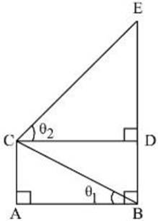
In the figure,\( \theta_{1} + \theta_{2} = \dfrac{\pi}{2} \) and \( \sqrt{3}(BE) = 4(AB) \). If the area of \( \triangle CAB \) is \( 2\sqrt{3} - 3 \) unit\( ^{2} \), when \( \theta_{2}/\theta_{1} \) is the largest, then the perimeter (in unit) of \( \triangle CED \) is equal to ______.
The number of solutions of the equation \( x + 2 \tan x = \dfrac{\pi}{2} \) in the internal \( [0, 2\pi] \) is :
Let a rectangle \(ABCD\) of sides \(2\) and \(4\) be inscribed in another rectangle \(PQRS\) such that the vertices of the rectangle \(ABCD\) lie on the sides of the rectangle \(PQRS\). Let \(a\) and \(b\) be the sides of the rectangle \(PQRS\) when its area is maximum. Then \( (a+b)^2 \) is equal to:
The number of values of \( x \) in the interval \( \left(\frac{\pi}{4}, \frac{7\pi}{4}\right) \) for which \( 14cosec^{2}x-2\sin^{2}x=21-4\cos^{2}x \) holds, is ________.
If \( \sin^2(10^\circ)\sin(20^\circ)\sin(40^\circ)\sin(50^\circ)\sin(70^\circ) = \alpha - \frac{1}{16}\sin(10^\circ) \), then \( 16 + \alpha^{-1} \) is equal to ____________ .
The value of \( 36(4\cos^{2}9^{\circ}-1)(4\cos^{2}27^{\circ}-1)(4\cos^{2}81^{\circ}-1)(4\cos^{2}243^{\circ}-1) \) is:
Let \( S=\{x\in[-\pi,\pi]:\sin x(\sin x+\cos x)=a,\; a\in \mathbb{Z}\} \). Then \( n(S) \) is equal to:
The number of solutions of the equation \( |\cot x| = \cot x + \frac{1}{\sin x} \) in the interval \( [0, 2\pi] \) is ______________ .
The value of \( 2\sin(12^{\circ})-\sin(72^{\circ}) \) is:
If \( \cot \alpha = 1 \) and \( \sec \beta = -\tfrac{5}{3} \), where \( \pi < \alpha < \tfrac{3\pi}{2} \) and \( \tfrac{\pi}{2} < \beta < \pi \), then the value of \( \tan(\alpha + \beta) \) and the quadrant in which \( \alpha + \beta \) lies, respectively are:
If \( S=\left\{\theta\in[-\pi,\pi]:\cos\theta\cos\dfrac{50}{2}=\cos70\cos\dfrac{70}{2}\right\} \), then \( n(S) \) is equal to ______________ .
The number of elements in the set \( S = \left\{ \theta \in [0, 2\pi] : 3\cos^4 \theta - 5\cos^2 \theta - 2\sin^6 \theta + 2 = 0 \right\} \) is:
Let \( \alpha_{\theta} \) and \( \beta_{\theta} \) be the distinct roots of \( 2x^{2}+(\cos \theta)x-1=0 , \; \theta \in (0,2\pi) \). If \( m \) and \( M \) are the minimum and the maximum values of \( \alpha_{\theta}^{4}+\beta_{\theta}^{4} \), then \( 16{(M+m)} \) equals:
If \( \sin\!\left(\dfrac{\pi}{18}\right)\sin\!\left(\dfrac{5\pi}{18}\right)\sin\!\left(\dfrac{7\pi}{18}\right)=k \), then the value of \( \sin\!\left(\dfrac{10k\pi}{3}\right) \) is:
The number of solutions of the equation \( 4\sin^{2}x - 4\cos^{3}x + 9 - 4\cos x = 0 \); \( x \in [-2\pi, 2\pi] \) is:
The number of elements in the set \( \{\, x \in [0,180^\circ] : \tan(x+100^\circ) = \tan(x+50^\circ)\tan x \tan(x-50^\circ) \,\} \) is _______________.
The number of elements in the set $S = \left\{ \theta \in [-4\pi, 4\pi] : 3\cos^2 2\theta - 10\cos^2 \theta + 6\cos 2\theta - 10\cos^2 \theta + 5 = 0 \right\}$ is ________.
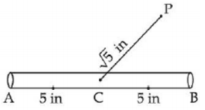
A \( 10 \) inches long pencil \( AB \) with mid point \( C \) and a small eraser \( P \) are placed on the horizontal top of a table such that \( PC = \sqrt{5} \) inches and \( \angle PCB = \tan^{-1}(2) \). The acute angle through which the pencil must be rotated about \( C \) so that the perpendicular distance between eraser and pencil becomes exactly \( 1 \) inch is:

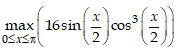 is equal to: