The number of values of \( \alpha \) for which the system of equations:\( x + y + z = \alpha \)\( \alpha x + 2\alpha y + 3z = -1 \)\( x + 3\alpha y + 5z = 4 \)is inconsistent, is
\( 0 \)
\( 1 \)
\( 2 \)
\( 3 \)
Let \( A \) be a \( 3\times3 \) matrix having entries from the set \( \{-1,0,1\} \). The number of all such matrices \( A \) having sum of all the entries equal to \( 5 \), is ________.
The positive value of the determinant of the matrix \( A \), whose
where \( \alpha \) is a non-zero real number an \( N=\displaystyle\sum_{k=1}^{49}M^{2k} \). If \( (I-M^{2})N=-2I \), then the positive integral values of \( \alpha \) is ______.
Let \( A = [a_{ij}] \) be a square matrix of order \( 3 \) such that \( a_{ij} = 2^{\,j-i} \), for all \( i, j = 1, 2, 3 \). Then, the matrix \( A^2 + A^3 + \ldots + A^{10} \) is equal to:
Let \( S \) be the set containing all \( 3 \times 3 \) matrices with entries from \( \{-1, 0, 1\} \). The total number of matrices \( A \in S \) such that the sum of all the diagonal elements of \( A^{T}A \) is \( 6 \) is _______.
Let A be a matrix of order $2 \times 2$, whose entries are from the set $\{0,1,2,3,4,5\}$. If the sum of all the entries of A is a prime number $p, 2 < p < 8$, then the number of such matrices A is _________.
If \( B = I - {^{5}C_{1}}(\operatorname{adj}A) + {^{5}C_{2}}(\operatorname{adj}A)^2 - \ldots - {^{5}C_{5}}(\operatorname{adj}A)^5 \), then the sum of all elements of the matrix \( B \) is:
Then the sum of the squares of all the values of \( a \), for which \( 2\, f'(10) - f'(5) + 100 = 0 \), is
Let \( f:\mathbb{R}\to \mathbb{R} \) be defined as \( f(x)=x^3+x-5 \).If \( g(x) \) is a function such that \( f(g(x))=x \), \( \forall 'x'\in \mathbb{R} \) then \( g'(63) \) is equal to ________________.
Let \( A \) and \( B \) be two \( 3 \times 3 \) matrices such that \( AB = I \) and \( \lvert A \rvert = \frac{1}{8} \). Then \( \left| \operatorname{adj}\left( B \, \operatorname{adj}(2A) \right) \right| \) is equal to
Let \( A \) be a \( 3 \times 3 \) invertible matrix. If \( \left| \operatorname{adj}(24A) \right| = \left| \operatorname{adj}\!\left( 3 \operatorname{adj}(2A) \right) \right| \), then \( |A|^{2} \) is equal to:
Let \( A = \begin{bmatrix} 0 & -2 \cr 2 & 0 \end{bmatrix} \). If \( M \) and \( N \) are two matrices given by \( M =\displaystyle \sum_{k=1}^{10} A^{2k} \) and \( N = \displaystyle \sum_{k=1}^{10} A^{2k-1} \) then \( MN^{2} \) is:
Let the system of linear equations \( x + 2y + z = 2 \), \( \alpha x + 3y - z = \alpha \), \( -\alpha x + y + 2z = -\alpha \) be inconsistent. Then \( \alpha \) is equal to:
Let \( A \) and \( B \) be any two \( 3\times 3 \) symmetric and skew symmetric matrices respectively. Then which of the following is NOT true?
The system of equation\( -k x + 3y - 14z = 25 \)\( -15x + 4y - k z = 3 \)\( -4x + y + 3z = 4 \)is consistent for all \( k \) in the set
Let the system of linear equations\( x + y + \alpha z = 2 \)\( 3x + y + z = 4 \)\( x + 2z = 1 \)have a unique solution \( (x^*, y^*, z^*) \). If \( (\alpha, x^*) \), \( (y^*, \alpha) \) and \( (x^*, -y^*) \) are collinear points, then the sum of absolute values of all possible values of \( \alpha \) is:
\( Y = \alpha I + \beta X + \gamma X^2 \) and \( Z = \alpha^2 I - \alpha \beta X + (\beta^2 - \alpha \gamma) X^2, \ \alpha, \beta, \gamma \in \mathbb{R}. \) Then \( (\alpha - \beta + \gamma)^2 \) is equal to _______.
The number of \( \theta \in (0,4\pi) \) for which the system is linear equations \( 3(\sin 3\theta)x - y + z = 2 \) \( 3(\cos 2\theta)x + 4y + 3z = 3 \) \( 6x + 7y + 7z = 9 \) Has no solution, is :
The number of matrices of order \( 3 \times 3 \), whose entries are either \( 0 \) or \( 1 \) and the sum of all the entries is a prime number, is__________.
If the system of linear equations:\( 2x + y - z = 7 \)\( x - 3y + 2z = 1 \)\( x + 4y + \delta z = k \), where \( \delta, k \in \mathbb{R} \)Has infinitely many solutions, then \( \delta + k \) is equal to:
Let \( A \) be a \( 2\times 2 \) matrix with \( \det(A) = -1 \) and \( \det\!\left((A+I)\big(\operatorname{Adj}(A)+I\big)\right)=4 \). Then the sum of the diagonal elements of \( A \) can be:
Let \( A \) be a matrix of order \( 3 \times 3 \) and \( \det(A) = 2 \). then \( \det\!\big(\det(A)\operatorname{adj}(5\operatorname{adj}(A^{3}))\big) \) is equal to ______.
The probability that a randomly chosen \( 2 \times 2 \) matrix with all the entries from the set of first \( 10 \) primes, is singular, is equal to:
Let \( S = \{ \sqrt{n} : 1 \leq n \leq 50 \text{ and } n \text{ is odd} \} \). If \( \sum\limits_{a \in S} \det(\operatorname{adj} A) = 100\,\lambda \), then \( \lambda \) is equal to:
Let \( A \) and \( B \) be two \( 3\times 3 \) non-zero real matrices such that \( AB \) is a zero matrix. Then.
If the system of linear equations,\( 2x + 3y - z = -2 \)\( x + y + z = 4 \)\( x - y + |\lambda| z = 4\lambda - 4 \)Where \( \lambda \in \mathbb{R} \), has no solution, then:
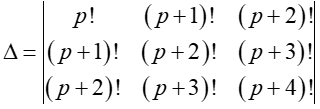
Let \( p \) and \( p+2 \) be prime number and letThen the sum of the maximum values of \( \alpha \) and \( \beta \), such that \( p^{\alpha} \) and \( (p+2)^{\beta} \) divide \( \Delta \), is__________.
, where \( \alpha,\beta,\gamma \) are three distinct natural numbers. If \( \dfrac{\det(\operatorname{adj}(\operatorname{adj}(\operatorname{adj}(\operatorname{adj}A))))}{(\alpha-\beta)^{16}(\beta-\gamma)^{16}(\gamma-\alpha)^{16}}=2^{32}\times 3^{16} \), then the number of such \( 3 \)- tuples \( (\alpha,\beta,\gamma) \) is ________.
The number of real values of \( \lambda \), such that the system of linear equations\( 2x-3y+5z=9 \)\( x+3y-z=-18 \)\( 3x-y+(\lambda^{2}-|\lambda|)z=16 \) has no solution is:
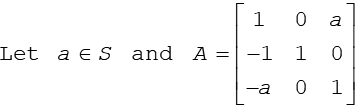
and let \( T_{n}=\{A\in S: A^{n(n+1)}=I\} \). Then the number of elements in \( \displaystyle \bigcap_{n=1}^{100} T_{n} \) is _______.
If the system of equations \( ax + y + z = 5 \), \( x + 2y + 3z = 4 \), \( x + 3y + 5z = \beta \) has infinitely many solutions, then the ordered pair \( (\alpha, \beta) \) is equal to:
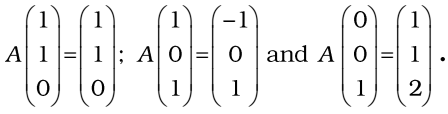
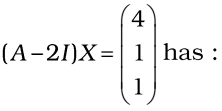
Let \( A \) be a \( 3\times 3 \) real matrix such thatIf \( X=(x_1,x_2,x_3)^T \) and \( I \) is an identity matrix of order \( 3 \), then the system
The ordered pair \( (a, b) \), for which the system of linear equations.\( 3x - 2y + z = b \)\( 5x - 8y + 9z = 3 \)\( 2x + y + az = -1 \)Has no solution, is:

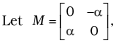 where \( \alpha \) is a non-zero real number an \( N=\displaystyle\sum_{k=1}^{49}M^{2k} \). If \( (I-M^{2})N=-2I \), then the positive integral values of \( \alpha \) is ______.
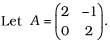 If \( B = I - {^{5}C_{1}}(\operatorname{adj}A) + {^{5}C_{2}}(\operatorname{adj}A)^2 - \ldots - {^{5}C_{5}}(\operatorname{adj}A)^5 \), then the sum of all elements of the matrix \( B \) is:
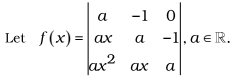 Then the sum of the squares of all the values of \( a \), for which \( 2\, f'(10) - f'(5) + 100 = 0 \), is
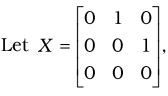 \( Y = \alpha I + \beta X + \gamma X^2 \) and \( Z = \alpha^2 I - \alpha \beta X + (\beta^2 - \alpha \gamma) X^2, \ \alpha, \beta, \gamma \in \mathbb{R}. \)
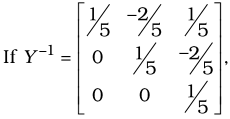 Then \( (\alpha - \beta + \gamma)^2 \) is equal to _______.
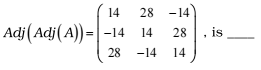
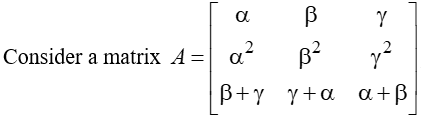 , where \( \alpha,\beta,\gamma \) are three distinct natural numbers. If \( \dfrac{\det(\operatorname{adj}(\operatorname{adj}(\operatorname{adj}(\operatorname{adj}A))))}{(\alpha-\beta)^{16}(\beta-\gamma)^{16}(\gamma-\alpha)^{16}}=2^{32}\times 3^{16} \), then the number of such \( 3 \)- tuples \( (\alpha,\beta,\gamma) \) is ________.
 and let \( T_{n}=\{A\in S: A^{n(n+1)}=I\} \). Then the number of elements in \( \displaystyle \bigcap_{n=1}^{100} T_{n} \) is _______.