The value of the integral \( \displaystyle \int_{1/2}^{2} \frac{\tan^{-1} x}{x} \, dx \) is equal to:
\( \frac{1}{2} \log_{e} 2 \)
\( \frac{\pi}{2} \log_{e} 2 \)
\( \pi \log_{e} 2 \)
\( \frac{\pi}{4} \log_{e} 2 \)
If \(\displaystyle \int\limits_{0}^{1} \dfrac{1}{(5+2x-2x^2)\left(1+e^{(2-4x)}\right)}\,dx=\frac{1}{\alpha}\log_e\left(\dfrac{\alpha+1}{\beta}\right),\ \alpha,\beta>0 \), then \( \alpha^4-\beta^4 \) is equal to:
Let a differentiable function \( f \) satisfy \( f(x)+\int_{3}^{x}\frac{f(t)}{t}\,dt=\sqrt{x+1}, \, x\geq 3 \). Then \( 12f(8) \) is equal to:
Let \( q \) be the maximum integral value of \( p \) in \([0,10]\) for which the roots of the equation \( x^{2}-px+\dfrac{5}{4}p=0 \) are rational. Then the area of the region \( \{(x,y): 0\le y \le (x-q)^{2},\ 0\le x \le q\} \) is :
\( f(x)=\dfrac{x}{(1+x^n)^\dfrac{1}{n}}, \ x \in \mathbb{R}-\{-1\}, \ n \in \mathbb{N}, \ n>2. \) If \( f^{n}(x)=(f \circ f \circ \ldots f \ \text{upto } n \ \text{times})(x) \), then let \(\displaystyle \lim\limits_{n \to \infty}\int_{0}^{1} x^{\,n-2}\big(f^{n}(x)\big)\,dx \) is equal to ________.
If \([t]\) denotes the greatest integer \(\le t\), then the value of \(\dfrac{3(e-1)}{e}\displaystyle \int_{1}^{2} x^{2} e^{[x]+[x^{3}]} dx\) is:
$\text{If } \int_{0}^{\pi} \frac{5^{\cos x} (1 + \cos x \cos 3x + \cos^2 x + \cos^3 x \cos 3x) dx}{1 + 5^{\cos x}} = \frac{k\pi}{16}, \text{ then } k \text{ is equal to } \_\_\_\_\_\_\_\_.$
$\displaystyle \lim_{n\to\infty} \left[ \frac{1}{1+n} + \frac{1}{2+n} + \frac{1}{3+n} + \ldots + \frac{1}{2n} \right] \text{ is equal to :}$
Let for \( x \in \mathbb{R} \), \( S_0(x) = x \), \( S_k(x) = C_k x + k \displaystyle\int_0^x S_{k-1}(t)dt \), where \( C_0 = 1, \; C_k = 1 - \displaystyle\int_0^1 S_{k-1}(x)dx, \; k = 1, 2, 3, \ldots \) Then \( S_2(3) + 6C_3 \) is equal to _____.
The value of \( 12\!\int_{0}^{3} \left| x^{2}-3x+2 \right| dx \) is _______.
The area of the region \( A = \{(x, y): |\cos x - \sin x| \le y \le \sin x, \, 0 \le x \le \frac{\pi}{2}\} \) is:
Let the area enclosed by the lines \( x+y=2 \), \( y=0 \), \( x=0 \) and the curve \( f(x)=\min\!\left\{x^{2}+\dfrac{3}{4},\,1+[ x ] \right\} \) where \( [ x ] \) denotes the greatest integer \( \le x \), be \( A \). Then the value of \( 12A \) is ________.
The area of the region \( \left\{(x,y): x^2 \leq y \leq 8 - x^2,\; y \leq 7 \right\} \) is:
\( \displaystyle \lim_{x\to 0} \dfrac{48}{x^{4}}\int_{0}^{x}\dfrac{t^{3}}{t^{6}+1}\,dt \) is equal to \( \_\_\_\_\_ \).
If the area enclosed by the parabolas \( P_1:2y=5x^2 \) and \( P_2:x^2-y+6=0 \) is equal to the area enclosed by \( P_1 \) and \( y=ax,\,a>0 \), then \( a^3 \) is equal to ________.
For \( m,n>0 \), let \( \alpha(m,n) = \displaystyle\int_{0}^{2} t^{m}(1+3t)^{n} dt \) .If \( 11\alpha(10,6)+18\alpha(11,5)=p(14)^{6} \), then \( p \) is equal to ______.
The value of \(\displaystyle \dfrac{e^{-\dfrac{\pi}{4}} + \displaystyle\int\limits_{0}^{\dfrac{\pi}{4}} e^{-x} \tan^{50}x \, dx}{\displaystyle\int\limits_{0}^{\pi/4} e^{-x} \left(\tan^{49}x + \tan^{51}x\right) dx}\) is :
The value of \( 8\int_{0}^{\frac{\pi}{2}} \frac{(\cos x)^{2023}}{(\sin x)^{2023}+(\cos x)^{2023}} \, dx \) is ______.
Let the area of the region \( \{(x,y): |2x-1|\le y \le |x^2-x|,\, 0\le x \le 1\} \) be \( A \). Then \( (6A+11)^2 \) is equal to ________.
Let \(\displaystyle 5f(x)+4f\!\left(\frac{1}{x}\right)=\frac{1}{x}+3,\, x>0 \). Then \(\displaystyle 18\!\int_{1}^{2} f(x)\,dx \) is equal to:
Let \( [t] \) denote the greatest integer \( \le t \). Then \( \dfrac{2}{\pi}\displaystyle\int_{\pi/6}^{5\pi/6}\big(8[\operatorname{cosec}x]-5[\cot x]\big)\,dx \) is equal to ________.
If \( \int_{\frac{1}{3}}^{3} |\log_{e} x| \, dx = \frac{m}{n} \log_{e}\!\left(\frac{n^{2}}{e}\right) \), where \( m \) and \( n \) are coprime natural numbers, then \( m^{2} + n^{2} - 5 \) is equal to ____.
Let \( \alpha > 0 \). If \( \displaystyle \int_{0}^{\alpha} \dfrac{x}{\sqrt{x+\alpha} - \sqrt{x}} \, dx = \dfrac{16 + 20\sqrt{2}}{15} \), then \( \alpha \) is equal to:
If \( f:\mathbb{R}\to\mathbb{R} \) be a continuous function satisfying \(\displaystyle \int_{0}^\dfrac{\pi}{2} f(\sin 2x)\sin x \, dx + \alpha \int_{0}^\dfrac{\pi}{4} f(\cos 2x)\cos x \, dx = 0 \), then the value of \( \alpha \) is:
\( \displaystyle \int\limits_{0}^{\infty}\frac{6}{e^{3x}+6e^{2x}+11e^{x}+6}\,dx = \)
Area of the region \( \{(x,y): x^{2}+(y-2)^{2}\le 4,\; x^{2}\ge 2y\} \) is:
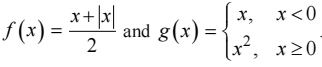
Let for \( x \in \mathbb{R} \),Then area bounded by the curve \( y = (fog)(x) \) and the lines \( y = 0 \), \( 2y - x = 15 \) is equal to _____.
Let \( f(x)=x+\dfrac{a}{\pi^2-4}\sin x+\dfrac{b}{\pi^2-4}\cos x, \; x\in \mathbb{R} \) be a function which satisfies\( f(x)=x+\displaystyle \int_{0}^{\pi/2}\sin(x+y)f(y)\,dy \). Then \( (a+b) \) is equal to:
The area bounded by the curves \( y = |x - 1| + |x - 2| \) and \( y = 3 \) is equal to:
The value of the integral $\int_{1}^{2}\left(\frac{t^{4} + 1}{t^{6} + 1}\right) dt$ is:
The area of the region enclosed by the curve \( f(x) = \max\{\sin x, \cos x\} ,\ -\pi \le x \le \pi \) and the x-axis is:
Let \( \Delta \) be the area of the region \( \{(x,y)\in \mathbb{R}^{2}: x^{2}+y^{2}\leq 21,\; y^{2}\leq 4x,\; x\geq 1\} \). Then \( \dfrac{1}{2}\!\left(\Delta - 21\sin^{-1}\!\dfrac{2}{\sqrt{7}}\right) \) is equal to:
Let \( A = \{(x,y) \in \mathbb{R}^2 : y \ge 0, \; 2x \le y \le \sqrt{4-(x-1)^2} \} \) and\( B = \{(x,y) \in \mathbb{R} \times \mathbb{R} : 0 \le y \le \min\{2x,\; \sqrt{4-(x-1)^2}\}\}\)Then the ratio of the area of \( A \) to the area of \( B \) is:
Let \( \alpha \in (0,1) \) and \( \beta = \log_{e}(1-\alpha) \). Let \( P_{n}(x) = x + \frac{x^{2}}{2} + \frac{x^{3}}{3} + \ldots + \frac{x^{n}}{n},\; x\in(0,1) \).Then the integral \( \displaystyle \int_{0}^{\alpha} \frac{t^{50}}{1-t}\,dt \) is equal to:
The integral \( 16 \int_{1}^{2} \frac{dx}{x^{3}(x^{2}+2)^{2}} \) is equal to:
If \( A \) is the area in the first quadrant enclosed by the curve \( C : 2x^{2} - y + 1 = 0 \), the tangent to \( C \) at the point \( (1,3) \) and the line \( x + y = 1 \), then the value of \( 60A \) is _______.
Let \( A \) be the area of the region \( \left\{ (x,y) : y \ge x^{2},\ y \ge (1-x)^{2},\ y \le 2x(1-x) \right\} \). Then \( 540A \) is equal to ________.
The area of the region given by \( \{(x, y) : xy \le 8, \, 1 \le y \le x^2\} \) is:
Let \( [t] \) denote the greatest integer function. If \( \displaystyle \int_{0}^{2.4}\!\!\left[\!x^{2}\!\right] \,dx=\alpha+\beta\sqrt{2}+\gamma\sqrt{3}+\delta\sqrt{5} \), then \( \alpha+\beta+\gamma+\delta \) is equal to ________.
If the area of the region \( S = \{(x, y) : 2y - y^2 \leq x^2 \leq 2y, \, x \geq y\} \) is equal to \( \dfrac{n+2}{n+1} - \dfrac{\pi}{n-1} \), then the natural number \( n \) is equal to ____________.
$\text{The value of the integral } \int_{-\pi/4}^{\pi/4} \frac{x + \frac{\pi}{4}}{2 - \cos 2x} \, dx \text{ is:}$
If the area bounded by the curve \( 2y^2=3x \), lines \( x+y=3 \), \( y=0 \) and outside the circle \( (x-3)^2+y^2=2 \) is \( A \), then \( 4(\pi+4A) \) is equal to:
The value of \( \displaystyle \int_{\pi/3}^{\pi/2} \frac{2 + 3\sin x}{\sin x (1 + \cos x)} \, dx \) is equal to:
If \( \int_{0}^{1} (x^{21} + x^{14} + x^{7}) (2x^{14} + 3x^{7} + 6)^{1/7} \, dx = \frac{1}{l} (11)^{m/n} \) where \( l, m, n \in \mathbb{N} \), \( m \) and \( n \) are coprime then \( l + m + n \) is equal to _______.
Let \( A \) be the area bounded by the curve \( y = x|x-3| \), the \( x \)-axis and the ordinates \( x = -1 \) and \( x = 2 \). Then \( 12A \) is equal to __________.
Let \( f_n=\displaystyle\int\limits_{0}^{\pi/2}\left(\sum_{k=1}^{n}\sin^{k-1}x\right)\left(\sum_{k=1}^{n}(2k-1)\sin^{k-1}x\right)\cos x \, dx,\; n\in \mathbb{N} \). Then \( f_{21}-f_{20} \) is equal to ______.
The area of the region enclosed by the curve \( y = x^3 \) and its tangent at the point \( (-1,-1) \) is:
The value of integral \( \displaystyle \int_{-\log_e 2}^{\log_e 2} e^x \Big( \log_e( e^x + \sqrt{1 + e^{2x}} ) \Big) \, dx \) is equal to:
Let \( f \) be a differentiable function defined on \( \left[0,\frac{\pi}{2}\right] \) such that \( f(x) > 0 \) and \( f(x) + \int_{0}^{x} f(t)\sqrt{1-(\log_{e} f(t))^{2}}\,dt = e, \ \forall x \in \left[0,\frac{\pi}{2}\right] \). Then \( \left(6 \log_{e} f\!\left(\frac{\pi}{6}\right)\right)^{2} \) is equal to ________.