44 questions from 2023
Let \( f : (0,1) \to IR \) be a function defined by \( f(x) = \dfrac{1}{1 - e^{-x}} \), and \( g(x) = (f(-x) - f(x)) \). Consider two statements.(\( I \)) \( g \) is an increasing function in \( (0, 1) \)(\( II \)) \( g \) is one-one in \( (0, 1) \) Then :
Let \( R \) be a relation on \( \mathbb{N} \times \mathbb{N} \) defined by \( (a,b) R (c,d) \) if and only if \( ad\,(b-c) = bc\,(a-d) \). Then \( R \) is:
Let \( R=\{a,b,c,d,e\} \) and \( S=\{1,2,3,4\} \). The total number of onto functions \( f:R\to S \) such that \( f(a)\neq 1 \), is equal to ______.
The domain of the function \( f(x)=\dfrac{1}{\sqrt{[x]^2-3[x]-10}} \)is: (where \( [x] \) denotes the greatest integer less than or equal to \( x \))
Let \( A = \{1, 2, 3, 5, 8, 9\} \). Then the number of possible functions \( f : A \to A \) such that \( f(m \cdot n) = f(m) \cdot f(n) \) for every \( m, n \in A \) with \( m \cdot n \in A \) is equal to _________.
Let \( x=2 \) be a local minima of the function \( f(x)=2x^{4}-18x^{2}+8x+12,\, x\in(-4,4) \). If \( M \) is local maximum value of the function \( f \) in \( (-4,4) \), then \( M= \)
Let \( f(x) \) be a function such that \( f(x+y) = f(x)\cdot f(y) \) for all \( x, y \in \mathbb{N} \). If \( f(1) = 3 \) and \( \displaystyle \sum_{k=1}^{n} f(k) = 3279 \), then the value of \( n \) is:
The set of all values of $a$ for which $\displaystyle \lim_{x \to a} ([x - 5] - [2x + 2]) = 0$, where $[\alpha]$ denotes the greatest integer less than or equal to $\alpha$ is equal to:
The relation \( R=\{(a,b):\gcd(a,b)=1,\, 2a\neq b,\, a,b\in \mathbb{Z}\} \) is:
The absolute minimum value, of the function \( f(x)=\left|x^{2}-x+1\right|+\left[\,x^{2}-x+1\,\right] \), where \([\,t\,]\) denotes the greatest integer function, in the interval \([ -1,\, 2 ]\), is:
Let \( A=\{x\in \mathbb{R}:[x+3]+[x+4]\le 3\} \), \( B=\left\{x\in \mathbb{R}:3^{x}\left(\displaystyle\sum_{r=1}^{\infty}\dfrac{3}{10^{r}}\right)^{x-3}<3^{-3x}\right\} \), where \([t]\) denotes greatest integer function. Then:
Consider a function \( f:\mathbb{N} \rightarrow \mathbb{R} \), satisfying \( f(1) + 2f(2) + 3f(3) + \ldots + x f(x) = {x(x+1)}{}; \, x \ge 2 \) with \( f(1) = 1 \). Then \( \frac{1}{f(2022)} + \frac{1}{f(2028)} \) is equal to:
Let \( S = \{1, 2, 3, 4, 5, 6\} \). Then the number of one-one functions \( f : S \to P(S) \), where \( P(S) \) denotes the power set of \( S \), such that \( f(n) \subset f(m) \) where \( n < m \) is ________.
Let \( f^1(x) = \frac{3x + 2}{2x + 3}, \; x \in \mathbb{R} - \left\{ \frac{-3}{2} \right\} \). For \( n \ge 2 \), define \( f^n(x) = f^1 \circ f^{n-1}(x) \). If \( f^5(x) = \frac{ax + b}{bx + a} \), \( \gcd(a,b) = 1 \), then \( a + b \) is equal to _______.
Let the function \( f:[0,2]\to \mathbb{R} \) be defined as where \( [t] \) denotes the greatest integer less then or equal to \( t \). Then the value of the integral \(\displaystyle \int_{0}^{2} x f(x)\,dx \) is:
The number of relations, on the set \( \{1,2,3\} \) containing \( (1,2) \) and \( (2,3) \), which are reflexive and transitive but not symmetric, is_____.
If the domain of the function $f(x) = \frac{[x]}{1+x^2}$, where $[x]$ is greatest integer $\leq x$, is $[2,6)$, then its range is:
Let \( D \) be the domain of the function \( f(x) = \sin^{-1}\!\left( \log_{3x} \left( \dfrac{6 + 2\log_3{x}}{-5x} \right) \right) \). If the range of the function \( g : D \to \mathbb{R} \) defined by \( g(x) = x - [x ] \), (\( [ x ] \) is the greatest integer function), is \( (\alpha, \beta) \), then \( \alpha^{2} + \dfrac{5}{\beta} \) is equal to:
The equation \( e^{4x} + 8e^{3x} + 13e^{2x} - 8e^{x} + 1 = 0, \, x \in \mathbb{R} \) has:
Let \( f : \mathbb{R} \to \mathbb{R} \) be a differentiable function that satisfies the relation \( f(x+y) = f(x) + f(y) - 1 \), \( \forall x, y \in \mathbb{R} \). If \( f'(0) = 2 \), then \( | f(-2) | \) is equal to __________.
If domain of the function \( \log_{e}\!\left(\dfrac{6x^{2}+5x+1}{2x-1}\right)+\cos^{-1}\!\left(\dfrac{2x^{2}-3x+4}{3x-5}\right) \) is \( (\alpha,\beta)\cup(\gamma,\delta] \), then \( 18(\alpha^{2}+\beta^{2}+\gamma^{2}+\delta^{2}) \) is equal to ________.
If \( y=y(x) \) is the solution of the differential equation \( \dfrac{dy}{dx}+\dfrac{4x}{(x^{2}-1)}y=\dfrac{x+2}{(x^{2}-1)^{5/2}},\, x>1 \) such that \( y(2)=\dfrac{2}{9}\log_{e}(2+\sqrt{3}) \) and \( y(\sqrt{2})=\alpha \log_{e}(\sqrt{\alpha}+\beta)+\beta-\sqrt{\gamma},\; \alpha,\beta,\gamma \in \mathbb{N} \), then \( \alpha\beta\gamma \) is equal to __________.
The number of functions \( f : \{1,2,3,4\} \to \{ a \in Z \, \, |a| \le 8 \} \) satisfying \( f(n) + \frac{1}{n} f(n+1) = 1 , \forall n \in \{1,2,3\} \) is:
The range of the function \( f(x) = \sqrt{3 - x} + \sqrt{2 + x} \) is :
Suppose \(f : \mathbb{R} \rightarrow (0, \infty)\) be a differentiable function such that \(5 f(x+y) = f(x)\cdot f(y), \; \forall \, x, y \in \mathbb{R}\). If \(f(3) = 320\), then \(\displaystyle \sum_{n=0}^{5} f(n)\) is equal to:
Let \( A = \{1,2,3,4,5\} \) and \( B = \{1,2,3,4,5,6\} \). Then the number of functions \( f : A \to B \) satisfying \( f(1) + f(2) = f(4) - 1 \) is equal to _______.
The range of \(f(x)\) \(=4\sin^{-1}\left(\dfrac{x^2}{x^2+1}\right)\) is :
Let \( f:\mathbb{R}-\{2,6\}\to\mathbb{R} \) be real valued function defined as \( f(x)=\frac{x^2+2x+1}{x^2-8x+12} \). Then range of \( f \) is
For \( x\in \mathbb{R} \), two real valued functions \( f(x) \) and \( g(x) \) are such that, \( g(x)=\sqrt{x}+1 \) and \( f\circ g(x)=x+3-\sqrt{x} \). Then \( f(0) \) is equal to:
Let \( f \) and \( g \) be two functions defined by and . Then \( (g \circ f)(x) \) is:
If \( f(x)=\dfrac{(\tan 1^\circ)\,x+\log_e (123)}{x\log_e(1234)-(\tan 1^\circ)} , \; x>0 \), then the least value of \( f(f(x))+f\!\left(f\!\left(\dfrac{4}{x}\right)\right) \) is:
Let \( f:\mathbb{R}\rightarrow \mathbb{R} \) be a function such that \( f(x)=\dfrac{x^{2}+2x+1}{x^{2}+1} \). Then:
For some \( a,b,c \in \mathbb{N} \), let \( f(x)=ax-3 \) and \( g(x)=x^{b}+c,\, x\in \mathbb{R} \). If \( (fog)^{-1}(x)=\left(\frac{x-7}{2}\right)^{\frac{1}{3}} \), then \( (fog)(ac)+(gof)(b) \) is equal to ________.
Let \( [\alpha] \) denote the greatest integer \( \le \alpha \). Then \( [\sqrt{1}] + [\sqrt{2}] + [\sqrt{3}] + \ldots + [\sqrt{120}] \) is equal to _____.
Let \( f : ℝ-\{0,1\} \to \) ℝ be a function such that \( f(x) + f\!\left(\dfrac{1}{1-x}\right) = 1 + x \). Then \( f(2) \) is equal to:
Let \( f : \mathbb{R} \to \mathbb{R} \) be a function defined by \( f(x) = \log_{\sqrt{m}} \left\{ \sqrt{2}(\sin x - \cos x) + m - 2 \right\} \), for some \( m \), such that the range of \( f \) is \( [0,2] \). Then the value of \( m \) is _______.
If \( f(x) = \dfrac{2^{2x}}{2^{2x} + 2} , \, x \in R \), then \( f\!\left(\dfrac{1}{2023}\right) + f\!\left(\dfrac{2}{2023}\right) + \ldots + f\!\left(\dfrac{2022}{2023}\right) \) is equal to:
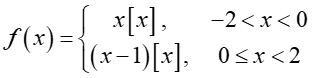
Let \( f:(-2,2)\rightarrow \mathbb{R} \) be defined by where \([x]\) denotes the greatest integer function. If \(m\) and \(n\) respectively are the number of points in \((-2,2)\) at which \(y=| f(x)|\) is not continuous and not differentiable then \(m+n\) is equal to ____.
Let the function \( f(x)=2x^{3}+(2p-7)x^{2}+3(2p-9)x-6 \) have a maxima for some value of \( x<0 \) and a minima for some value of \( x>0 \). Then, the set of all values of \( p \) is:
Let \( f(x)=2x^{n}+\lambda, \lambda\in \mathbb{R}, n\in \mathbb{N} \), and \( f(4)=133, f(5)=255 \). Then the sum of all the positive integer divisors of \( \left(f(3)-f(2)\right) \) is:
The number of integral solutions \( x \) of \( \log_{\left(x+\dfrac{7}{2}\right)}\left(\dfrac{x-7}{2x-3}\right)^2 \ge 0 \) is:
Let \( A=\{1,3,4,6,9\} \) and \( B=\{2,4,5,8,10\} \). Let \( R \) be a relation defined on \( A\times B \) such that \( R=\{((a_1,b_1),(a_2,b_2)):\; a_1\le b_2 \;\&\; b_1\le a_2\} \). Then the number of elements in the set \( R \) is:
Suppose \( f \) is a function satisfying \( f(x+y)=f(x)+f(y) \) for all \( x,y \in \mathbb{N} \) and \( f(1)=\dfrac{1}{5} \). If \( \displaystyle \sum_{n=1}^{m} \dfrac{f(n)}{n(n+1)(n+2)}=\dfrac{1}{12} \), then \( m \) is equal to _________.
Let \( f(x)=2x+\tan^{-1}x \) and \( g(x)=\log_{e}\!\left(\sqrt{1+x^{2}}+x\right) \), \( x\in[0,3] \). Then:

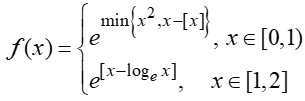 where \( [t] \) denotes the greatest integer less then or equal to \( t \). Then the value of the integral \(\displaystyle \int_{0}^{2} x f(x)\,dx \) is:
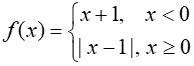 and
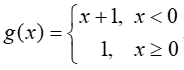 . Then \( (g \circ f)(x) \) is: