27 questions from 2022
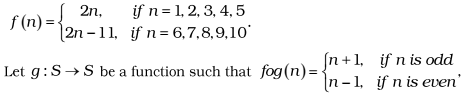
Let \( S=\{1,2,3,4,5,6,7,8,9,10\} \). Define \( f:S\to S \) asThen \( g(10)\big(g(1)+g(2)+g(3)+g(4)+g(5)\big) \) is equal to _______.
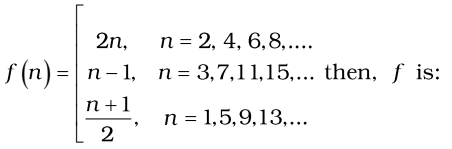
Let a function \( f : \mathbb{N} \to \mathbb{N} \) be defined by
\( f(\alpha)=\displaystyle\int\limits_{1}^{\alpha}\frac{\log_{10} t}{1+t}\,dt, \ \alpha>0 \) If , then \( f(e^{3})+f(e^{-3}) \) is equal to:
Let \( f(x) = \frac{x - 1}{x + 1} ,\; x \in \mathbb{R} - \{ 0, -1, 1 \} \). If \( f^{\,n+1}(x) = f\!\left(f^{\,n}(x)\right) \) for all \( n \in \mathbb{N} \), then \( f^{6}(6) + f^{7}(7) \) is equal to:
The number of distinct real roots of the equation \( x^{7} - 7x - 2 = 0 \) is:
The domain of the function \( f(x) := \dfrac{\cos^{-1}\!\left( \dfrac{x^{2} - 5x + 6}{x^{2} - 9} \right)}{\log_{e}(x^{2} - 3x + 2)} \) is:
Let \( f(x)=2x^{2}-x-1 \) and \( S=\{\,n\in \mathbb{Z}:\; |f(n)|\le 800\,\} \). Then, the value of \( \sum\limits_{n\in S} f(n) \) is equal to ______.
Let \( R_1 = \{(a,b) \in N \times N : |a-b| \le 13\} \) and \( R_2 = \{(a,b) \in N \times N : |a-b| \ne 13\} \). Then on \( N \):
The number of functions \( f \), from the set \( A=\left\{x\in \mathbb{N}:x^{2}-10x+9\le 0\right\} \) to the set \( B=\left\{n^{2}:n\in \mathbb{N}\right\} \) such that \( f(x)\le (x-3)^{2}+1 \), for every \( x\in A \), is ________.
Let $f:\mathbb{R} \rightarrow \mathbb{R}$ be a function defined by $f(x)=\left( 2\left( 1-\frac{x^{25}}{2} \right) \left( 2+x^{25} \right) \right)^{\frac{1}{50}}$. If the function $g(x)=f(f(f(x)))+f(f(x))$, then the greatest integer less than or equal to $g(1)$ is ______.
Let \( f : R \to R \) be defined as \( f(x) = x - 1 \) and \( g : R - \{ 1, -1 \} \to R \) be defined as \( g(x) = \frac{x^2}{x^2 - 1} \). Then the function \( fog \) is:
Let \( S=\{4,6,9\} \) and \( T=\{9,10,11,\ldots,1000\} \). If \( A=\{ a_1+a_2+\ldots+a_k : k\in \mathbb{N}, a_1,a_2,a_3,\ldots,a_k\in S \} \), then the sum of all the elements in the set \( T-A \) is equal to__________.
Let \( R_1 \) and \( R_2 \) be two relations defined on \( \mathbb{R} \) by \( a \, R_1 \, b \Leftrightarrow ab \ge 0 \) and \( a \, R_2 \, b \Leftrightarrow a \ge b \). Then:
The domain of the function \( f(x) = \sin^{-1}\!\left(\dfrac{x^{2}-3x+2}{x^{2}+2x+7}\right) \) is :
Let \( f:\mathbb{R}\to\mathbb{R} \) be a function defined by \( f(x)=\dfrac{2e^{2x}}{e^{2x}+e} \). Then \( f\!\left(\frac{1}{100}\right)+f\!\left(\frac{2}{100}\right)+f\!\left(\frac{3}{100}\right)+\ldots+f\!\left(\frac{99}{100}\right) \) is equal to \( \_\_\_ \).
Let \( f,g : \mathbb{N} - \{1\} \to \mathbb{N} \) be functions defined by \( f(a) = \alpha \), where \( \alpha \) is the maximum of the powers of those primes \( p \) such that \( p^{\alpha} \) divided \( a \), and \( g(a) = a + 1 \), for all \( a \in \mathbb{N} - \{1\} \). Then, the function \( f + g \) is:
Let \( R_1 \) and \( R_2 \) be relations on the set \( \{ 1, 2, \ldots, 50 \} \) such that \( R_1 = \{ (p, p^n) : p \text{ is a prime and } n \ge 0 \text{ is an integer} \} \) and \( R_2 = \{ (p, p^n) : p \text{ is a prime and } n = 0 \text{ or } 1 \} \). Then, the number of elements in \( R_1 - R_2 \) is ________.
The number of elements in the set \( S = \left\{ x \in \mathbb{R} : 2\cos\!\left(\dfrac{x^2 + x}{6}\right) = 4^{x} + 4^{-x} \right\} \) is:
Let \( f(x)=2+|x|-|x-1|+|x+1|,\, x\in \mathbb{R} \).Consider\((S1):\;\displaystyle f'\!\left(-\frac{3}{2}\right)+f'\!\left(-\frac{1}{2}\right)+f'\!\left(\frac{1}{2}\right)+f'\!\left(\frac{3}{2}\right)=2\)\((S2):\; \displaystyle\int\limits_{-2}^{2} f(x)\,dx = 12\)Then,
If the absolute maximum value of the function \( f(x)=(x^{2}-2x+7)e^{(4x^{3}-12x^{2}-180x+31)} \) in the interval \( [-3,0] \) is \( f(\alpha) \), then :
Let \( c,k \in R \). If \( f(x)=(c+1)x^2+(1-c^2)x+2k \) and \( f(x+y)=f(x)+f(y)-xy \), for all \( x,y \in R \), then the value of \( \left| 2 \left( f(1)+f(2)+f(3)+\ldots+f(20) \right) \right| \) is equal to __________.
Let \( f:\mathbb{R}\to\mathbb{R} \) satisfies \( f(x+y)=2^{x}f(y)+4^{y}f(x),\ \forall x,y\in\mathbb{R}. \) If \( f(2)=3 \), then \( 14\cdot \frac{f'(4)}{f'(2)} \) is equal to ______.
Let \( f:\mathbb{N}\to \mathbb{R} \) be a function such that \( f(x+y)=2f(x)f(y) \) for natural numbers \( x \) and \( y \). If \( f(1)=2 \), then the value of \( \alpha \) for which \( \displaystyle \sum_{k=1}^{10} f(\alpha+k)=\dfrac{512}{3}\left(2^{20}-1\right) \) holds, is:
Let \( f:\mathbb{R}\to \mathbb{R} \) and \( g:\mathbb{R}\to \mathbb{R} \) be two functions defined by \( f(x)=\log_{e}(x^{2}+1)-e^{-x}+1 \) and \( g(x)=\dfrac{1-2e^{2x}}{e^{x}} \). Then, for which of the following range of \( \alpha \), the inequality \( f\!\left(g\!\left(\dfrac{(\alpha-1)^{2}}{3}\right)\right)>f\!\left(g\!\left(\alpha-\dfrac{5}{3}\right)\right) \) holds?
The total number of functions \( f : \{1,2,3,4\} \to \{1,2,3,4,5,6\} \) Such that \( f(1) + f(2) = f(3) \) is equal to :
The domain of the function \( \cos^{-1}\!\left( \dfrac{2 \sin^{-1}\!\left( \dfrac{1}{4x^{2}-1} \right)}{\pi} \right) \) is:
The domain of the function \( f(x)=\sin^{-1}\!\left[\;2x^{2}-3\;\right]+\log_{2}\!\left(\log_{\dfrac{1}{2}}\!\left(x^{2}-5x+5\right)\right) \), where \([t]\) is the greatest integer functions, is :