Number of integral terms in the expansion of $\left\{ 7^{\left(\frac{1}{2}\right)} + 11^{\left(\frac{1}{6}\right)} \right\}^{824}$ is equal to _________.
Let \( (1+x+x^{2})^{10}=a_{0}+a_{1}x+a_{2}x^{2}+\ldots+a_{20}x^{20} \). If \( (a_{1}+a_{3}+a_{5}+\ldots+a_{19})-11a_{2}=121k \), then \( k \) is equal to __________.
Let \( y = y(x) \) be the solution of the differential equation \( x\,dy - y\,dx = \sqrt{(x^2 - y^2)}\,dx, \; x \geq 1 \), with \( y(1) = 0 \).If the area bounded by the line \( x = 1 \), \( x = e^{\pi} \), \( y = 0 \) and \( y = y(x) \) is \( \alpha e^{2\pi} + \beta \), then the value of \( 10(\alpha + \beta) \) is equal to:
Let the smallest value of \( k \in \mathbb{N} \), for which the coefficient of \( x^3 \) in \( (1+x)^3 + (1+x)^4 + (1+x)^5 + \ldots + (1+x)^{99} + (1+kx)^{100} \), \( x \neq 0 \), is \( \left( \frac{43n + 101}{4} \right)\binom{100}{3} \) for some \( n \in \mathbb{N} \), be \( p \). Then the value of \( p + n \) is:
If the constant term in the expansion of \( \left( 3x^{3} - 2x^{2} + \dfrac{5}{x^{5}} \right)^{10} \) is \( 2^{k} \cdot l \), where \( l \) is an odd integer, then the value of \( k \) is equal to:
Three defective oranges are accidently mixed with seven good ones and on looking at them, it is not possible to differentiate between them. Two oranges are drawn at random from the lot. If \( x \) denote the number of defective oranges, then the variance of \( x \) is:
Let \( x = (8\sqrt{3} + 13)^{13} \) and \( y = (7\sqrt{2} + 9)^{9} \). If \( [t] \) denotes the greatest integer \( \le t \), then:
If \( \dfrac{1}{n+1} \, {}^{n}C_{n} + \dfrac{1}{n} \, {}^{n}C_{n-1} + \ldots + \dfrac{1}{2} \, {}^{n}C_{1} + {}^{n}C_{0} = \dfrac{1023}{10} \) then \( n \) is equal to:
Let \( a \) be the sum of all coefficients in the expansion of \( (1-2x+2x^{2})^{2023}(3-4x^{2}+2x^{3})^{2024} \) and \( b=\ \displaystyle \lim_{x\to 0}\left(\frac{\displaystyle \int_{0}^{x}\frac{\log(1+t)}{t^{2024}+1}\,dt}{x^{2}}\right) \). If the equations \( cx^{2}+dx+e=0 \) and \( 2bx^{2}+ax+4=0 \) have a common root, where \( c,d,e\in \mathbb{R} \), then \( d:c:e \) equals:
If the second, third and fourth terms in the expansion of \( (x + y)^n \) are \( 135 \), \( 30 \) and \( \frac{10}{3} \), respectively, then \( 6(n^3 + x^2 + y) \) is equal to ______.
Let the coefficient of \( x^{r} \) in the expansion of \( (x+3)^{n-1}+ (x+3)^{n-2}(x+2)+ (x+3)^{n-3}(x+2)^{2}+\cdots +(x+2)^{n-1} \) be \( \alpha_{\gamma} \). If \(\displaystyle \sum_{r=0}^{n}a_{\gamma}=\beta ^{n}-\gamma ^{n},\ \beta ,\gamma \in \mathbb{N} \), then the value of \( \beta ^{2}+\gamma ^{2} \) equals ________.
Among the statements:(S1): \( 2023^{2022} - 1999^{2022} \) is divisible by \( 8 \)(S2): \( 13(13)^{n} - 11n - 13 \) is divisible by \( 144 \) for infinitely many \( n \in \mathbb{N} \)
Let the coefficients of third, fourth and fifth terms in the expansion of \( \left(x+\dfrac{a}{x^{2}}\right)^{n},\ x\neq 0, \) be in the ratio \( 12:8:3 \). Then the term independent of \( x \) in the expansion, is equal to ________.
The product of the last two digits of \( (1919)^{1919} \) is ______.
The term independent of \( x \) in the expansion of \( \left(1 - x^2 + 3x^3\right)\left(\dfrac{5}{2}x^3 - \dfrac{1}{5x^2}\right)^{11} , \; x \ne 0 \) is:
The value of \( \dfrac{1}{1!50!}+\dfrac{1}{3!48!}+\dfrac{1}{5!46!}+\ldots+\dfrac{1}{49!2!}+\dfrac{1}{51!1!} \) is:
If \( A \) denotes the sum of all the coefficients in the expansion of \( (1-3x+10x^{2})^{n} \) and \( B \) denotes the sum of all the coefficients in the expansion of \( (1+x^{2})^{n} \), then:
The coefficient of \( x^{2012} \) in the expansion of \( (1 - x)^{2008} (1 + x + x^{2})^{2007} \) is equal to __________ .
If the maximum value of the term independent of \( t \) in the expansion of \( \left(t^{2}x^{1/5}+\dfrac{(1-x)^{1/10}}{t}\right)^{15},\ x\ge 0, \) is \( K \), then \( 8K \) is equal to ______.
If \( \displaystyle \sum_{k=1}^{10} K^{2}\left({10}_{C_{K}}\right)^{2}=22000L \), then \( L \) is equal to ________.
If the coefficient of \( a^{7}b^{8} \) in the expansion of \( (a+2b+4ab)^{10} \) is \( K\cdot 2^{16} \), then \( K \) is equal to ______.
Remainder when \( 64^{\,32^{32}} \) is divided by \( 9 \) is equal to ________.
Let for the \( 9^{\text{th}} \) term in the binomial expansion of \( (3+6x)^{n} \), in the increasing powers of \( 6x \), to be the greatest for \( x=\dfrac{3}{2} \), the least value of \( n \) is \( n_{0} \). If \( k \) is the ratio of the coefficient of \( x^{6} \) to the coefficient of \( x^{3} \), then \( k+n_{0} \) is equal to:
If the coefficients of \( x \) and \( x^{2} \) in the expansion of \( (1+x)^{p}(1-x)^{q} \), \( p,q\leq15 \), are \( -3 \) and \( -5 \) respectively, then the coefficient of \( x^{3} \) is equal to ______.
The mean of the coefficients of \( x, x^{2}, \ldots, x^{7} \) in the binomial expansion of \( (2+x)^{9} \) is __________ .
If \( \alpha = 1 + \displaystyle \sum_{r=1}^{6}(-3)^{\,r-1} \, {}^{12}C_{2r-1}, \) then the distance of the point \( (12, \sqrt{3}) \) from the line \( \alpha x - \sqrt{3}\, y + 1 = 0 \) is ______.
The remainder when $\left((64)^{(64)}\right)^{(64)}$ is divided by 7 is equal to:
Let the coefficients of the middle terms in the expansion of \( \left(\dfrac{1}{\sqrt{6}} + \beta x\right)^4 \), \( (1 - 3 \beta x)^2 \) and \( \left(1 - \dfrac{\beta}{2} x\right)^6 \), \( \beta > 0 \) , respectively from the first three terms of an A.P. If \( d \) is the common difference of this A.P., then \( 50 -\dfrac{ 2d}{\beta^2} \) is equal to ____________.
The value of \( \displaystyle\sum_{r=0}^{6} \left({}^{6}C_{r}\cdot {}^{6}C_{6-r}\right) \) is equal to:
If \( 1 + (2 + {}^{49}C_{1} + {}^{49}C_{2} + \ldots + {}^{49}C_{49})({}^{50}C_{2} + {}^{50}C_{4} + \ldots + {}^{50}C_{50}) \) is equal to \( 2^{n} \cdot m \), where \( m \) is odd, then \( n + m \) is equal to ______________.
The remainder on dividing \( 5^{99} \) by \( 11 \) is ______.
The sum of the coefficients of three consecutive terms in the binomial expansion of \( (1 + x)^{n+2} \), which are in the ratio \( 1:3:5 \), is equal to:
If the co-efficients of \( x^7 \) and \( x^8 \) in the expansion of \( \left(2 + \dfrac{x}{3}\right)^n \) are equal, then the value of \( n \) is equal to ________.
\( {}^{n-1}C_r = (k^2 - 8)\, {}^{n}C_{r+1} \) if and only if:
The number of integral terms in the expansion of \( \left(3^\dfrac{1}{{2}}+5^\dfrac{1}{{4}}\right)^{680} \) is equal to:
The sum of all rational terms in the expansion of $\left(1 + 2^{1/3} + 3^{1/2}\right)^6$ is equal to __________.
Let \( m \) and \( n \) be the coefficients of seventh and thirteenth terms respectively in the expansion of \( \left( \dfrac{1}{3} x^{\dfrac{1}{3}} + \dfrac{1}{2 x^{\dfrac{2}{3}}} \right)^{18} \). Then \( \left( \dfrac{n}{m} \right)^\dfrac{1}{3} \) is:
If the coefficients of three consecutive terms in the expansion of \( (1 + x)^{n} \) are in the ratio \( 1 : 5 : 20 \), then the coefficient of the fourth term is:
Let \( (1 + x + 2x^2)^{20} = a_0 + a_1 x + a_2 x^2 + \ldots + a_{40}x^{40} \). Then, \( a_1 + a_3 + a_5 + \ldots + a_{37} \) is equal to:
Let \( p \) be the number of all triangles that can be formed by joining the vertices of a regular polygon \( P \) of \( n \) sides and \( q \) be the number of all quadrilaterals that can be formed by joining the vertices of \( P \). If \( p+q=126 \), then the eccentricity of the ellipse \( \dfrac{x^2}{16}+\dfrac{y^2}{n}=1 \).
$\displaystyle \sum_{k=0}^{20} ({}^{20}C_k)^2$ is equal to:
If the co-efficient of \( x^{9} \) in \( \left(\alpha x^{3}+\dfrac{1}{\beta x}\right)^{11} \) and the co-efficient of \( x^{-9} \) in \( \left(\alpha x-\dfrac{1}{\beta x^{3}}\right)^{11} \) are equal, then \( (\alpha\beta)^{2} \) is equal to __________.
Let \( n \in \mathbb{N} \) and \( [ x ] \) denote the greatest integer less than or equal to \( x \). If the sum of \( (n+1) \) terms \( \, {^{n}C_{0}},\, 3\cdot {^{n}C_{1}},\, 5\cdot {^{n}C_{2}},\, 7\cdot {^{n}C_{3}}, \ldots \\, \) is equal to \( 2^{100}\cdot 101 \), then \( 2\left[ \dfrac{n-1}{2} \right] \) is equal to _______.
\( 3 \times 7^{22} + 2 \times 10^{22} - 44 \) when divided by \( 18 \) leaves the remainder ________.
If the sum of the coefficients in the expansion of \( (x + y)^n \) is \( 4096 \), then the greatest coefficient in the expansion is:
If the term independent of \( x \) in the expansion of \( \left(\sqrt{a}\,x^2+\frac{1}{2x^3}\right)^{10} \) is \( 105 \), then \( a^2 \) is equal to:
The sum of the series \( 2\times 1\times {}^{20}C_{4}-3\times 2\times {}^{20}C_{5}+4\times 3\times {}^{20}C_{6}-5\times 4\times {}^{20}C_{7}+\ldots +18\times 17\times {}^{20}C_{20} \) equal to _________.
If the sum of the coefficients of all the position powers of \( x \), in the Binomial expansion of \( \left(x^{n}+\frac{2}{x^{5}}\right)^{7} \) is \( 939 \), then the sum of all the possible values of \( n \) is __________.
A possible value of '\(x\)' for which the ninth term in the expansion of in the increasing powers of \( 3^{\left(-\dfrac{1}{8}\right)\log_{3}\!\left(5^{x-1}+1\right)} \) is equal to \( 180 \), is:
If the coefficients of \( x^{7} \) in \( \left(ax^{2}+\dfrac{1}{2bx}\right)^{11} \) and \( x^{-7} \) in \( \left(ax-\dfrac{1}{3bx^{2}}\right)^{11} \) are equal, then:
If the greatest value of the term independent of ‘\( x \)’ in the expansion of \( \left(x{\sin \alpha + a}+\dfrac{\cos \alpha}{x}\right)^{10} \) is \( \dfrac{10!}{(5!)^2} \), then the value of ‘\( a \)’ is equal to:
The remainder, when \( 7^{103} \) is divided by \( 23 \), is equal to:
Let \( {}^nC_{r-1} = 28 \), \( {}^nC_r = 56 \) and \( {}^nC_{r+1} = 70 \). Let \( A(4\cos t, 4\sin t) \), \( B(2\sin t, -2\cos t) \) and \( C(3r - n, r^2 - n - 1) \) be the vertices of a triangle \( ABC \), where \( r \) is a parameter. If \( (3x - 1)^2 + (3y)^2 = \alpha \), is the locus of the centroid of triangle \( ABC \), then \( \alpha \) equals:
The coefficient of \( x^{18} \) in the expansion of \( \left( x^{4} - \dfrac{1}{x^{3}} \right)^{15} \) is _______________.
The sum of all possible values of \( n \in \mathbb{N} \), so that the coefficients of \( x \), \( x^{2} \) and \( x^{3} \) in the expansion of \( (1 + x^{2})(1 + x)^{n} \), are in arithmetic progression is:
If the sum of the coefficients of \( x^{7} \) and \( x^{14} \) in the expansion of \( \left(\frac{1}{x^{3}}-x^{4}\right)^{n} \), \( x\neq 0 \), is zero, then the value of \( n \) is ______.
If for then \( m \) equals:
If $\left({}^{30}C_1\right)^2 + 2\left({}^{30}C_2\right)^2 + 3\left({}^{30}C_3\right)^2 + \ldots + 30\left({}^{30}C_{30}\right)^2 = \frac{\alpha 60!}{(30!)^2}$ then $\alpha$ is equal to:
If \( a_r \) is the coefficient of \( x^{10-r} \) in the Binomial expansion of \( (1+x)^{10} \), then \( \displaystyle \sum_{r=1}^{10} r^3 \left( \frac{a_r}{a_{r-1}} \right)^2 \) is equal to:
Let \( a = 1 + \frac{{}^{2}C_{2}}{3!} + \frac{{}^{3}C_{2}}{4!} - \frac{{}^{4}C_{2}}{5!} \ldots \), \( b = 1 + \frac{{}^{1}C_{0} + {}^{1}C_{1}}{1!} + \frac{{}^{2}C_{0} + {}^{2}C_{1} + {}^{2}C_{2}}{2!} + \frac{{}^{3}C_{0} + {}^{3}C_{1} + {}^{3}C_{2} + {}^{3}C_{3}}{3!} + \ldots \). Then \( \dfrac{2b}{a^{2}} \) is equal to ________.
The remainder when \( (2021)^{2023} \) is divided by \( 7 \) is:
The remainder when \( 7^{2022} + 3^{2022} \) is divided by \( 5 \) is:
If for some \( m ,n\) : \( {^6}C_m + 2({^6}C_{m+1}) + {^6}C_{m+2} > {^8}C_3 \) and \( {^{\,n-1}}P_3 : {^{\,n}}P_4 = 1:8 \) then \( {^{\,n}}P_{m+1} + {^{\,n+1}}C_m \) is equal to:
Suppose \( 2-p, \ p, \ 2-\alpha, \ \alpha \) are the coefficients of four consecutive terms in the expansion of \( (1+x)^{n} \). Then the value of \( p^{2} - \alpha^{2} + 6\alpha + 2p \) equals.
The coefficient of \( x^{70} \) in \( x^2(1 + x)^{98} + x^3(1 + x)^{97} + x^4(1 + x)^{96} + \ldots + x^{54}(1 + x)^{46} \) is \( {}^{99}C_p - {}^{46}C_q \). Then a possible value of \( p + q \) is:
The coefficient of \( x^{-6} \), in the expansion of \( \left(\dfrac{4x}{5}+\dfrac{5}{2x^{2}}\right)^{9} \), is ______.
If the coefficients of the middle terms in the binomial expansions of \( (1+\alpha x)^{26} \) and \( (1-\alpha x)^{28} \), \( \alpha \neq 0 \) are equal, then the value of \( \alpha \) is:
The number of positive integers \( k \) such that the constant term in the binomial expansion of \( \left(2x^3 + \frac{3}{x^k}\right)^{12} , \, x \neq 0 \) is \( 2^{8} \).\(\ell\) where \( \ell \) is an odd integer is ________.
If the constant term in the expansion of \( (1 + 2x - 3x^{3}) \left( \dfrac{3}{2}x^{2} - \dfrac{1}{3x} \right)^{9} \) is \( p \), then \( 108p \) is equal to \( \_\_\_\_\_\_\_\_\_\_\_ \).
If the coefficient of \( x^{15} \) in the expansion of \( \left(ax^{3}+\frac{1}{bx^{1/3}}\right)^{15} \) is equal to the coefficient of \( x^{-15} \) in the expansion of \( \left(ax^{1/3}-\frac{1}{bx^{3}}\right)^{15} \), where \( a \) and \( b \) are positive real numbers, then for each such ordered pair \( (a,b) \),
If the ratio of the fifth term from the beginning to the fifth term from the end in the expansion of \(\displaystyle \left(\sqrt[4]{2} + \frac{1}{\sqrt[4]{3}}\right)^n \) is \( \sqrt{6}:1 \), then the third term from the beginning is:
Let the sixth term in the binomial expansion of \( \left( \sqrt{2^{\log_{2}(10-3^{x})}} + \sqrt[5]{2^{(x-2)\log_{2} 3}} \right)^{m} \), in the increasing powers of \( 2^{(x-2)\log_{2} 3} \), be \( 21 \). If the binomial coefficients of the second, third and fourth terms in the expansion are respectively the first, third and fifth terms of an A.P., then the sum of the squares of all possible values of \( x \) is _______.
If \( \frac{{}^{11}C_{1}}{2}+\frac{{}^{11}C_{2}}{3}+\ldots+\frac{{}^{11}C_{9}}{10}=\frac{n}{m} \) with \( \gcd(n,m)=1 \), then \( n+m \) is equal to __________.
Let the sum of the coefficients of the first three terms in the expansion of \( \left(x-\dfrac{3}{x^{2}}\right)^{n} , \ x \neq 0, \ n \in \mathbb{N}, \) be \( 376 \). Then the coefficient of \( x^{4} \) is __________.
The number of rational terms in the binomial expansion of \( \displaystyle \left( 4^{\dfrac{1}{4}} + 5^{\dfrac{1}{6}} \right)^{120} \) is ________.
The absolute difference of the coefficients of \( x^{10} \) and \( x^{7} \) in the expansion of \( \left(2x^{2}+\dfrac{1}{2x}\right)^{11} \) is equal to:
Let \( S = \dfrac{1}{25!} + \dfrac{1}{3!23!} + \dfrac{1}{5!21!} + \ldots \) upto \( 13 \) terms. If \( 13S = \dfrac{2^{k}}{n!} ,\ k \in \mathbb{N} \), then \( n + k \) is equal to:
Fractional part of the number \( \dfrac{4^{2022}}{15} \) is equal to:
The coefficient of \( x^2 \) in the expansion of \( \left(2x^2 + \frac{1}{x}\right)^{10} \), \( x \neq 0 \), is:
The sum of all rational terms in the expansion of \( (2+\sqrt{3})^8 \) is:
The ratio of the coefficient of the middle term in the expansion of \( (1+x)^{20} \) and the sum of the coefficients of two middle terms in expansion of \( (1+x)^{19} \) is:
The least value of \( n \) for which the number of integral terms in the Binomial expansion of \( \left(\sqrt[3]{7}+\sqrt[4]{11}\right)^n \) is \( 183 \), is:
Let \( K \) be the sum of the coefficients of the odd powers of \( x \) in the expansion of \( (1+x)^{99} \). Let \( a \) be the middle term in the expansion of \( \left( 2+\dfrac{1}{\sqrt{2}} \right)^{200} \). If \( \dfrac{{}^{200}C_{99}K}{a}=\dfrac{2^{\ell}m}{n} \), where \( m \) and \( n \) are odd numbers, then the ordered pair \( (\ell , n) \) is equal to:
Let \( [t] \) denote the greatest integer \( \le t \). If the constant term in the expansion of \( \left(3x^2-\dfrac{1}{2x^5}\right)^{7} \) is \( \alpha \), then \( [\alpha] \) is equal to ________.
If \( \displaystyle \sum_{r=0}^{5}\dfrac{{^{11}C_{\,2r+1}}}{2r+2}=\dfrac{m}{n},\, \gcd(m,n)=1 \), then \( m-n \) is equal to ______.
For the natural numbers \( m,n \), if \( (1-y)^{m}(1+y)^{n}=1+a_{1}y+a_{2}y^{2}+\ldots +a_{m+n}y^{\,m+n} \) and \( a_{1}=a_{2}=10 \), then the value of \( m+n \) is equal to:
If the fourth term in the expansion of \( (x + x^{\log_{2} x})^{7} \) is \( 4480 \), then the value of \( x \) where \( x \in \mathbb{N} \) is equal to:
In the expansion of \( \left(9x-\frac{1}{3\sqrt{x}}\right)^{18},\ x>0 \), if the term independent of \( x \) is \( (221)k \), then \( k \) is equal to:
Let \( n \geq 5 \) be an integer. If \( 9^{n} - 8n - 1 = 64\alpha \) and \( 6^{n} - 5n - 1 = 25\beta \), then \( \alpha - \beta \) is equal to:
If \( (1-x^{3})^{10}=\sum_{r=0}^{10} a_{r}x^{r}(1-x)^{30-2r} \), then \( \dfrac{9a_{9}}{a_{10}} \) is equal to __________
Let \( n \) be a positive integer. Let \( A=\displaystyle\sum_{k=0}^{n}(-1)^k \,{{}^n C_ k}\left[\left(\dfrac{1}{2}\right)^k+\left(\dfrac{3}{4}\right)^k+\left(\dfrac{7}{8}\right)^k+\left(\dfrac{15}{16}\right)^k+\left(\dfrac{31}{32}\right)^k\right] \). If \( 63A=1-\dfrac{1}{2^{30}} \), then \( n \) is equal to ____________.
The remainder when \( (2023)^{2023} \) is divided by \( 35 \) is ______.
Let the coefficients of \( x^{-1} \) and \( x^{-3} \) in the expansion of \( \left(2x^{1/5}-\frac{1}{x^{1/5}}\right)^{15} \), \( x>0 \), be \( m \) and \( n \) respectively. If \( r \) is a positive integer such that \( mn^{2}=\,^{15}\!C_{r}\cdot 2^{r} \), then the value of \( r \) is equal to ______.
If $\sum_{k=1}^{31} \left({}^{31}C_k\right)\left({}^{31}C_{k-1}\right) - \displaystyle \sum_{k=1}^{30} \left({}^{30}C_k\right)\left({}^{30}C_{k-1}\right) = \frac{\alpha(60!)}{(30!)(31!)}$, where $\alpha \in R$, then the value of $16\alpha$ is equal to:
The remainder when \( (11)^{1011}+(1011)^{11} \) is divided by \( 9 \) is:
Let \( x \) and \( y \) be distinct integers where \( 1 \le x \le 25 \) and \( 1 \le y \le 125 \). Then, the number of ways of choosing \( x \) and \( y \), such that \( x + y \) is divisible by \( 5 \), is __________.
Let the coefficients of three consecutive terms \( T_{r},T_{r+1} \) and \( T_{r+2} \) in the binomial expansion of \( (a+b)^{12} \) be in a G.P., and let \( p \) be the number of all possible values of \( r \). Let \( q \) be the sum of all rational terms in the binomial expansion of \( \left(\sqrt[4]{3}+\sqrt[3]{4}\right)^{12} \). Then \( p+q \) is equal to:
The coefficient of \( x^{256} \) in the expansion of \( (1-x)^{101}\left(x^{2}+x+1\right)^{100} \) is:
The constant term in the expansion of \( \left(2x+\frac{1}{x^7}+3x^2\right)^5 \) is _______.
\( 50^{\text{th}} \) root of a number \( x \) is \( 12 \) and \( 50^{\text{th}} \) root of another number \( y \) is \( 18 \). Then the remainder obtained on dividing \( (x + y) \) by \( 25 \) is __________.
If the coefficients of \( x \) and \( x^2 \) in \( (1+x)^p(1-x)^q \) are \( 4 \) and \( -5 \) respectively, then \( 2p + 3q \) is equal to:
If the constant term in the binomial expansion of \( \left(\dfrac{x^{5/2}}{2}-\dfrac{4}{x^{l}}\right)^{9} \) is \( -84 \) and coefficient of \( x^{-3l} \) is \( 2^{\alpha}\beta \), where \( \beta<0 \) is an odd number, then \( |\alpha l-\beta| \) is equal to ________.
If the coefficient of \( x^{10} \) in the binomial expansion of \( \left( \dfrac{\sqrt{x}}{5^{1/4}} + \dfrac{\sqrt{5}}{x^{1/3}} \right)^{60} \) is \( {5^{k}}{} .l\), where \( l, k \in \mathbb{N} \) and \( l \) is co-prime, to \( 5 \), then \( k \) is equal to _______.
The remainder when \( (2021)^{2022}+(2022)^{2021} \) is divided by \( 7 \) is:
The coefficient of \( x^{7} \) in \( (1-x+2x^{3})^{10} \) is ____________.
If the coefficient of \( x^7 \) in \( \left(x^2 + \dfrac{1}{bx}\right)^{11} \) and \( x^{-7} \) in \( \left(x - \dfrac{1}{bx^2}\right)^{11} \), \( b \neq 0 \), are equal, then the value of \( b \) is equal to:
\(\displaystyle \sum_{i,j=0}^{n} {}^{n}C_{i}\,{}^{n}C_{j} \) is equal to \( i\neq j \)
The remainder, when \( 7^{103} \) is divided by \( 17 \), is __________.
The remainder when \( 428^{2024} \) is divided by \( 21 \) is ________.
The remainder when \( 3^{2022} \) is divided by \( 5 \) is :
Let the coefficients of three consecutive terms in the binomial expansion of \( (1 + 2x)^n \) be the ratio \( 2:5:8 \). Then the coefficient of the term, which is in the middle of these three terms, is _______ .
The sum of all rational terms in the expansion of $\left(2^{\frac{1}{5}} + 5^{\frac{1}{3}}\right)^{15}$ is equal to:
\( \displaystyle \sum_{k=0}^{6} {}^{\,51-k}\!C_{3} \) is equal to:
The remainder, when \( 19^{200} + 23^{200} \) is divided by \( 49 \), is __________.
The term independent of ' \( x \) ' in the expansion of \( \left( \dfrac{x+1}{x^{2/3}-x^{1/3}+1}-\dfrac{x-1}{x-x^{1/2}} \right)^{10} \), where \( x \neq 0,1 \) is equal to __________ .
Let \( 0 \le r \le n \). If \( \ ^{n+1}C_{r+1} : \ ^{n}C_{r} : \ ^{n-1}C_{r-1} = 55 : 35 : 21 \), then \( 2n + 5r \) is equal to:
If the coefficient of \( x^{30} \) in the expansion of \( \left(1+\dfrac{1}{x}\right)^{6}(1+x^{2})^{7}(1-x^{3})^{8};\, x\neq 0 \) is \( \alpha \), then \( |\alpha| \) equals ______.
\( 25^{190} - 19^{190} - 8^{190} + 2^{190} \) is divisible by:
The number of integral terms in the expansion of \( \left(5^{1/2} + 7^{1/8}\right)^{1016} \) is:
The value of \( \frac{{}^{100}C_{50}}{51} + \frac{{}^{100}C_{51}}{52} + \ldots + \frac{{}^{100}C_{100}}{101} \) is:
If \( 1^2 \cdot ({^{15}C_1} )+ 2^2 \cdot ({^{15}C_2} )+ 3^2 \cdot ({^{15}C_3}) + \cdots + 15^2 \cdot ({^{15}C_{15}}) = 2^m \cdot 3^n \cdot 5^k \), where \( m,n,k \in \mathbb{N} \), then \( m + n + k \) is equal to:
Let \( \alpha, \beta, \gamma \) and \( \delta \) be the coefficients of \( x^{7}, x^{5}, x^{3} \) and \( x \) respectively in the expansion of \( \left(x + \sqrt{x^{3} - 1}\right)^{5} + \left(x - \sqrt{x^{3} - 1}\right)^{5} ,\; x > 1 \). If \( u \) and \( v \) satisfy the equations \( \alpha u + \beta v = 18, \gamma u + \delta v = 20 \), then \( u + v \) equals:
The remainder on dividing \( 1 + 3 + 3^{2} + 3^{3} + \ldots + 3^{2021} \) by \( 50 \) is ________ .
If the term without \( x \) in the expansion of \( \left(x^{2/3} + \frac{\alpha}{x^{3}}\right)^{22} \) is \( 7315 \), then \( |\alpha| \) is equal to ______.
The sum, of the coefficients of the first \( 50 \) terms in the binomial expansion of \( (1-x)^{100} \), is equal to:
The coefficient of \( x^{301} \) in \( (1+x)^{500} + x(1+x)^{499} + x^{2}(1+x)^{498} + \ldots + x^{500} \) is:
If \( \displaystyle \sum_{r=1}^{9} \left( \frac{r+3}{2^{r}} \right) \, {}^{.9}C_{r} = \alpha \left( \frac{3}{2} \right)^{9} - \beta \), \( \alpha , \beta \in \) \(\mathbb{R}\) , then \( (\alpha + \beta)^{2} \) is equal to:
In the expansion of \( (1+x)(1-x^2)\left(1+\frac{3}{x}+\frac{3}{x^2}+\frac{1}{x^3}\right)^5 \) ; \( x\ne 0 \) , the sum of the coefficients of \( x^3 \) and \( x^{-13} \) is equal to ______
If the \( 1011^{\text{th}} \) term from the end in the binomial expansion of \( \left( \dfrac{4x}{5} - \dfrac{5}{2x} \right)^{2022} \) is \( 1024 \) times \( 1011^{\text{th}} \) term from the beginning, then \( |x| \) is equal to:
The sum of all those terms which are rational numbers in the expansion of \( \left(2^{1/3} + 3^{1/4}\right)^{12} \) is:
If \( b \) is very small as compared to the value of \( a \), so that the cube and other higher powers of \( \dfrac{b}{a} \) can be neglected in the identify\( \dfrac{1}{a-b} + \dfrac{1}{a-2b} + \dfrac{1}{a-3b} + \ldots + \dfrac{1}{a-nb} = \alpha n + \beta n^2 + \gamma n^3 \), then the value of \( \gamma \) is:
If \( n \ge 2 \) is a positive integer, then the sum of the series \( {}^{n+1}C_{2}+2({}^{2}C_{2}+{}^{3}C_{2}+{}^{4}C_{2}+\cdots+{}^{n}C_{2}) \) is:
Let \( (a+bx+cx^{2})^{10}=\sum\limits_{i=0}^{20} p_{i}x^{i},\; a,b,c\in \mathbb{N} \). If \( p_{1}=20 \) and \( p_{2}=210 \), then \( 2(a+b+c) \) is equal to:
If $\left(^{40}C_{0}\right) + \left(^{41}C_{1}\right) + \left(^{42}C_{2}\right) + \dots + \left(^{60}C_{20}\right) = \frac{m}{n} {}^{60}C_{20}$, $m$ and $n$ are coprime, then $m+n$ is equal to _____________.
For some \( n \neq 10 \), let the coefficients of the \( 5^{\text{th}} \), \( 6^{\text{th}} \) and \( 7^{\text{th}} \) terms in the binomial expansion of \( (1 + x)^{n+4} \) be in A.P. Then the largest coefficient in the expansion of \( (1 + x)^{n+4} \) is:
The coefficient of \( x^{101} \) in the expression \( (5 + x)^{500} + x(5 + x)^{499} + x^{2}(5 + x)^{498} + \ldots + x^{500}, \, x > 0, \) is
Let \( \alpha = \displaystyle \sum_{r=0}^{n} (4r^{2} + 2r + 1)\, { }^{n}C_{r} \), and \( \beta = \left( \displaystyle \sum_{r=0}^{n} \frac{{ }^{n}C_{r}}{r+1} \right) + \frac{1}{n+1} \). If \( 140 < \frac{2\alpha}{\beta} < 281 \), then the value of \( n \) is _______.
The lowest integer which is greater than \( \left( 1 + \dfrac{1}{10^{100}} \right)^{10^{100}} \) is ______.
The coefficient of \(x^5\) in the expansion of \(\left(2x^3-\dfrac{1}{3x^2}\right)^5\) is :
If \( 26\left( \dfrac{2^{3}}{3}\left({}^{12}C_{2}\right)+\dfrac{2^{5}}{5}\left({}^{12}C_{4}\right)+\dfrac{2^{7}}{7}\left({}^{12}C_{6}\right)+\ldots+\dfrac{2^{13}}{13}\left({}^{12}C_{12}\right) \right)=3^{13}-a \), then \( a \) is equal to:
Suppose \( \displaystyle \sum_{r=0}^{2023} r^{2} \, {^{2023}\!C_{r}} = 2023 \times \alpha \times 2^{2022} \). Then the value of \( \alpha \) is _______.
The coefficient of \( x^{48} \) in \( (1 + x) + 2(1 + x)^{2} + 3(1 + x)^{3} + \ldots + 100(1 + x)^{100} \) is:
If the coefficient of \( x^{7} \) in \( \left(ax-\dfrac{1}{bx^{2}}\right)^{13} \) and the coefficient of \( x^{-5} \) in \( \left(ax+\dfrac{1}{bx^{2}}\right)^{13} \) are equal, then \( a^{4}b^{4} \) is equal to:
If the sum of the co-efficients of all the positive even powers of \( x \) in the binomial expansion of \( \left( 2x^3 + \frac{3}{x} \right)^{10} \) is \( 5^{10} - \beta \cdot 3^9 \), then \( \beta \) is equal to __________.
If \( (2021)^{3762} \) is divided by \( 17 \), then the remainder is______________.
Let \( \alpha = \displaystyle\sum_{k=0}^{n} \left( \dfrac{({}^{n}C_{k})}{k+1} \right)^{2} \) and \( \beta =\displaystyle \sum_{k=0}^{n-1} \left( \dfrac{{}^{n}C_{k}\,{}^{n}C_{k+1}}{k+2} \right) \). If \( 5\alpha = 6\beta \), then \( n \) equals _______.
and $A_4 - A_3 = 190p$, then $p$ is equal to ________.
The term independent of \( x \) in the expansion of \( \left( \dfrac{x+1}{(x^{2/3}+1-x^{1/3})} - \dfrac{x-1}{(x-x^{1/2})} \right)^{10} , \; x>1, \) is:
If in the expansion of \( (1 + x)^{p} (1 - x)^{q} \), the coefficients of \( x \) and \( x^{2} \) are \( 1 \) and \( -2 \), respectively, then \( p^{2} + q^{2} \) is equal to:
Suppose \( A \) and \( B \) are the coefficients of \( 30^{\text{th}} \) and \( 12^{\text{th}} \) terms respectively in the binomial expansion of \( (1 + x)^{2n-1} \). If \( 2A = 5B \), then \( n \) is equal to:

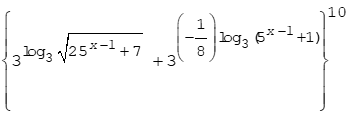 in the increasing powers of \( 3^{\left(-\dfrac{1}{8}\right)\log_{3}\!\left(5^{x-1}+1\right)} \) is equal to \( 180 \), is:
 then \( m \) equals:

