Let \( [x] \) denote the greatest integer function, and let \( m \) and \( n \) respectively be the numbers of the points, where the function \( f(x) = [x] + |x - 2|, \, -2 < x < 3, \) is not continuous and not differentiable. Then \( m + n \) is equal to :
In an arithmetic progression, if \( S_{40} = 1030 \) and \( S_{12} = 57 \), then \( S_{30} - S_{10} \) is equal to:
Let \( (2, 3) \) be the largest open interval in which the function \( f(x) = 2 \, \log_e (x - 2) - x^2 + a x + 1 \) is strictly increasing and \( (b, c) \) be the largest open interval, in which the function \( g(x) = (x - 1)^3 (x + 2 - a)^2 \) is strictly decreasing. Then \( 100(a + b - c) \) is equal to :
The number of real solution(s) of the equation \( x^2 + 3x + 2 = m\ \, in\{\,|x - 3|, \, |x + 2|\,\} \) is :
The equation of the chord, of the ellipse \(\displaystyle \frac{x^2}{25} + \frac{y^2}{16} = 1 \), whose mid-point is \( (3, 1) \) is:
If \( 7 = 5 + \frac{1}{7}(5 + \alpha) + \frac{1}{7^2}(5 + 2\alpha) + \frac{1}{7^3}(5+ 3\alpha) + \ldots \\infty \), then the value of \( \alpha \) is:
Let the points \( \left(\frac{11}{2}, \alpha\right) \) lie on or inside the triangle with sides \( x + y = 11 \), \( x + 2y = 16 \) and \( 2x + 3y = 29 \). Then the product of the smallest and the largest values of \( \alpha \) is equal to:
Group \( A \) consists of \( 7 \) boys and \( 3 \) girls, while group \( B \) consists of \( 6 \) boys and \( 5 \) girls. The number of ways, \( 4 \) boys and \( 4 \) girls can be invited for a picnic if \( 5 \) of them must be from group \( A \) and the remaining \( 3 \) from group \( B \), is equal to:
Let \( f : (0,\infty) \to \mathbb{R} \) be a function which is differentiable at all points of its domain and satisfies the condition \( x^{2} f'(x) = 2x f(x) + 3 \), with \( f(1) = 4 \). Then \( 2\,f(2) \) is equal to:
Let \( A = [a_{ij}] \) be a square matrix of order \( 2 \) with entries either \( 0 \) or \( 1 \). Let \( E \) be the event that \( A \) is an invertible matrix. Then the probability \( P(E) \) is:
Let \( \vec{a} = 3\hat{i} - \hat{j} + 2\hat{k} \), \( \vec{b} = \vec{a} \times (\hat{i} - 2\hat{k}) \) and \( \vec{c} = \vec{b} \times \hat{k} \). Then the projection of \( \vec{c} - 2\hat{j} \) on \( \vec{a} \) is:
Suppose \( A \) and \( B \) are the coefficients of \( 30^{\text{th}} \) and \( 12^{\text{th}} \) terms respectively in the binomial expansion of \( (1 + x)^{2n-1} \). If \( 2A = 5B \), then \( n \) is equal to:
If the equation of the parabola with vertex \( V\left(\frac{3}{2},\,3\right) \) and the directrix \( x+2y=0 \) is \( \alpha x^{2}+\beta y^{2}-\gamma xy-30x-60y+225=0 \), then \( \alpha+\beta+\gamma \) is equal to:
The area of the region enclosed by the curves \( y=e^{x} \), \( y=|e^{x}-1| \) and y-axis is:
Let \( A=\left\{x\in(0,\pi)-\left\{\frac{\pi}{2}\right\}:\;\log_{({2}/{\pi})}\!\left| \sin x \right|+\log_{({2}/{\pi})}\!\left| \cos x \right|= 2\right\} \) and \( B=\left\{x\ge 0:\sqrt{x}\left(\sqrt{x}-4\right)-3\left|\sqrt{x}-2\right|+6=0\right\} \). Then \( n\!\left(A\cup B\right) \) is equal to:
If the system of equations\( x+2y-3z=2 \)\( 2x+\lambda y+5z=5 \) \( 14x+3y+\mu z=33 \) has infinitely many solutions, then \( \lambda+\mu \) is equal to:
For some \( a,b \), let\( x\ne 0,\; \displaystyle\lim_{x\to 0} f(x)=\lambda+\mu a+\nu b. \) Then \(( \lambda+\mu+\nu)^{2} \) is equal to:
If \( \alpha>\beta>\gamma>0 \), then the expression \( \displaystyle \cot^{-1} \left\{ \beta + \frac{(1 + \beta^2)}{(\alpha - \beta)} \right\} + \cot^{-1} \left\{ \gamma + \frac{(1 + \gamma^2)}{(\beta - \gamma)} \right\} + \cot^{-1} \left\{ \alpha + \frac{(1 + \alpha^2)}{(\gamma - \alpha)} \right\} \) is equal to:
Let the position vectors of three vertices of a triangle be \( 4\vec{p} + \vec{q} - 3\vec{r} \), \( -5\vec{p} + \vec{q} + 2\vec{r} \) and \( 2\vec{p} - \vec{q} + 2\vec{r} \). If the position vectors of the orthocenter and the circumcenter of the triangle are \( \frac{\vec{p} + \vec{q} + \vec{r}}{4} \) and \( \alpha \vec{p} + \beta \vec{q} + \gamma \vec{r} \) respectively, then \( \alpha + 2\beta + 5\gamma \) is equal to:
The function \( f : (-\infty,\infty) \to (-\infty,1) \) defined by \( f(x) = \dfrac{2^x - 2^{-x}}{2^x + 2^{-x}} \) is:
Let \( P \) be the image of the point \( Q(7,-2,5) \) in the line \( L:\; \dfrac{x-1}{2} = \dfrac{y+1}{3} = \dfrac{z}{4} \) and \( R(5,p,q) \) be a point on \( L \). Then the square of the area of \( \triangle PQR \) is \( \underline{\phantom{xxxx}} \).
Let \( y = y(x) \) be the solution of the differential equation \( 2\cos x \dfrac{dy}{dx} = \sin 2x - 4y \sin x, \; x \in \left(0,\dfrac{\pi}{2}\right). \) If \( y\!\left(\dfrac{\pi}{3}\right)=0 \), then \( y'\!\left(\dfrac{\pi}{4}\right) + y\!\left(\dfrac{\pi}{4}\right) \) is equal to \( \underline{\phantom{xxxx}} \).
Number of functions \( f : \{1,2,\ldots,100\} \to \{0,1\} \), that assign \( 1 \) to exactly one of the positive integers less than or equal to \( 98 \), is equal to \( \underline{\phantom{xxxx}} \).
Let \( H_1 : \dfrac{x^2}{a^2} - \dfrac{y^2}{b^2} = 1 \) and \( H_2 : -\dfrac{x^2}{A^2} + \dfrac{y^2}{B^2} = 1 \) be two hyperbolas having length of latus rectums \( 15\sqrt{2} \) and \( 12\sqrt{5} \) respectively. Let their eccentricities be \( e_1 = \sqrt{\dfrac{5}{2}} \) and \( e_2 \) respectively. If the product of the lengths of their transverse axes is \( 100\sqrt{10} \), then \( 25e_2^2 \) is equal to \( \underline{\phantom{xxxx}} \).
If \(\displaystyle \int \frac{2x^2 + 5x + 9}{\sqrt{x^2 + x + 1}} \, dx = x\sqrt{x^2 + x + 1} + \alpha \sqrt{x^2 + x + 1} + \beta \log_{e}\left| x + \frac{1}{2} + \sqrt{x^2 + x + 1} \right| + C \), where \( C \) is the constant of integration, then \( \alpha + 2\beta \) is equal to ____________.

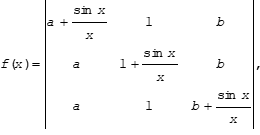 \( x\ne 0,\; \displaystyle\lim_{x\to 0} f(x)=\lambda+\mu a+\nu b. \) Then \(( \lambda+\mu+\nu)^{2} \) is equal to: