If the first term of an A.P. is \( 3 \) and the sum of its first four terms is equal to one-fifth of the sum of the next four terms, then the sum of the first \( 20 \) terms is equal to:
One die has two faces marked \( 1 \), two faces marked \( 2 \), one face marked \( 3 \) and one face marked \( 4 \). Another die has one face marked \( 1 \), two faces marked \( 2 \), two faces marked \( 3 \) and one face marked \( 4 \). The probability of getting the sum of numbers to be \( 4 \) or \( 5 \), when both the dice are thrown together, is:
Let $\left| \frac{\bar{z} - i}{2\bar{z} + i} \right| = \frac{1}{3}, z \in C$, be the equation of a circle with center at $C$. If the area of the triangle, whose vertices are at the points $(0, 0)$, $C$ and $(\alpha, 0)$ is $11$ square units, then $\alpha^2$ equals:
If the system of equations\( (\lambda - 1)x + (\lambda - 4)y + \lambda z = 5 \)\( \lambda x + (\lambda - 1)y + (\lambda - 4)z = 7 \)\( (\lambda + 1)x + (\lambda + 2)y - (\lambda + 2)z = 9 \)has infinitely many solutions, then \( \lambda^{2} + \lambda \) is equal to:
Let the position vectors of the vertices $A, B$ and $C$ of a tetrahedron $ABCD$ be $\hat{i} + 2\hat{j} + \hat{k}$, $\hat{i} + 3\hat{j} - 2\hat{k}$ and $2\hat{i} + \hat{j} - \hat{k}$ respectively. The altitude from the vertex $D$ to the opposite face $ABC$ meets the median line segment through $A$ of the triangle $ABC$ at the point $E$. If the length of $AD$ is $\frac{\sqrt{110}}{3}$ and the volume of the tetrahedron is $\frac{\sqrt{805}}{6\sqrt{2}}$, then the position vector of $E$ is:
The number of words, which can be formed using all the letters of the word “DAUGHTER”, so that all the vowels never come together, is:
If \( \frac{\pi}{2} \leq x \leq \frac{3\pi}{4} \), then \( \cos^{-1}\!\left( \frac{12}{13}\cos x + \frac{5}{13}\sin x \right) \) is equal to:
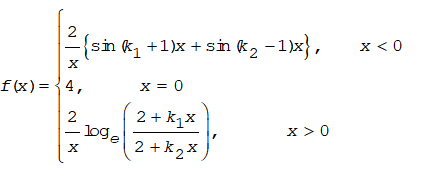
If the functionis continuous at \( x=0 \), then \( k_1^2+k_2^2 \) is equal to:
Let the arc \( AC \) of a circle subtend a right angle at the centre \( O \). If the point \( B \) on the arc \( AC \), divides the arc \( AC \) such that \( \dfrac{\text{length of arc }AB}{\text{length of arc }BC}=\dfrac{1}{5} \), and \( \overrightarrow{OC}=\alpha\,\overrightarrow{OA}+\beta\,\overrightarrow{OB} \), then \( a+\sqrt{2}(\sqrt{3}-1)\beta \) is equal to:
Let \( I(x)=\displaystyle \int \frac{dx}{(x-11)^{\frac{11}{13}}(x+15)^{\frac{5}{13}}} \). If \( I(37)-I(24)=\frac{1}{4}\left(\frac{1}{b^{\frac{1}{13}}}-\frac{1}{c^{\frac{1}{13}}}\right) \), \( b,c\in \mathbb{N} \), then \( 3(b+c) \) is equal to:
Let \( P \) be the foot of the perpendicular from the point \( Q(10,-3,-1) \) on the line \( \dfrac{x-3}{7}=\dfrac{y-2}{-1}=\dfrac{z+1}{-2} \). Then the area of the right-angled triangle \( PQR \), where \( R \) is the point \( (3,-2,1) \) is:
Let \( R=\{(1,2),(2,3),(3,3)\} \) be a relation defined on the set \( \{1,2,3,4\} \). Then the minimum number of elements, needed to be added in \( R \) so that \( R \) becomes an equivalence relation, is:
The value of $\int_{e^2}^{e^4} \frac{1}{x} \left( \frac{e^{\left((\log_e x)^2 + 1\right)^{-1}}}{e^{\left((\log_e x)^2 + 1\right)^{-1}} + e^{\left((6 - \log_e x)^2 + 1\right)^{-1}}} \right) dx$ is :
Marks obtains by all the students of class \( 12 \) are presented in a frequency distribution with classes of equal width. Let the median of this grouped data be \( 14 \) with median class interval \( 12\text{–}18 \) and median class frequency \( 12 \). If the number of students whose marks are less than \( 12 \) is \( 18 \), then the total number of students is:
Let \( f(x) = \log_e x \) and \( g(x) = \dfrac{x^4 - 2x^3 + 3x^2 - 2x + 2}{2x^2 - 2x + 1} \). Then the domain of \( fog \) is:
Let the area of a \( \triangle PQR \) with vertices \( P(5, 4) \), \( Q(-2, 4) \) and \( R(a, b) \) be \( 35 \) square units. If its orthocenter and centroid are \( O\!\left(2, \dfrac{14}{5}\right) \) and \( C(c, d) \) respectively, then \( c + 2d \) is equal to:
If \( A, B \) and \( \operatorname({adj}(A^{-1}) + \operatorname{adj}(B^{-1}) \)) are non-singular matrices of same order, then the inverse of \( A\left(\operatorname{adj}(A^{-1}) + \operatorname{adj}(B^{-1})\right)^{-1}B \) , is equal to:
The value of \( (\sin 70^\circ)(\cot 10^\circ \cot 70^\circ - 1) \) is:
If the line \( 3x - 2y + 12 = 0 \) intersects the parabola \( 4y = 3x^2 \) at the points \( A \) and \( B \), then at the vertex of the parabola, the line segment \( AB \) subtends an angle equal to:
Let a curve \( y = f(x) \) pass through the points \( (0, 5) \) and \( (\log_{e} 2,\; k) \). If the curve satisfies the differential equation \( 2(3 + y)e^{2x}\, dx - (7 + e^{2x})\, dy = 0 \), then \( k \) is equal to:
The sum of all rational terms in the expansion of $\left(1 + 2^{1/3} + 3^{1/2}\right)^6$ is equal to __________.
Let the circle \( C \) touch the line \( x - y + 1 = 0 \), have the centre on the positive \( x \)-axis, and cut off a chord of length \( \dfrac{4}{\sqrt{13}} \) along the line \( -3x + 2y = 1 \). Let \( H \) be the hyperbola \( \dfrac{x^{2}}{\alpha^{2}} - \dfrac{y^{2}}{\beta^{2}} = 1 \), whose one of the foci is the centre of \( C \) and the length of the transverse axis is the diameter of \( C \). Then \( 2\alpha^{2} + 3\beta^{2} \) is equal to ________.
If the set of all values of \( a \), for which the equation \( 5x^{3} - 15x - a = 0 \) has three distinct real roots, is the interval \( (\alpha, \beta) \), then \( \beta - 2\alpha \) is equal to ________.
If the area of the larger portion bounded between the curves \( x^{2} + y^{2} = 25 \) and \( y = |x - 1| \) is \( \dfrac{1}{4}(b\pi + c), \; b, c \in \mathbb{N} \), then \( b + c \) is equal to ________.
If the equation \( a(b - c)x^2 + b(c - a)x + c(a - b) = 0 \) has equal roots, where \( a + c = 15 \) and \( b = \frac{36}{5} \), then \( a^2 + c^2 \) is equal to ________.