The area of the region bounded by the parabola \( (y - 2)^2 = (x - 1) \), the tangent to it at the point whose ordinate is \( 3 \) and the \( x \)-axis is :
Each of the persons \( A \) and \( B \) independently tosses \( 3 \) fair coins. The probability that both of them get the same number of heads is :
A box open from top is made from a rectangular sheet of dimension \( a \times b \) by cutting squares each of side \( x \) from each of the four corners and folding up the flaps. If the volume of the box is maximum, then \( x \) is equal to :
Let \( \mathbb{Z} \) be the set of all integers, \( A = \{(x,y) \in \mathbb{Z} \times \mathbb{Z} : (x-2)^{2} + y^{2} \leq 4 \} \), \( B = \{(x,y) \in \mathbb{Z} \times \mathbb{Z} : x^{2} + y^{2} \leq 4 \} \) and \( C = \{(x,y) \in \mathbb{Z} \times \mathbb{Z} : (x-2)^{2} + (y-2)^{2} \leq 4 \} \). If the total number of relations from \( A \cap B \) to \( A \cap C \) is \( 2^{p} \), then the value of \( p \) is :
Let \( [\lambda] \) be the greatest integer less than or equal to \( \lambda \). The set of all values of \( \lambda \) for which the system of linear equations \( x + y + z = 4 \), \( 3x + 2y + 5z = 3 \), \( 9x + 4y + (28 + [\lambda])z = [\lambda] \) has a solution is :
Let \( A(a,0) \), \( B(b, 2b + 1) \) and \( C(0,b) \), \( b \neq 0 \), \( |b| \neq 1 \), be points such that the area of triangle \( ABC \) is \( 1 \, \text{sq. unit} \), then the sum of all possible values of \( a \) is :
The angle between the straight lines, whose direction cosines are given by the equations \( 2l + 2m - n = 0 \) and \( mn + nl + lm = 0 \), is:
Two poles, \( AB \) of length \( a \) meters and \( CD \) of length \( a+b \) (\( b\neq a \)) meters are erected at the same horizontal level with bases at \( B \) and \( D \). If \( BD=x \) and \( \tan \angle ACB=\frac{1}{2} \), then:
If the solution curve of the differential equation \( (2x-10y^{3})\,dy+y\,dx=0 \), passes through the points \( (0,1) \) and \( (2,\beta) \), then \( \beta \) is a root of the equation:
The value of the integral \( \displaystyle \int_{0}^{1}\frac{\sqrt{x}\,dx}{(1+x)(1+3x)(3+x)} \) is:
A differential equation representing the family of parabolas with axis parallel to y-axis and whose length of latus rectum is the distance of the point \( (2,-3) \) from the line \( 3x+4y=5 \), is given by:
If two tangents drawn from a point \( P \) to the parabola \( y^{2}=16(x-3) \) are at right angles, then the locus of point \( P \) is:
If \( 0 < x < 1 \) and \( y = \frac{1}{2} x^{2} + \frac{2}{3} x^{3} + \frac{3}{4} x^{4} + \ldots \), then the value of \( e^{\,1 + y} \) at \( x = \frac{1}{2} \) is:
where \( [t] \) denotes the greatest integer less than or equal to \( t \). If \( \det(A) = 192 \), then the set of values of \( x \) is the interval:
The set of all values of \( k > -1 \), for which the equation \( (3x^{2} + 4x + 3)^{2} - (k + 1)\,(3x^{2} + 4x + 3)\,(3x^{2} + 4x + 2) + k\,(3x^{2} + 4x + 2)^{2} = 0 \) has real roots, is:
The equation of the plane passing through the line of intersection of the planes \( \vec{r} \cdot (\hat{i} + \hat{j} + \hat{k}) = 1 \) and \( \vec{r} \cdot (2\hat{i} + 3\hat{j} - \hat{k}) + 4 = 0 \) and parallel to the \( x \)-axis is:
The Boolean expression \( (p \land q) \Rightarrow \big((r \land q) \land p\big) \) is equivalent to:
If \( y(x) = \cot^{-1}\!\left(\sqrt{\frac{\sqrt{1 + \sin x} + \sqrt{1 - \sin x}}{\sqrt{1 + \sin x} - \sqrt{1 - \sin x}}}\right),\ x \in \left( \frac{\pi}{2}, \pi \right) \) then \( \frac{dy}{dx} \) at \( x = \frac{5\pi}{6} \) is:
If \( \displaystyle \lim_{x \to \infty}\left(\sqrt{x^2 - x + 1} - a x\right) = b \), then the ordered pair \( (a, b) \) is:
Let \( M \) and \( m \) respectively be the maximum and minimum values of the function \( f(x)=\tan^{-1}(\sin x+\cos x) \) in \( \left[0,\frac{\pi}{2}\right] \). Then the value of \( \tan(M-m) \) is equal to:
Let \( S \) be the mirror image of the point \( Q(1,\,3,\,4) \) with respect to the plane \( 2x-y+z+3=0 \) and let \( R(3,\,5,\gamma) \) be a point of this plane. Then the square of the length of the line segment \( SR \) is ______.
Let \( S \) be the sum of all solutions (in radians) of the equation \( \sin^4\theta+\cos^4\theta-\sin\theta\cos\theta=0 \) in \( [0,\,4\pi] \). Then \( \dfrac{8S}{\pi} \) is equal to ______.
Let \( z_1 \) and \( z_2 \) be two complex numbers such that \( \arg(z_1-z_2)=\dfrac{\pi}{4} \) and \( z_1,\,z_2 \) satisfy the equation \( |z-3|=\operatorname{Re}(z) \). Then the imaginary part of \( z_1+z_2 \) is equal to ______.
Let \( S=\{1,\,2,\,3,\,4,\,5,\,6,\,9\} \). Then the number of elements in the set \( T=\{A\subseteq S:\ A\neq \phi \ \text{and the sum of all the elements of }A \text{ is not a multiple of }3\} \) is ______.
\( 3 \times 7^{22} + 2 \times 10^{22} - 44 \) when divided by \( 18 \) leaves the remainder ________.
If \( \int \frac{2e^{x} + 3e^{-x}}{4e^{x} + 7e^{-x}} \, dx = \frac{1}{14}\left( ux + v \log_{e}(4e^{x} + 7e^{-x}) \right) + C \), where \( C \) is a constant of integration, then \( u + v \) is equal to ________.
The probability distribution of random variable \( X \) is given by:
Let \( p = P(1 < X < 4 \mid X < 3) \). If \( 5p = \lambda k \), then \( \lambda \) is equal to ________.
Two circles each of radius \( 5 \) units touch each other at the point \( (1, 2) \). If the equation of their common tangents is \( 4x + 3y = 10 \), and \( C_{1} (\alpha, \beta) \) and \( C_{2} (\gamma, \delta) \), \( C_{1} \ne C_{2} \) are their centres, then \( |(\alpha + \beta)(\gamma + \delta)| \) is equal to ________.
Let \( A (\sec \theta, 2 \tan \theta) \) and \( B (\sec \phi, 2 \tan \phi) \), where \( \theta + \phi = \frac{\pi}{2} \), be two points on the hyperbola \( 2x^{2} - y^{2} = 2 \). If \( (\alpha, \beta) \) is the point of the intersection of the normals to the hyperbola at \( A \) and \( B \), then \( (2\beta)^{2} \) is equal to ________.
An online exam is attempted by \( 50 \) candidates out of which \( 20 \) are boys. The average marks obtained by boys is \( 12 \) with variance \( 2 \). The variance of marks obtained by \( 30 \) girls is also \( 2 \). The average marks of \( 50 \) candidates is \( 15 \). If \( \mu \) is the average marks of girls and \( \sigma^{2} \) is varience of marks of \( 50 \) candidates, then \( \mu + \sigma^{2} \) is equal to ________.

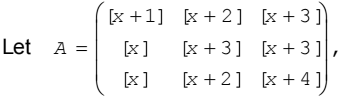 where \( [t] \) denotes the greatest integer less than or equal to \( t \). If \( \det(A) = 192 \), then the set of values of \( x \) is the interval:
