The total number of functions \( f : \{1,2,3,4\} \to \{1,2,3,4,5,6\} \) Such that \( f(1) + f(2) = f(3) \) is equal to :
If \( \alpha,\beta,\gamma,\delta \) are the roots of the equation \( x^{4}+x^{3}+x^{2}+x+1=0 \), then \( \alpha^{2021}+\beta^{2021}+\gamma^{2021}+\delta^{2021} \) is equal to :
For \( n \in N \), let \( S_{n}=\{ z \in C : |z-3+2i|=\dfrac{n}{4} \} \) & \( T_{n}=\{ z \in C : |z-2+3i|=\dfrac{1}{n} \} \). Then the number of elements in the set \( \{ n \in N : S_{n} \cap T_{n}=\phi \} \) is :
The number of \( \theta \in (0,4\pi) \) for which the system is linear equations \( 3(\sin 3\theta)x - y + z = 2 \) \( 3(\cos 2\theta)x + 4y + 3z = 3 \) \( 6x + 7y + 7z = 9 \) Has no solution, is :
If \( \displaystyle\lim_{n \to \infty} \left( \sqrt{n^{2}-n-1} + n\alpha + \beta \right)=0 \), then \( 8(\alpha+\beta) \) is equal to :
If the absolute maximum value of the function \( f(x)=(x^{2}-2x+7)e^{(4x^{3}-12x^{2}-180x+31)} \) in the interval \( [-3,0] \) is \( f(\alpha) \), then :
The curve \( y(x) = ax^3 + bx^2 + cx + 5 \) touches the x-axis at the point \( P(-2,0) \) and cuts then y-axis at the point \( Q \), where \( y' \) is equal to \( 3 \). Then the local maximum value of \( y(x) \) is :
The area of the region given by \( A=\{(x,y): x^2 \leq y \leq \min\{x+2,\, 4-3x\}\} \) is :
For any real number \( x \), let \( [x] \) denote the largest integer less than equal to \( x \). Let \( f \) be a real valued function defined on the interval \( [-10,10] \) by . Then the value of \( \dfrac{\pi^{2}}{10}\displaystyle\int\limits_{-10}^{10} f(x)\cos \pi x \, dx \) is :
The slope of the tangent to a curve \( C: y=y(x) \) at any point \( (x,y) \) on it is \( \dfrac{2e^{2x}-6e^{-x}+9}{2+9e^{-2x}} \). If \( C \) passes through the points \( \left(0,\dfrac{1}{2}+\dfrac{\pi}{2\sqrt{2}}\right) \) & \( \left(\alpha,\dfrac{1}{2}e^{2\alpha}\right) \), then \( e^{\alpha} \) is equal to :
The general solution of the differential equation \( (x-y^{2})dx+y(5x+y^{2})dy=0 \) is :
A line, with the slope greater than one, passes through the point \( A(4,3) \) and intersects the line \( x-y-2=0 \) at the point \( B \). If the length of the line segment \( AB \) is \( \dfrac{\sqrt{29}}{3} \), then \( B \) also lies on the line:
Let the locus of the centre \( (\alpha, \beta) \), \( \beta > 0 \), of the circle which touches the circle \( x^2 + (y-1)^2 = 1 \) externally and also touches the \( x \)-axis be \( L \). Then the area bounded by \( L \) and the line \( y = 4 \) is:
Let \( P \) be the plane containing the straight line \( \displaystyle\frac{x-3}{9}=\frac{y+4}{-1}=\frac{z-7}{-5} \) and perpendicular to the plane containing the straight lines \(\displaystyle \frac{x}{2}=\frac{y}{3}=\frac{z}{5} \) & \(\displaystyle \frac{x}{3}=\frac{y}{7}=\frac{z}{8} \). If \( d \) is the distance of \( P \) from the point \( (2,-5,11) \), then \( d^2 \) is equal to:
Let \( ABC \) be a triangle such that \( \overrightarrow{BC}=\vec{a} \), \( \overrightarrow{CA}=\vec{b} \), \( \overrightarrow{AB}=\vec{c} \), \( |\vec{a}|=6\sqrt{2} \), \( |\vec{b}|=2\sqrt{3} \) and \( \vec{b}\cdot\vec{c}=12 \). Consider the statements:(S1): \( \big|(\vec{a}\times\vec{b})+(\vec{c}\times\vec{b})\big| - |\vec{c}| = 6(2\sqrt{2}-1) \)(S2): \( \angle ACB = \cos^{-1}\!\left(\sqrt{\dfrac{2}{3}}\right) \)Then
If the sum and the product of mean and variance of a binomial distribution are \( 24 \) and \( 128 \) respectively, then the probability of one or two successes is:
If the numbers appeared on the two thrown of a fair six faced die are \( \alpha \) & \( \beta \), then the probability that \( x^{2}+\alpha x+\beta>0 \), for all \( x\in \mathbb{R} \) is:
The number of solutions of \( |\cos x|=\sin x \), such that \( -4\pi \le x \le 4\pi \) is:
A tower \( PQ \) stands on a horizontal ground with base \( Q \) on the ground. The point \( R \) divides the tower in two parts such that \( QR = 15 \, \text{m} \). If from a point \( A \) on the ground the angle of elevation of \( R \) is \( 60^\circ \) and the part \( PR \) of the tower subtends an angle of \( 15^\circ \) at \( A \), then the height of the tower is :
Which of the following statements is a tautology?
Let \(\displaystyle A = \begin{pmatrix} 2 & -1 & -1 \\ 1 & 0 & -1 \\ 1 & -1 & 0 \end{pmatrix}\) \(\ \& \ B=A-I. \) Let \( \omega=\dfrac{\sqrt{3}\,i-1}{2} \). If the number of elements in the set \( \{\, n\in \{1,2,\ldots,100\} : A^n+(\omega B)^n + A + B \, \} \) is equal to ______.
The letters of the word ‘\( \text{MANKIND} \)’ are written in all possible orders and arranged in serial order as in an English dictionary. Then the serial number of the word ‘\( \text{MANKIND} \)’ is ______.
If the maximum value of the term independent of \( t \) in the expansion of \( \left(t^{2}x^{1/5}+\dfrac{(1-x)^{1/10}}{t}\right)^{15},\ x\ge 0, \) is \( K \), then \( 8K \) is equal to ______.
Let \( a,b \) be two non-zero real numbers. If \( p \) and \( r \) are the roots of the equation \( x^{2}-8ax+2a=0 \) and \( q \) and \( s \) are the roots of the equation \( x^{2}+12bx+6b=0 \), such that \( \dfrac{1}{p},\ \dfrac{1}{q},\ \dfrac{1}{r},\ \dfrac{1}{s} \) are in A.P., then \( a^{-1}-b^{-1} \) is equal to ______.
Let \( a_1 = b_1 = 1, \ a_n = a_{n-1} + 2 \ \& \ b_n = a_n + b_{n-1} \) for every natural number \( n \ge 2 \). Then \( \displaystyle\sum_{n=1}^{15} a_n \cdot b_n \) is equal to ________.
, Where\( [\alpha] \) denotes the greatest integer less than or equal to \( \alpha \). Then the number of points in \( \mathbb{R} \) where \( f \) is not differentiable is ________.
If \(\displaystyle \lim_{n \to \infty} \frac{(n+1)^{k-1}}{n^{k+1}} \left[(nk+1) + (nk+2) + \ldots + (nk+n)\right] = 33 \cdot \lim_{n \to \infty} n^\dfrac{1}{{k+1}} \left[1^k + 2^k + 3^k + \ldots + n^k\right] \), Then the integral value of \( k \) is equal to ________.
Let the equation of two diameters of a circle \( x^2 + y^2 - 2x + 2fy + 1 = 0 \) be \( 2px - y = 1 \) and \( 2x + py = 4p \). Then the slope \( m \in (0,\infty) \) of the tangent to the hyperbola \( 3x^2 - y^2 = 3 \) passing through the centre of the circle is equal to ________.
The sum of diameters of the circles that touch (i) the parabola \( 75x^2 = 64(5y - 3) \) at the point \( \left(\dfrac{8}{5}, \dfrac{6}{5}\right) \) and (ii) the y-axis, is equal to ________.
The line of shortest distance between the lines \(\displaystyle \frac{x-2}{0} = \frac{y-1}{1} = \frac{z}{1} \) and \(\displaystyle \frac{x-3}{2} = \frac{y-5}{2} = \frac{z-1}{1} \) makes an angle of \(\displaystyle \cos^{-1}\!\left(\sqrt{\frac{2}{27}}\right) \) with the plane \( P: ax - y - z = 0, \ (a>0) \). If the image of the point \( (1,1,-5) \) in the plane \( P \) is \( (\alpha,\beta,\gamma) \), then \( \alpha + \beta - \gamma \) is equal to ______.

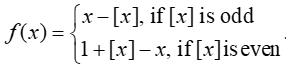 . Then the value of \( \dfrac{\pi^{2}}{10}\displaystyle\int\limits_{-10}^{10} f(x)\cos \pi x \, dx \) is :
 , Where\( [\alpha] \) denotes the greatest integer less than or equal to \( \alpha \). Then the number of points in \( \mathbb{R} \) where \( f \) is not differentiable is ________.