Let \([.]\) denote the greatest integer function. If the domain of the function \( f(x) = \cos^{-1}\!\left(\frac{4x + 2[x]}{3}\right) \) is \([\alpha,\beta]\), then \( 12(\alpha + \beta) \) is equal to:
If the set of all solutions of \( |x^{2}+x-9| = |x| + |x^{2}-9| \) is \([\alpha,\beta] \cup [\gamma,\infty)\), then \( (\alpha^{2}+\beta^{2}+\gamma^{2}) \) is equal to:
Let \( z \) be a complex number such that \( |z+2| = |z-2| \) and \( \arg\!\left(\frac{z+3}{z-i}\right) = \frac{\pi}{4} \). Then \( |z|^{2} \) is equal to:
The number of functions \( f : \{1,2,3,4\} \to \{a,b,c\} \), which are not onto, is:
Let be a set of \( 2 \times 2 \) matrices. Then the number of matrices in \( S \), for which the sum of the diagonal elements is equal to \( 4 \), is:
Let Then the sum of all elements of the matrix \( \operatorname{adj}(\operatorname{adj}(2(\operatorname{adj}A)^{-1})) \) is equal to:
The first term of an A.P. of \( 30 \) non-negative terms is \( \frac{10}{3} \). If the sum of this A.P. is the cube of its last term, then its common difference is:
The number of ways, of forming a queue of \( 4 \) boys and \( 3 \) girls such that all the girls are not together, is:
Let the smallest value of \( k \in \mathbb{N} \), for which the coefficient of \( x^3 \) in \( (1+x)^3 + (1+x)^4 + (1+x)^5 + \ldots + (1+x)^{99} + (1+kx)^{100} \), \( x \neq 0 \), is \( \left( \frac{43n + 101}{4} \right)\binom{100}{3} \) for some \( n \in \mathbb{N} \), be \( p \). Then the value of \( p + n \) is:
Suppose that the mean and median of the non-negative numbers \( 21, 8, 17, a, 51, 103, b, 13, 67 \), \( (a > b) \), are \( 40 \) and \( 21 \), respectively. If the mean deviation about the median is \( 26 \), then \( 2a \) is equal to:
Let the line \( L_1 : x + 3 = 0 \) intersect the lines \( L_2 : x - y = 0 \) and \( L_3 : 3x + y = 0 \) at the points \( A \) and \( B \), respectively. Let the bisector of the obtuse angle between the lines \( L_2 \) and \( L_3 \) intersect the line \( L_1 \) at the point \( C \). Then \( BC^2 : AC^2 \) is equal to:
Let the vertex \( A \) of a triangle \( ABC \) be \( (1, 2) \), and the mid-point of the side \( AB \) be \( (5, -1) \). If the centroid of this triangle is \( (3, 4) \) and its circumcenter is \( (\alpha, \beta) \), then \( 21(\alpha + \beta) \) is equal to:
Suppose that two chords, drawn from the point \( (1, 2) \) on the circle \( x^{2}+y^{2}+x-3y=0 \) are bisected by the \( y \)-axis. If the other ends of these chords are \( R \) and \( S \), and the midpoint of the line segment \( RS \) is \( (\alpha,\beta) \), then \( 6(\alpha+\beta) \) is equal to:
A line with direction ratios \( 1,-1,2 \) intersects the lines \( \dfrac{x}{2}=\dfrac{y}{3}=\dfrac{z+1}{3} \) and \( \dfrac{x+1}{-1}=\dfrac{y-2}{1}=\dfrac{z}{4} \) at the points \( P \) and \( Q \), respectively. If the length of the line segment \( PQ \) is \( a \), then \( 225a^{2} \) is equal to:
The square of the distance of the point \( (-2,-8,6) \) from the line \( \dfrac{x-1}{1}=\dfrac{y-1}{2}=\dfrac{z}{-1} \) along the line \( \dfrac{x+5}{1}=\dfrac{y+5}{-1}=\dfrac{z}{2} \) is equal to:
If \( y=\tan^{-1}\!\left(\dfrac{3\cos x-4\sin x}{4\cos x+3\sin x}\right)+2\tan^{-1}\!\left(\dfrac{x}{1+\sqrt{1-x^{2}}}\right) \), then \( \dfrac{dy}{dx} \) at \( x=\dfrac{\sqrt{3}}{2} \) is equal to:
Let \( f \) be a real polynomial of degree \( n \) such that \( f(x)=f'(x)f''(x) \), for all \( x\in\mathbb{R} \). If \( f(0)=0 \), then \( 36\left(f'(2)+f''(2)+\int_{0}^{2}f(x)\,dx\right) \) is equal to:
The area of the region \( \{(x,y): y\le \pi-|x|,\, |y|\le |\sin x|,\, y\ge 0\} \) is:
Let \( \int_{-2}^{2} \left(|\sin x| + [x\sin x]\right)\,dx = 2(3-\cos 2)+\beta \), where \( [\cdot] \) is the greatest integer function. Then \( \beta \sin\!\left(\dfrac{\beta}{2}\right) \) equals:
Let \( y=y(x) \) be the solution of the differential equation \( \dfrac{dy}{dx}=(1+x+x^{2})(1-y+y^{2}) \), \( y(0)=\dfrac{1}{2} \). Then \( (2y(1)-1) \) is equal to:
A coin is tossed \( 8 \) times. If the probability that exactly \( 4 \) heads appear in the first six tosses and exactly \( 3 \) heads appear in the last five tosses is \( p \), then \( 96p \) is equal to ________.
Consider the parabola \( P: y^{2}=4kx \) and the ellipse \( E: \dfrac{x^{2}}{a^{2}}+\dfrac{y^{2}}{b^{2}}=1 \). Let the line segment joining the points of intersection of \( P \) and \( E \), be their latus rectums. If the eccentricity of \( E \) is \( e \), then \( e^{2}+2\sqrt{2} \) is equal to ________.
If \( A=\dfrac{\sin 3^{\circ}}{\cos 9^{\circ}}+\dfrac{\sin 9^{\circ}}{\cos 27^{\circ}}+\dfrac{\sin 27^{\circ}}{\cos 81^{\circ}} \) and \( B=\tan 81^{\circ}-\tan 3^{\circ} \), then \( \dfrac{B}{A} \) is equal to ________.
Let \( \vec{a}_{k}=(\tan\theta_{k})\,\hat{i}+\hat{j} \) and \( \vec{b}_{k}=\hat{i}-(\cot\theta_{k})\,\hat{j} \), where \(\theta_k = \frac{2^{k-1}\pi}{2^{n} + 1}\), for some \( n\in \mathbb{N},\, n>5 \). Then the value of \( \dfrac{\sum_{k=1}^{n}|\vec{a}_{k}|^{2}}{\sum_{k=1}^{n}|\vec{b}_{k}|^{2}} \) is ________.
The number of points, at which the function \( f(x) = \max \{ 6x,\; 2 + 3x^2 + |x-1|\cos|x^2 - \tfrac{1}{4}| \} \), \( x \in (-\pi,\pi) \), is not differentiable is, is ________.

 be a set of \( 2 \times 2 \) matrices. Then the number of matrices in \( S \), for which the sum of the diagonal elements is equal to \( 4 \), is:
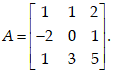 Then the sum of all elements of the matrix \( \operatorname{adj}(\operatorname{adj}(2(\operatorname{adj}A)^{-1})) \) is equal to: