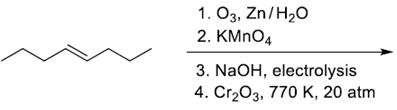
The number of \( -\mathrm{CH}_2- \) (methylene) groups in the product formed from the following reaction sequence is _______.
Treatment of buta-\( 1,3 \)-diyne with \( \mathrm{NaNH_2} \) (\( 2 \) equivalents), followed by reaction with excess of trans–\( \mathrm{CH_3-CH=CH-CH_2-Br} \) gives \( X \) as the major product. The maximum number of carbon atoms that are collinear (in a straight line) in \( X \) is ______.
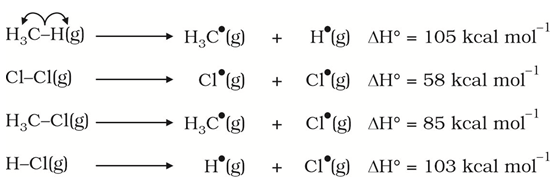
The amount of energy required to break a bond is same as the amount of energy released when the same bond is formed. In gaseous state, the energy required for homolytic cleavage of a bond is called Bond Dissociation Energy (BDE) or Bond Strength. BDE is affected by s-character of the bond and the stability of the radicals formed. Shorter bonds are typically stronger bonds. BDEs for some bonds are given below:For the following reaction,\( \mathrm{CH_4(g) + Cl_2(g) \xrightarrow{light} CH_3Cl(g) + HCl(g)} \)the correct statement is:
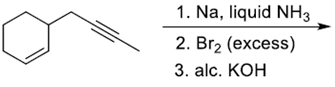
The number of isomeric tetraenes (NOT containing \( sp \)-hybridized carbon atoms) that can be formed from the following reaction sequence is _______.
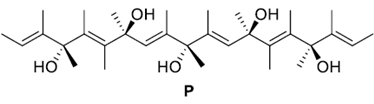
The total number of chiral molecules formed from one molecule of \( P \) on complete ozonolysis \( (\mathrm{O_3,\,Zn/H_2O}) \) is _______.