The amount of energy required to break a bond is same as the amount of energy released when the same bond is formed. In gaseous state, the energy required for homolytic cleavage of a bond is called Bond Dissociation Energy (BDE) or Bond Strength. BDE is affected by s-character of the bond and the stability of the radicals formed. Shorter bonds are typically stronger bonds. BDEs for some bonds are given below: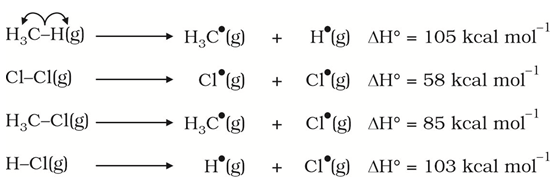
For the following reaction,
\( \mathrm{CH_4(g) + Cl_2(g) \xrightarrow{light} CH_3Cl(g) + HCl(g)} \)
the correct statement is: