9 questions
An ideal gas undergoes a reversible isothermal expansion from state \( \text{I} \) to state \( \text{II} \) followed by a reversible adiabatic expansion from state \( \text{II} \) to state \( \text{III} \). The correct plot(s) representing the changes from state \( \text{I} \) to state \( \text{III} \) is(are): \( (p : \text{pressure}, \; V : \text{volume}, \; T : \text{temperature}, \; H : \text{enthalpy}, \; S : \text{entropy}) \)
One mole of an ideal gas at \( 900 \, \text{K} \), undergoes two reversible processes, I followed by II, as shown below. If the work done by the gas in the two processes are same, the value of \( \ln \dfrac{V_3}{V_2} \) is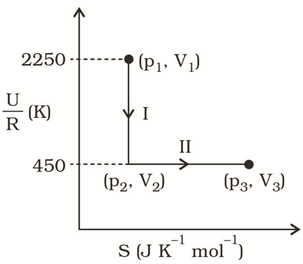
(\( U \): internal energy, \( S \): entropy, \( p \): pressure, \( V \): volume, \( R \): gas constant)
(Given: molar heat capacity at constant volume, \( C_{v,m} \) of the gas is \( \dfrac{5}{2} R \) )
Paragraphs-1
The entropy versus temperature plot for phase \( \alpha \) and \( \beta \) at \( 1 \) bar pressure is given. \( S_T \) and \( S_0 \) are entropies of the phases at temperature \( T \) and \( 0 \, \text{K} \), respectively.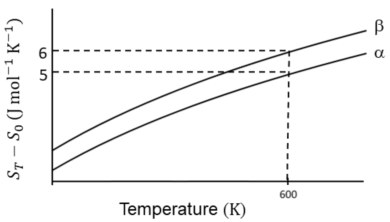
The transition temperature for \( \alpha \) to \( \beta \) phase change is \( 600 \, \text{K} \) and \( C_{p,\beta} - C_{p,\alpha} = 1 \, \text{J mol}^{-1} \text{ K}^{-1} \). Assume \( (C_{p,\beta}-C_{p,\alpha}) \) is independent of temperature in the range of \( 200 \) to \( 700 \, \text{K} \). \( C_{p,\alpha} \) and \( C_{p,\beta} \) are heat capacities of \( \alpha \) and \( \beta \) phases, respectively.
The value of entropy change, \( S_{\beta} - S_{\alpha} \) (in \( \text{J mol}^{-1} \text{ K}^{-1} \)), at \( 300 \, \text{K} \) is ____________.
[Use : \( \ln 2 = 0.69 \) ;
Given : \( S_{\beta} - S_{\alpha} = 0 \) at \( 0 \, \text{K} \) ]
List-I contains various physical/chemical processes, and List-II contains combinations of changes in enthalpy (\( \Delta H \)) and entropy (\( \Delta S \)). Match each entry in List-I to the appropriate entry in List-II, and choose the correct option.
One mole of an ideal monoatomic gas undergoes two reversible processes \(( A \to B \) and \( B \to C \)) as shown in the given figure: 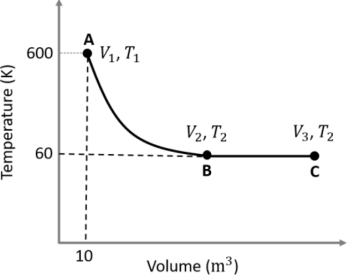
\( A \to B \) is an adiabatic process. If the total heat absorbed in the entire process \(( A \to B \) and \( B \to C \)) is \( RT_2 \ln 10 \), the value of \( 2 \log V_3 \) is _______.
[Use, molar heat capacity of the gas at constant pressure, \( C_{p,m} = \frac{5}{2} R \)]
Considering ideal gas behavior, the expansion work done (in \( \mathrm{kJ} \)) when \( 144 \) \( \mathrm{g} \) of water is electrolyzed completely under constant pressure at \( 300 \) \( \mathrm{K} \) is _______.
Use: Universal gas constant \( (R) = 8.3 \) \( \mathrm{J\ K^{-1}\ mol^{-1}} \); Atomic mass (in amu): \( \mathrm{H} = 1 \), \( \mathrm{O} = 16 \)
Consider the following volume-temperature (V–T) diagram for the expansion of \( 5 \, \text{moles} \) of an ideal monoatomic gas. 
Considering only P–V work is involved, the total change in enthalpy (in Joule) for the transformation of state in the sequence \( X \to Y \to Z \) is ______.
[Use the given data: Molar heat capacity of the gas for the given temperature range, \( C_{V,m} = 12 \, \text{J K}^{-1} \, \text{mol}^{-1} \) and gas constant, \( R = 8.3 \, \text{J K}^{-1} \, \text{mol}^{-1} \)]
Paragraphs-1
The entropy versus temperature plot for phase \( \alpha \) and \( \beta \) at \( 1 \) bar pressure is given. \( S_T \) and \( S_0 \) are entropies of the phases at temperature \( T \) and \( 0 \, \text{K} \), respectively.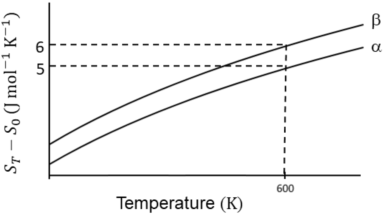
The transition temperature for \( \alpha \) to \( \beta \) phase change is \( 600 \, \text{K} \) and \( C_{p,\beta} - C_{p,\alpha} = 1 \, \text{J mol}^{-1} \text{ K}^{-1} \).Assume \( (C_{p,\beta}-C_{p,\alpha}) \) is independent of temperature in the range of \( 200 \) to \( 700 \, \text{K} \). \( C_{p,\alpha} \) and \( C_{p,\beta} \) are heat capacities of \( \alpha \) and \( \beta \) phases, respectively.
The value of enthalpy change, \( H_{\beta} - H_{\alpha} \) (in \( \text{J mol}^{-1} \)), at \( 300 \, \text{K} \) is ____________.
An ideal gas \( (0.5 \; \text{mol}) \), initially at \( 2 \; \text{bar} \) pressure, is compressed at a constant temperature of \( 600 \; \text{K} \) in two steps: first, against a constant external pressure of \( P \; \text{bar} \) \( (2 < P < 8) \), and then against constant external pressure of \( 8 \; \text{bar} \). At each step, the compression is stopped only when the pressure of the gas becomes equal to the external pressure. The total work done on the gas in these steps is \( W \). Considering all possible values of \( P \) \( (2 < P < 8) \) and taking the gas constant as \( R \) (in \( \text{J K}^{-1}\text{mol}^{-1} \)), the minimum value of \( |W| \) (in \( \text{J} \)) is:
