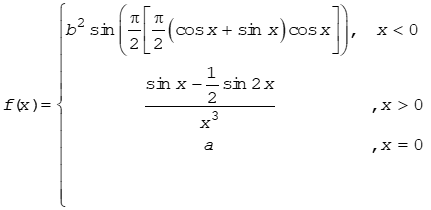
Let \([t]\) denote the greatest integer less than or equal to \( t \). If the functionis continuous at \( x=0 \), then \( a^{2}+b^{2} \) is equal to:
\( \frac{1}{2} \)
\( \frac{3}{4} \)
\( \frac{5}{8} \)
\( \frac{9}{16} \)