Let \( f(x) = x^6 + 2x^4 + x^3 + 2x + 3, \ x \in \mathbb{R} \). Then the natural number \( n \) for which \( \displaystyle \lim_{x \to 1} \dfrac{x^n f(1) - f(x)}{x - 1} = 44 \) is:
Let \( f : S \to S \) where \( S = (0,\infty) \) be a twice differentiable function such that \( f(x+1)=x f(x) \). If \( g:S \to \mathbb{R} \) be defined as \( g(x)=\log_e f(x) \), then the value of \( \left|\, g''(5)-g''(1)\,\right| \) is equal to:
The value of \( \displaystyle \lim_{x \to 0^+} \frac{\cos^{-1}(x - [x^2]) - \sin^{-1}(x - [x^2])}{x - x^3} \), where \( [x] \) denotes the greatest integer \( \le x \) is:
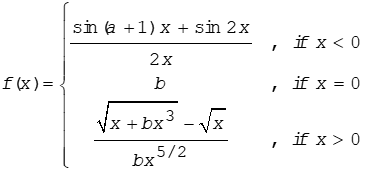
Let \( f:\mathbb{R}\to\mathbb{R} \) be a function defined as .If \( f \) is continuous at \( x=0 \), then the value of \( a+b \) is equal to:
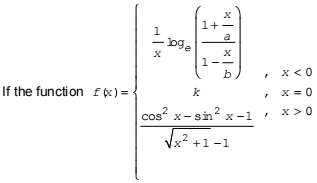
is continuous at \( x=0 \), then \( \frac{1}{a}+\frac{1}{b}+\frac{4}{k} \) is equal to:
Let \( [t] \) denote the greatest integer less than or equal to \( t \). Let \( f(x)=x-[x] \), \( g(x)=1-x+[x] \), and \( h(x)=\min\{f(x),g(x)\} \), \( x \in [-2,2] \). Then \( h \) is:
If \( \displaystyle\lim_{x\to 0}\frac{\alpha x e^{x}-\beta \log_{\alpha}(1+x)+\gamma x^{2}e^{-x}}{x\sin^{2}x}=10, \; \alpha,\beta,\gamma \in \mathbb{R}, \) then the value of \( \alpha+\beta+\gamma \) is ____________.
Let \( f:\mathbb{R} \to \mathbb{R} \) be a function such that \( f(2) = 4 \) and \( f'(2) = 1 \). Then, the value of \( \displaystyle \lim_{x \to 2} \frac{x^2 f(2) - 4 f(x)}{x - 2} \) is equal to:
Let \( f:\left[-\frac{\pi}{4},\frac{\pi}{4}\right]\to \mathbb{R} \) be defined as If \( f \) is continuous at \( x=0 \), then the value of \( 6a+b^{2} \) is equal to:
Let \([t]\) denote the greatest integer \( \le t \). The number of points where the function \( f(x) = [x] \, |x^2 - 1| + \sin\!\left( \dfrac{\pi}{[x] + 3} \right) - [x + 1], \ x \in (-2, 2) \) is continuous is:
If ‘\( R \)’ is the least value of ‘\( a \)’ such that the function \( f(x) = x^{2} + ax + 1 \) is increasing on \( [1, 2] \) and ‘\( S \)’ is the Greatest value of ‘\( a \)’ such that the function \( f(x) = x^{2} + ax + 1 \) is decreasing on \( [1, 2] \), then the value of \( |R - S| \) is __________ .
The function \( f(x) = x^{3} - 6x^{2} + ax + b \) is such that \( f(2) = f(4) = 0 \). Consider two statements, (\( S1 \)) there exists \( x_{1}, x_{2} \in (2, 4) \), \( x_{1} < x_{2} \), such that \( f'(x_{1}) = -1 \) and \( f'(x_{2}) = 0 \). (\( S2 \)) there exists \( x_{3}, x_{4} \in (2, 4) \), \( x_{3} < x_{4} \), such that \( f \) is decreasing in \( (2, x_{4}) \), increasing in \( (x_{4}, 4) \) and \( 2\, f'(x_{3}) = \sqrt{3}\, f(x_{4}) \).
The value of the limit \( \displaystyle\lim_{\theta \to 0} \dfrac{\tan\!\left(\pi \cos^{2}\theta\right)}{\sin\!\left(2\pi \sin^{2}\theta\right)} \) is equal to:
is differentiable at every point of the domain, then the values of \( a \) and \( b \) are respectively:
The number of real roots of the equation \( e^{4x}+2e^{3x}-e^{x}-6=0 \) is/are:
If the value of \( \displaystyle\lim_{x \to 0}\left(2-\cos x \sqrt{\cos 2x}\right)^\left({\dfrac{x+2}{x^{2}}}\right) \) is equal to \( e^{a} \), then \( a \) is equal to _______.
Consider the function Where \( P(x) \) is a polynomial such that \( P''(x) \) is always a constant and \( P(3) = 9 \). If \( f(x) \) is continuous at \( x = 2 \), then \( P(5) \) is equal to ________.
Let \( f \) be any continuous function on \( [0,\,2] \) and twice differentiable on \( (0,\,2) \). If \( f(0)=0 \), \( f(1)=1 \) and \( f(2)=2 \), then:
Let a function \( g : (0,4] \to \mathbb{R} \) be defined as, then the number of points in the interval \( (0,4) \) where \( g(x) \) is NOT differentiable, is ____________.
Let \( f:\mathbb{R}\to\mathbb{R} \) be defined as If \( f \) is continuous at \( x=0 \), then \( \alpha \) is equal to:
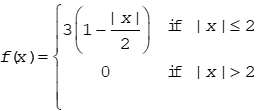
Let \( f:\mathbb{R}\to\mathbb{R} \) be a function defined as Let \( g:\mathbb{R}\to\mathbb{R} \) be given by \( g(x)=f(x+2)-f(x-2) \). If \( n \) and \( m \) denote the number of points in \( \mathbb{R} \) where \( g \) is not continuous and not differentiable, respectively, then \( n+m \) is equal to ________.
Let \( f \) be a real valued function, defined on \( \mathbb{R}-\{-1,1\} \) and given by \( f(x)=3\log_e \left|\dfrac{x-1}{x+1}\right|-\dfrac{2}{x-1} \). Then in which of the following intervals, function \( f(x) \) is increasing?
The value of \( \displaystyle \lim_{n \to \infty} \frac{[r] + [2r] + \ldots + [nr]}{n^{2}} \), where \( r \) is a non-zero number and \( [r] \) denotes the greatest integer than or equal to \( r \), is equal to:
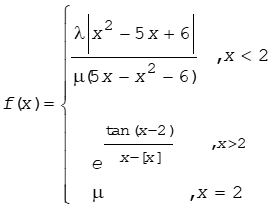
Let \( f:\mathbb{R}\to\mathbb{R} \) be defined asWhere \( [x] \) is the greatest integer less than or equal to \( x \). If \( f \) is continuous at \( x=2 \), then \( \lambda+\mu \) is equal to:
The sum of all the local minimum values of the twice differentiable function \( f:\mathbb{R}\to\mathbb{R} \) defined by \( f(x)=x^{3}-3x^{2}-\dfrac{3\,f''(2)}{2}\,x+f'(1) \) is:
If \( \alpha, \beta \) are the distinct roots of \( x^2+bx+c=0 \), then\( \displaystyle \lim_{x\to \beta} \frac{e^{2(x^2+bx+c)}-1-2(x^2+bx+c)}{(x-\beta)^2} \)is equal to:
Let \( f:(a,b)\to \mathbb{R} \) be twice differentiable function such that \( f(x)=\int\limits_{a}^{x} g(t)\,dt \) for a differentiable function \( g(x) \). If \( f(x)=0 \) has exactly five distinct roots in \( (a,b) \) then \( g(x)\,g'(x)=0 \) has at least:
If \( \alpha = \displaystyle \lim_{x \to \pi/4} \dfrac{\tan^{3} x - \tan x}{\cos \left( x + \dfrac{\pi}{4} \right)} \) and \( \beta =\displaystyle \lim_{x \to 0} (\cos x)^{\cot x} \) are the roots of the equation \( ax^{2} + bx - 4 = 0 \) , then the ordered pair \( (a , b) \) is:
Let \( f : \mathbb{R} \to \mathbb{R} \) be a continuous function. Then $\displaystyle \lim_{x \to \frac{\pi}{4}} \frac{\frac{\pi}{4} \int_{2}^{\sec^2 x} f(x) \, dx}{x^2 - \frac{\pi^2}{16}}$ is equal to:

 .
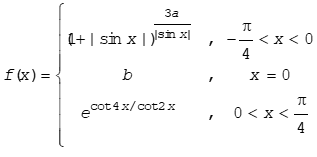 If \( f \) is continuous at \( x=0 \), then the value of \( 6a+b^{2} \) is equal to:
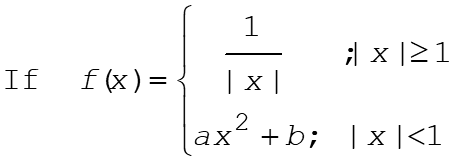 is differentiable at every point of the domain, then the values of \( a \) and \( b \) are respectively:
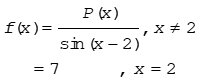 Where \( P(x) \) is a polynomial such that \( P''(x) \) is always a constant and \( P(3) = 9 \). If \( f(x) \) is continuous at \( x = 2 \), then \( P(5) \) is equal to ________.
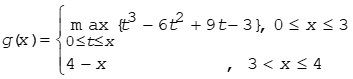 , then the number of points in the interval \( (0,4) \) where \( g(x) \) is NOT differentiable, is ____________.
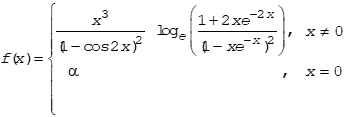 If \( f \) is continuous at \( x=0 \), then \( \alpha \) is equal to: