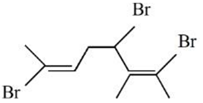
Which amongst the following is not a pesticide?
DDT
Organophosphates
Dieldrin
Sodium arsenite
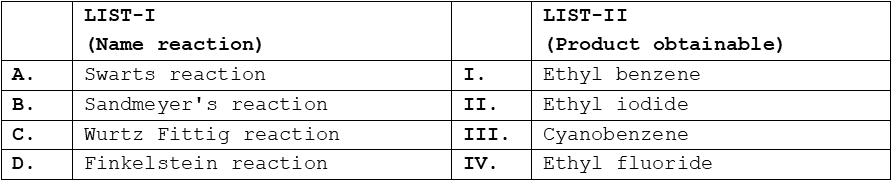
Match List I and List II:
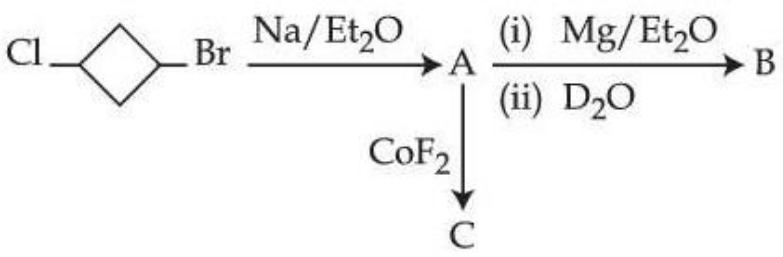
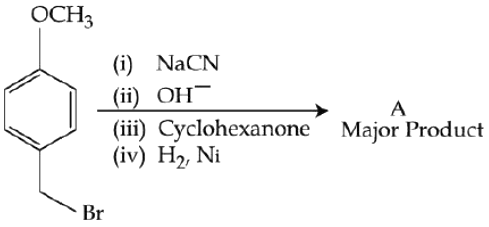
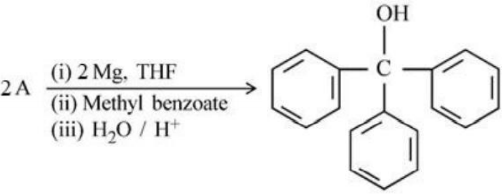
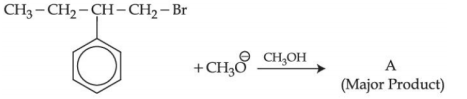
Consider the given reaction, the Product \( A \) is:
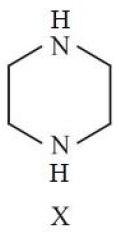
During estimation of nitrogen by Dumas’ method of compound \( X \) \( (0.42 \,\text{g}) \)__________ \( \text{mL} \) of \( \text{N}_2 \) gas will be liberated at STP. (Nearest integer)(Given molar mass in \( \text{g mol}^{-1} \) : \( \text{C} : 12 \) ; \( \text{H} : 1 \) ; \( \text{N} : 14 \))
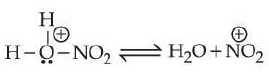
Given below are \( 2 \) statements:Statement I: Nitration of benzene involves the following step:Statement II: Use of Lewis base promotes the electrophilic substitution of benzene.In the light of the above statements, choose the most appropriate answer from the option given below:
In the given reaction‘A’ can be
On complete combustion, \( 0.492 \, \text{g} \) of an organic compound gave \( 0.792 \, \text{g} \) of \( \text{CO}_{2} \). The \( \% \) of carbon in the organic compound is ______ (Nearest integer).
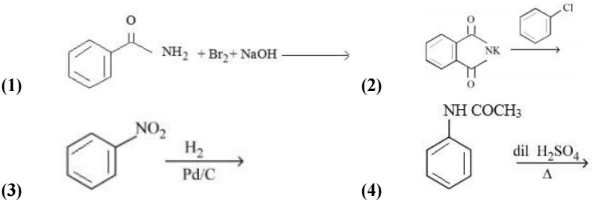
How many of the transformations given below would result in aromatic amines?
Given below are two statements: Statement (I): Benzyl chloride reacts faster in \( \mathrm{S_{N}1} \) mechanism than ethyl chloride. Statement (II): Ethyl carbocation intermediate is less stabilized by hyperconjugation than benzyl carbocation by resonance. In the light of the above statements, choose the correct answer from the options given below:
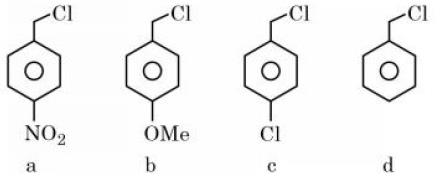
The correct order of reactivity of the given chlorides with acetate in acetic acid is:
Number of compounds from the following which will not dissolve in cold \( \mathrm{NaHCO_3} \) and \( \mathrm{NaOH} \) solutions but will dissolve in hot \( \mathrm{NaOH} \) solution is ________.
The major product (A) formed in the reaction given below is:
Given below are two statements:Statement I: \( \mathrm{C_2H_5OH} \) and \( \mathrm{AgCN} \) both can generate nucleophileStatement II: \( \mathrm{KCN} \) and \( \mathrm{AgCN} \) both will generate nitrile nucleophile with all reaction conditions.Choose the most appropriate answer from the options given below:
Given below are two statements: One is labelled as Assertion A and the other is labelled as Reason R.Assertion A: can be easily reduced using \( \mathrm{Zn\!-\!Hg/HCl} \) to.Reason R: \( \mathrm{Zn\!-\!Hg/HCl} \) is used to reduce carbonyl group to \( \mathrm{–CH_2–} \) group.In the light of the above statements, choose the correct answer from the options given below:
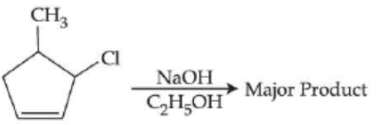
The major product of the following reaction is:
The complex that shows Facial – Meridional isomerism is:
Given below are two statements: one is labelled as Assertion (A) and the other is labelled as Reason (R).Assertion (A): \( \mathrm{S_{N}2} \) reaction of \( \mathrm{C_6H_5CH_2Br} \) occurs more readily than the \( \mathrm{S_{N}2} \) reaction of \( \mathrm{CH_3CH_2Br} \).Reason (R): The partially bonded unhybridized p-orbital that develops in the trigonal bipyramidal transition state is stabilized by conjugation with the phenyl ring.In the light of the above statements, choose the most appropriate answer from the options given below:
An organic compound ‘A’ with empirical formula \( \mathrm{C_6H_6O} \) gives sooty flame on burning. Its reaction with bromine solution in low polarity solvent results in high yield of B. B is:
The number of possible stereoisomers of dimethyl cyclopentane is ________.
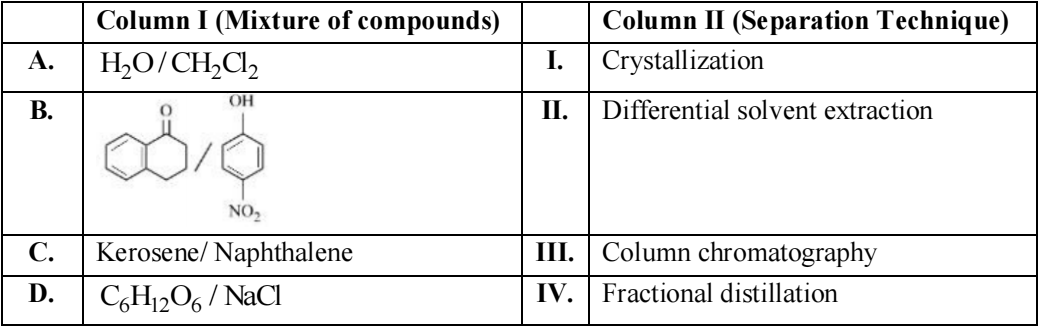
Match items of column I and II.
Identify the correct statements from the following:Choose the correct answer from the options given below:
n-Butane on monochlorination under photochemical condition gives an optically active compound “P”. “P” on further chlorination gives dichloro compounds.The number of dichloro compounds obtained (ignore stereoisomers) is:
During "S" estimation, \( 160 \, \text{mg} \) of an organic compound gives \( 466 \, \text{mg} \) of barium sulphate. The percentage of Sulphur in the given compound is ________ \( \% \).(Given molar mass in \( \text{g mol}^{-1} \) of Ba : \( 137 \), S : \( 32 \), O : \( 16 \))
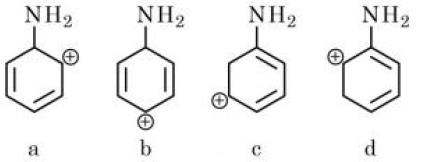
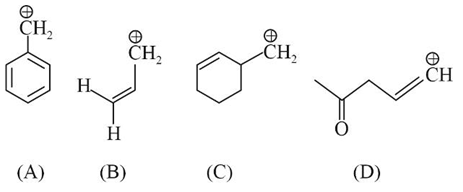
Among the given species the Resonance stabilized carbocations are:
Decreasing order towards \( \mathrm{S_N1} \) reaction for the following compounds is:
The correct stability order of the following resonance structures of \( \mathrm{CH_3-CH=CH-CHO} \) is
The correct order of nucleophilicity is:
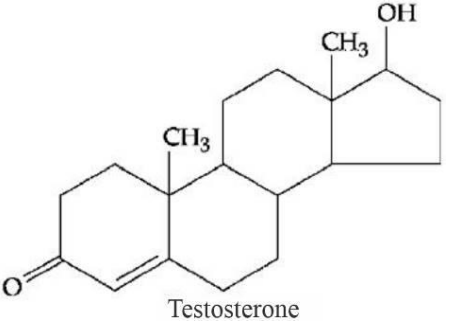
Testosterone, which is a steroidal hormone, has the following structure.The total number of asymmetric carbon atom/s in testosterone is \( \_\_\_\_\_ \).
Which one of the following techniques is not used to spot components of a mixture separated on thin layer chromatographic plate?
A hydrocarbon ‘P’ (\( \mathrm{C_4H_8} \)) on reaction with HCl gives an optically active compound ‘Q’ (\( \mathrm{C_4H_9Cl} \)) which on reaction with one mole of ammonia gives compound ‘R’ (\( \mathrm{C_4H_{11}N} \)). ‘R’ on diazotization followed by hydrolysis gives ‘S’. Identify P, Q, R and S.
Given below are two statements:Statement-I: \( \mathrm{CH_3 - O - CH_2 - Cl} \) will undergo \( \mathrm{S_{N}1} \) reaction though it is a primary halide.Statement-II:will not undergo \( \mathrm{S_{N}2} \) reaction very easily though it is a primary halide.In the light of the above statements, choose the most appropriate answer from the options given below:
Given below are two statements: one is labeled as Assertion A and the other is labeled as Reason R.Assertion A: A mixture contains benzoic acid and naphthalene. The pure benzoic acid can be separated out by the use of benzene.Reason R: Benzoic acid is soluble in hot water.In the light of the above statements, choose the most appropriate answer from the options given below.
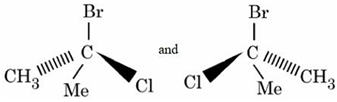
The following structures are:
Which one of the following compounds is inactive towards \( \mathrm{S_{N}1} \) reaction?
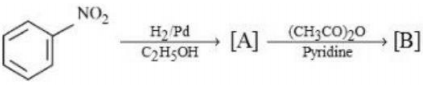
Consider the given reaction, Identify ‘X’ and ‘Y’:
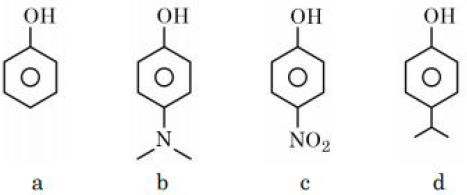
Which one of the following phenols does not give colour when condensed with phthalic anhydride in presence of conc. \( \mathrm{H_2SO_4} \)?
A hydroxy compound (\( X \)) with molar mass \( 122 \, \mathrm{g \, mol^{-1}} \) is acetylated with acetic anhydride, using a large excess of the reagent ensuring complete acetylation of all hydroxyl groups. The product obtained has a molar mass of \( 290 \, \mathrm{g \, mol^{-1}} \). The number of hydroxyl groups present in compound (\( X \)) is:
In the following sequence of reactions, \(\mathrm{C_3H_6}\;\xrightarrow{H^+/H_2O}\;A\;\xrightarrow[\text{dil KOH}]{\mathrm{KIO}}\;B + C\). The compounds B and C respectively are:
Match List - I with List - II.Choose the most appropriate match.
Which of the following ketone will NOT give enamine on treatment with secondary amines? [where \( t\text{-}\mathrm{Bu} \) is \( -\mathrm{C(CH_3)_3} \)]
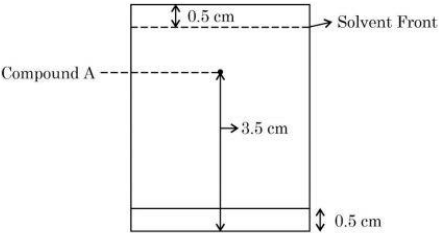
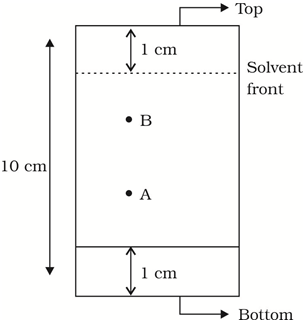
Following chromatogram was developed by adsorption of compound ‘A’ on a \( 6 \, \text{cm} \) TLC glass plate. Retardation factor of the compound ‘A’ is ______ \( \times 10^{-1} \).
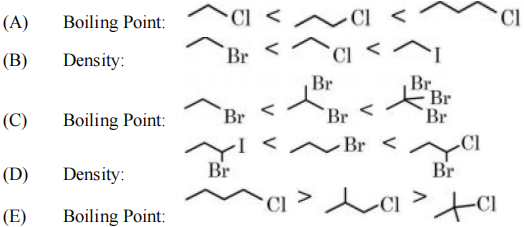
Identify the correct order for the given property for following compounds.
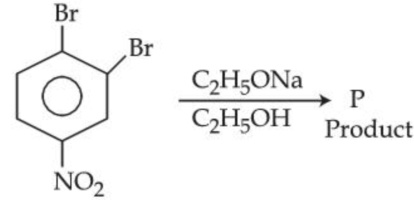
In the following substitution reaction:product ‘P’ formed is:
In the given TLC, the distance of spot A & B are \( 5 \, \text{cm} \) and \( 7 \, \text{cm} \) from the bottom of TLC plate, respectively. \( R_f \) value of B is \( x \times 10^{-1} \) times more than A. The value of \( x \) is
Which of the following is not an example of benzenoid compound?
In the following sequence of reaction, the major products B and C respectively are:
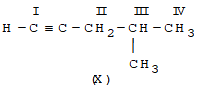
Consider the following compound \( (X) \)The most stable and least stable carbon radicals, respectively, produced by homolytic cleavage of corresponding \( \mathrm{C-H} \) bond are:
The most stable carbocation for the following is:
Match the LIST-I with LIST-II:
Choose the correct answer from the options given below:
A trisubstituted compound ‘A’, \( \mathrm{C_{10}H_{12}O_2} \) gives neutral \( \mathrm{FeCl_3} \) test positive. Treatment of compound ‘A’ with \( \mathrm{NaOH} \) and \( \mathrm{CH_3Br} \) gives \( \mathrm{C_{11}H_{14}O_2} \), with hydroiodic acid gives methyl iodide and with hot conc. \( \mathrm{NaOH} \) gives a compound B, \( \mathrm{C_{10}H_{12}O_2} \). Compound ‘A’ also decolorizes alkaline \( \mathrm{KMnO_4} \). The number of \( \pi \) bond(s) present in the compound ‘A’ is ________.
The correct order of \( \mathrm{p}K_a \) values for the following compounds is:
The major product of the above reactions is:
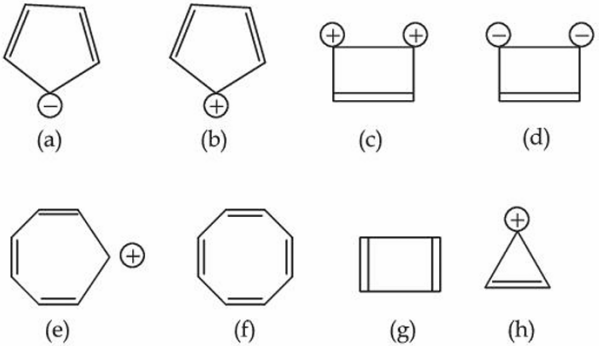
Which one of the following compounds is not aromatic?
Designate whether each of the following compounds is aromatic or not aromatic.
Consider the above reaction and identify the product B.
The graph which represents the following reaction is:
Total number of stereo isomers possible for the given structure:
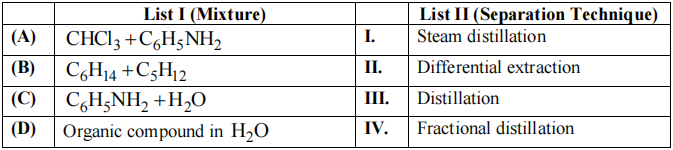
Match the LIST-I with LIST-II.
The purification method based on the following physical transformation is: \(\underset{(X)}{\text{Solid}} \xrightarrow{\text{Heat}} \underset{(X)}{\text{Vapour}} \xrightarrow{\text{Cool}} \underset{(X)}{\text{Solid}}\)
During halogen test, sodium fusion extract is boiled with concentrated \( \mathrm{HNO_3} \) to

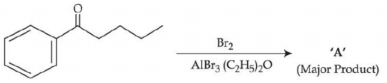

 can be easily reduced using \( \mathrm{Zn\!-\!Hg/HCl} \) to
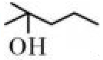 .

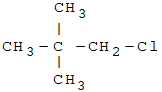 will not undergo \( \mathrm{S_{N}2} \) reaction very easily though it is a primary halide.