25 questions from 2026
Initial velocity \( \vec{u} \) and acceleration \( \vec{a} \) of a particle are given as \( \vec{u}=(2\hat{i}+5\hat{j}) \, \text{m}/\text{s} \; ; \; \vec{a}=5\hat{i} \, \text{m}/\text{s}^2 \)
Given below are two statements: One is labelled as Assertion (A) and other is labelled as Reason (R).
Assertion (A) : Trajectory of particle is parabolic.
Reason (R) : If motion in \( 2 \)-Dimension is uniform and uniformly accelerated along mutually perpendicular directions, then path followed is parabolic.
In the light of above statements, choose the correct answer from the options given below.
Two identical bodies, projected with the same speed at two different angles cover the same horizontal range \( R \). If the time of flight of these bodies are \( 5 \) and \( 10 \) \( \text{s} \), respectively, then the value of \( R \) is ______ \( \text{m} \). [Take \( g = 10 \, \text{m} \, \text{s}^{-2} \)]
A gun mounted on the ground fires bullets in all directions with same speed. The farthest distance the bullets could reach is \( 64 \, \text{m} \). The speed of the bullets from the gun is _____ \( \text{m/s} \). (take \( g = 10 \, \text{m/s}^2 \))
An object is projected with kinetic energy \( K \) from a point A at an angle \( 60^\circ \) with the horizontal. The ratio of the difference in kinetic energies at points B and C to that at point A (see figure), in the absence of air friction is: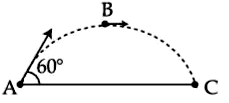
A particle is thrown horizontally from the top of a tower of height \( H \). The angle made by velocity of particle just before hitting the ground is \( 45^\circ \) with the horizontal. What is the horizontal range of particle?
A boy throws a ball into air at \( 45^\circ \) from the horizontal to land it on a roof of a building of height \( H \). If the ball attains maximum height in \( 2 \, \text{s} \) and lands on the building in \( 3 \, \text{s} \) after launch, then value of \( H \) is _______ \( \text{m} \). (\( g = 10 \, \text{m/s}^2 \))
The maximum heights of a projectile for two complementary angles of projection are \( 50 \, \text{m} \) and \( 30 \, \text{m} \) respectively. The initial speed of projectile is: \( (g = 10 \, \text{m/s}^2) \)
The two projectiles are projected with the same initial velocities at the \( 15^\circ \) and \( 30^\circ \) with respect to the horizontal. The ratio of their ranges is \( 1:x \). The value of \( x \) is:
If \( x \) and \( y \) coordinates of a projectile as a function of time \( (t) \) are given as \( 24t \) and \( 43.6t - 4.9t^2 \), respectively, then the angle \( (\text{in degrees}) \) made by the projectile with horizontal when \( t = 2 \, \text{s} \) is ________.
A projectile is thrown upward at an angle \( 60^\circ \) with the horizontal. The speed of the projectile is \( 20 \, \mathrm{m/s} \) when its direction of motion is \( 45^\circ \) with the horizontal. The initial speed of the projectile is ______ \( \mathrm{m/s} \).
When one moves from a point \( 16 \, \text{km} \) below the earth's surface to a point \( 16 \, \text{km} \) above the earth's surface. The change in \( g \) is approximately \( \alpha\% \). The value of \( \alpha \) is ______.
A wedge \( Y \) with mass of \( 10 \, \text{kg} \) and all frictionless surfaces and the inclined surface making \( 37^\circ \) with horizontal. A block \( X \) with mass \( 2 \, \text{kg} \) is placed at the highest point of the wedge as shown in figure is at rest. At \( t = 0 \) wedge \( (Y) \) is pulled toward right with constant force \( (f) \) of \( 24 \, \text{N} \). Taking the block \( X \) at rest at \( t = 0 \), the time taken by it to slide down \( 8.8 \, \text{m} \) on the slope, while \( Y \) is on the move, is _____ \( \text{s} \).
(take \( \tan(37^\circ) = \frac{3}{4} \) and \( g = 10 \, \text{m}/\text{s}^2 \) )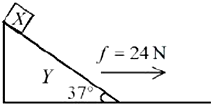
At \( t = 0 \), a body of mass \( 100 \, \text{g} \) starts moving under the influence of a force \( (5\hat{i} + 10\hat{j}) \, \text{N} \). After \( 2 \, \text{s} \) its position is \( (2x\hat{i} + 5y\hat{j}) \, \text{m} \). The ratio \( x : y \) is ________.
A river of width \( 200 \, \text{m} \) is flowing from west to east with a speed of \( 18 \, \text{km/h} \). A boat, moving with speed of \( 36 \, \text{km/h} \) in still water, is made to travel one-round trip (bank to bank of the river). Minimum time taken by the boat for this journey and also the displacement along the river bank are ________ and ________ respectively.
If a particle is projected from origin and it follows the trajectory \( y=x-\dfrac{1}{2}x^2 \), then the time of flight is:
\( (g=\text{acceleration due to gravity}) \)
A $4\text{ kg}$ mass moves under the influence of a force $\vec{F} = \left( 4t^3\hat{i} - 3t\hat{j} \right)\text{N}$ where $t$ is the time in second. If mass starts from origin at $t = 0$, the velocity and position after $t = 2\text{s}$ will be:
A projectile is thrown up from top of a tower of height \( 30 \, \text{m} \) at angle \( 30^\circ \) with horizontal, with speed of \( 10\sqrt{3} \, \text{m/s} \). Based on above information match the entries of Column I, with Column – II. \( \\text{(take } g = 10 \, \text{m/s}^2 \\text{)} \)
| Column I | Column II (in suitable SI units) |
|---|---|
| i Let time of flight be \( \tau \), then \( 10\tau = ? \) | P \( 30\sqrt{3} \) |
| ii Distance where particle lands from foot of tower is | Q \( 20\sqrt{3} \) |
| iii Speed with which particle strikes ground is | R \( 30 \) |
| iv Distance between point of projection and landing is | S \( 60 \) |
Angular displacement of a particle moving along a circle of radius \( 2 \, \text{m} \) varies as \( \theta = t^2 \, \text{rad} \). Find the centripetal acceleration of the particle at time \( t = 3 \, \text{sec} \).
Three masses \( m_{1} = 4 \, \text{kg} \), \( m_{2} = 4 \, \text{kg} \) and \( m_{3} = 6 \, \text{kg} \) are suspended from a fixed smooth frictionless pully as shown in the figure below. The value of \( \dfrac{T_{1}}{T_{2}} \) is _______.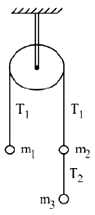
\( \text{(take } g = 10 \, \text{m/s}^{2} ) \)
A bead \( P \) sliding on a frictionless semi-circular string \( (ACB) \) and it is at point \( S \) at \( t = 0 \) and at this instant the horizontal component of its velocity is \( v \). Another bead \( Q \) of the same mass as \( P \) is ejected from point \( A \) at \( t = 0 \) along the horizontal string \( AB \), with the speed \( v \), friction between the beads and the respective strings may be neglected in both cases. Let \( t_{p} \) and to be the respective times taken by beads \( P \) and \( Q \) to reach the point \( B \), then the relation between \( t_{p} \) and \( t_{Q} \) is: 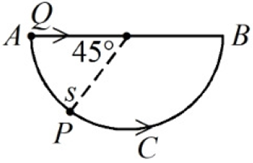
Given below are two statements: One is labelled as Assertion (A) and other is labelled as Reason (R).
Initial velocity \( \vec{u} \) and acceleration \( \vec{a} \) of a particle are given as \( \vec{u}=2\hat{i}+5\hat{j} \, \text{m/s} \; ; \; \vec{a}=-5\hat{i} \, \text{m/s}^2 \)
Assertion (A) : Trajectory of particle is parabolic.
Reason (R) : If motion in \( 2 \)-Dimension is uniform and uniformly accelerated along mutually perpendicular directions, then path followed is parabolic.
In the light of above statements, choose the correct answer from the options given below.
The maximum height of a projectile for two complementary angles of projection are \( 50 \, \text{m} \) and \( 30 \, \text{m} \) respectively. The initial speed of projectile is: \( (g = 10 \, \text{m}/\text{s}^2) \)
A fly wheel is accelerated uniformly from rest and rotates through \( 5 \, \text{rad} \) in the first second. The angle rotated by the fly wheel in the next second, will be:
A particle is rotating in a circular path and at any instant its motion can be described as \( \theta = \frac{5 t^4}{40} - \frac{t^3}{3} \). The angular acceleration of the particle after \( 10 \) seconds is ______ \( \text{rad}/\text{s}^2 \).
Angular displacement of a particle moving along a circle of radius \( 2 \, \text{m} \) varies as \( \theta = t^2 \, \text{rad} \). Find the centripetal acceleration of the particle at time \( t = 3 \, \text{sec} \).
