Choose the INCORRECT statement.
Carbon cannot exceed its covalency more than four.
Among the isotopes of carbon, \( ^{13}\!C \) is a radioactive isotope.
Carbon exhibits negative oxidation states along with +4 and +2.
\( \mathrm{CO}_{2} \) is the most acidic oxide among the dioxides of group of 14 elements.
The set in which compounds have different nature is:
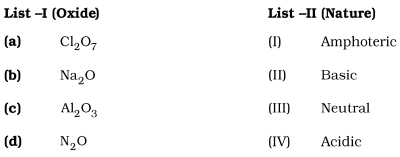
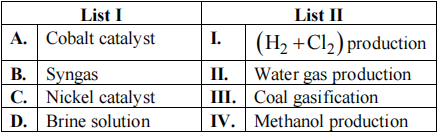
Match List I with List II
Choose the correct answer from the options given below:
A group \( 15 \) element forms \( d\pi - d\pi \) bond with transition metals. It also forms hydride, which is a strongest base among the hydrides of other group members that form \( d\pi - d\pi \) bond. The atomic number of the element is __________.
Given below are two statements: Statement (I) : The metallic radius of Al is less than that of Ga. Statement (II) : The ionic radius of \( \text{Al}^{3+} \) is less than that of \( \text{Ga}^{3+} \). In the light of the above statements, choose the most appropriate answer from the options given below:
Which one of the following correctly represents the order of stability of oxides, \( X_2O \). (\( X \) = halogen)?
The oxide without nitrogen-nitrogen bond is:
The normal rain water is slightly acidic and its pH value is \( 5.6 \) because of which one of the following?
The correct set that contains all kinds (basic, acidic, amphoteric and neutral) of oxides is:
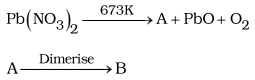
The number of bridged oxygen atoms present in compound B formed from the following reaction is
During water-gas shift reaction.
Aluminium chloride in acidified aqueous solution forms an ion having geometry.
For electron gain enthalpies of the elements denoted as \( \Delta_{eg}H \), the incorrect option is:
Given below are two statements:Statement I: Boron is extremely hard indicating its high lattice energyStatement II: Boron has highest melting and boiling point compared to its other group members.In the light of the above statements, choose the most appropriate answer from the option given below
Given below are the statements about diborane.\( (a) \) Diborane is prepared by the oxidation of \( \mathrm{NaBH_4} \) with \( \mathrm{I_2} \)\( (b) \) Each boron atom is in \( sp^{2} \) hybridized state\( (c) \) Diborane has one bridged \( 3 \) centre-\( 2 \)-electron bond\( (d) \) Diborane is a planar moleculeThe option with correct statement(s) is:
The correct statements from the following are:A. Ionic radii of trivalent cations of group \( 13 \) elements decreases down the group.B. Electronegativity of group \( 13 \) elements decreases down the group.C. Among the group \( 13 \) elements, Boron has highest first ionisation enthalpy.D. The trichloride and triiodide of group \( 13 \) elements are covalent in nature.Choose the correct answer from the options given below:
Dinitrogen is a robust compound, but reacts at high altitudes to form oxides. The oxide of nitrogen that can damage plant leaves and retard photosynthesis is:
Which of the following happens when \( \mathrm{NH_4OH} \) is added gradually to the solution containing \( 1 \, \text{M} \) \( A^{2+} \) and \( 1 \, \text{M} \) \( B^{3+} \) ions? Given: \( K_{sp}[A(OH)_2] = 9 \times 10^{-10} \) and \( K_{sp}[B(OH)_3] = 27 \times 10^{-18} \) at \( 298 \, \text{K} \).
Consider the oxides of group \( 14 \) elements\( \mathrm{SiO_2} \), \( \mathrm{GeO_2} \), \( \mathrm{SnO_2} \), \( \mathrm{PbO_2} \), \( \mathrm{CO} \) and \( \mathrm{GeO} \). The amphoteric oxides are:
The \( \mathrm{F^-} \) ions make the enamel on teeth much harder by converting hydroxyapatite (the enamel on the surface of teeth) into much harder fluoroapatite having the formula.
Given below are two statements: one is labelled as Assertion (A) and the other is labelled as Reason (R).Assertion (A): Melting point of Boron \( (2453 \, \text{K}) \) is unusually high in group \( 13 \) elements.Reason (R): Solid Boron has very strong crystalline lattice.In the light of the above statements, choose the most appropriate answer from the options given below :
First ionization enthalpy values of first \( 4 \) group \( 15 \) elements are given below: Choose the correct value for the element that is a main component of apatite family:
Aqueous solution of which of the following boron compounds will be strongly basic in nature?
Identify the correct statements about p-block elements and their compounds.(A) Non metals have higher electronegativity then metals.(B) Non metals have lower ionization enthalpy than metals.(C) Compounds formed between highly reactive non-metals and highly reactive metals are generally ionic.(D) The non-metal oxides are generally basic in nature.(E) The metal oxides are generally acidic or neutral in nature.Choose the correct answer from the option given below:
Among the following basic oxide is:
Choose the correct statements about the hydrides of group \( 15 \) elements.A. The stability of the hydrides decreases in the order \( \mathrm{NH_3} > \mathrm{PH_3} > \mathrm{AsH_3} > \mathrm{SbH_3} > \mathrm{BiH_3} \).B. The reducing ability of the hydride increases in the order \( \mathrm{NH_3} < \mathrm{PH_3} < \mathrm{AsH_3} < \mathrm{SbH_3} < \mathrm{BiH_3} \).C. Among the hydrides, \( \mathrm{NH_3} \) is strong reducing agent while \( \mathrm{BiH_3} \) is mild reducing agent.D. The basicity of the hydrides increases in the order \( \mathrm{NH_3} < \mathrm{PH_3} < \mathrm{AsH_3} < \mathrm{SbH_3} < \mathrm{BiH_3} \).
Chemical nature of the nitrogen oxide compound obtained from a reaction of concentrated nitric acid and \( \mathrm{P_4O_{10}} \) (in \( 4:1 \) ratio) is:
Give below are two statements: One is labelled as Assertion A and the other is labelled as Reason R.Assertion A: The stability order of \( +1 \) oxidation state of Ga, In and Tl is \( \mathrm{Ga} < \mathrm{In} < \mathrm{Tl} \).Reason R: The inert pair effect stabilizes the lower oxidation state down the group.In the light of the above statements, choose the correct answer from the options given below:
Find the correct statements related to group \( 15 \) hydrides.A. Reducing nature increases from \( \mathrm{NH_3} \) to \( \mathrm{BiH_3} \)B. Tendency to donate lone pair of electrons decreases from \( \mathrm{NH_3} \) to \( \mathrm{BiH_3} \)C. The stability of hydrides decreases from \( \mathrm{NH_3} \) to \( \mathrm{BiH_3} \)D. \( \mathrm{HEH} \) bond angle decreases from \( \mathrm{NH_3} \) to \( \mathrm{SbH_3} \) (\( \mathrm{E} = \) Elements of group \( 15 \))Choose the correct answer from the options given below:
Consider the following elements \( \mathrm{In} \), \( \mathrm{Tl} \), \( \mathrm{Al} \), \( \mathrm{Pb} \), \( \mathrm{Sn} \) and \( \mathrm{Ge} \).The most stable oxidation states of elements with highest and lowest first ionisation enthalpies, respectively, are:
Anomalous behavior of oxygen is clue to its:
Given below are two statements:Statement I: Upon heating a borax bead dipped in cupric sulphate in a luminous flame, the colour of the bead becomes greenStatement II: The green colour observed is due to the formation of copper(I) metaborateIn the light of the above statements, choose the most appropriate answer from the options given below:
Identify the incorrect statements about group \( 15 \) elements :(A) Dinitrogen is a diatomic gas which acts like an inert gas at room temperature.(B) The common oxidation states of these elements are \( -3, +3 \) and \( +5 \).(C) Nitrogen has unique ability to form \( p\pi - p\pi \) multiple bonds.(D) The stability of \( +5 \) oxidation states increases down the group.(E) Nitrogen shows a maximum covalency of \( 6 \).
Given below are two statements: one is labelled as Assertion (A) and the other is labelled as Reason (R).Assertion (A): Both rhombic and monoclinic sulphur exist as \( \text{S}_8 \) while oxygen exists as \( \text{O}_2 \).Reason (R): Oxygen forms \(p\pi - p\pi \) multiple bonds with itself and other elements having small size and high electronegativity like C, N, which is not possible for sulphur.In the light of the above statements, choose the most appropriate answer from the options given below:
The reaction of white phosphorus on boiling with alkali in inert atmosphere resulted in the formation of product ‘A’. The reaction of \( 1 \) mol of ‘A’ with excess of \( \mathrm{AgNO_3} \) in aqueous medium gives __________ mol(s) of \( \mathrm{Ag} \). (Round off to the Nearest Integer).
Given below are two statements: one is labelled as Assertion \( (A) \) and the other is labelled as Reason \( (R) \).Assertion \( (A) \): Boron is unable to form \( \mathrm{BF}_6^{3-} \)Reason \( (R) \): Size of \( \mathrm{B} \) is very small.
The total number of acidic oxides from the following list is: \( \text{NO} \), \( \text{N}_2\text{O} \), \( \text{B}_2\text{O}_3 \), \( \text{N}_2\text{O}_5 \), \( \text{CO} \), \( \text{SO}_3 \), \( \text{P}_4\text{O}_{10} \)
Which one of the following is formed (mainly) when red phosphorus is heated in a sealed tube at \( 803 \, \text{K} \)?
The incorrect statement from the following for borazine is:
Given below are two statements:Statement I : \( \mathrm{H_2Se} \) is more acidic than \( \mathrm{H_2Te} \).Statement II : \( \mathrm{H_2Se} \) has higher bond enthalpy for dissociation than \( \mathrm{H_2Te} \).In the light of the above statements, choose the correct answer from the options given below:
Give below are two statements:Statement I : The higher oxidation states are more stable down the group among transition elements unlike p-block elements.Statement II : Copper can not liberate hydrogen from weak acids.In the light of the above statements, choose the correct answer from the options given below:
The number of neutrons present in the more abundant isotope of boron is ‘\( x \)’. Amorphous boron upon heating with air forms a product, in which the oxidation state of boron is ‘\( y \)’. The value of \( x + y \) is ______________.
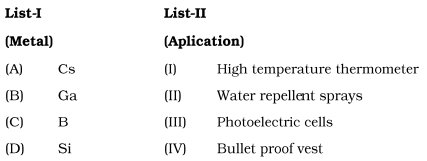
Match List –I with List – II
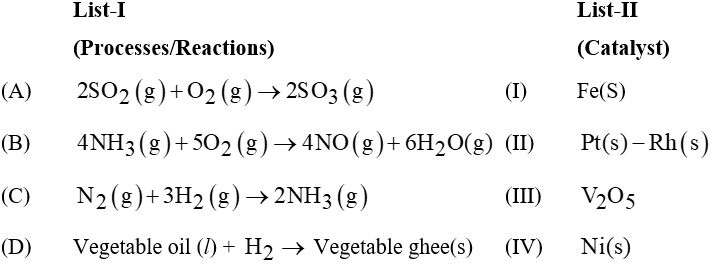
Match List – I with List – II.
Choose the most appropriate answer from the options given below:
Nitrogen gas is obtained by thermal decomposition of:
The major component/ingredient of Portland Cement is:
Given below are two statements:Statement I : The electronegativity of group \( 14 \) elements from \( \mathrm{Si} \) to \( \mathrm{Pb} \), gradually decreases.Statement II : Group \( 14 \) contains non-metallic, metallic, as well as metalloid elements.In the light of the above statements, choose the most appropriate from the options given below:
Number of electron deficient molecules among the following \( \mathrm{PH_3} \), \( \mathrm{B_2H_6} \), \( \mathrm{CCl_4} \), \( \mathrm{NH_3} \), \( \mathrm{LiH} \) and \( \mathrm{BCl_3} \) is:
Given below are two statements:Statement-I: The pentavalent oxide of group-\( 15 \) element, \( \mathrm{E_2O_5} \), is less acidic than trivalent oxide, \( \mathrm{E_2O_3} \), of the same element.Statement-II: The acidic character of trivalent oxide of group \( 15 \) elements, \( \mathrm{E_2O_3} \), decreases down the group.In light of the above statements, choose most appropriate answer from the options given below:
The correct statements from the following are:(A) \( \mathrm{Tl^{3+}} \) is a powerful oxidising agent(B) \( \mathrm{Al^{3+}} \) does not get reduced easily(C) Both \( \mathrm{Al^{3+}} \) and \( \mathrm{Tl^{3+}} \) are very stable in solution(D) \( \mathrm{Tl^{+}} \) is more stable than \( \mathrm{Tl^{3+}} \)(E) \( \mathrm{Al^{3+}} \) and \( \mathrm{Tl^{+}} \) are highly stableChoose the correct answer from the options given below:
The ratio of number of water molecules in Mohr's salt and potash alum is ______ \( \times 10^{-1} \). (Integer answer)
Choose the correct statement from the following.A All group \( 16 \) elements form oxides of general formula \( \mathrm{EO_2} \) and \( \mathrm{EO_3} \) where \( \mathrm{E = S,\; Se,\; Te\; and\; Po} \). Both the types of oxides are acidic in nature.B \( \mathrm{TeO_2} \) is an oxidising agent while \( \mathrm{SO_2} \) is reducing in nature.C The reducing property decreases from \( \mathrm{H_2S} \) to \( \mathrm{H_2Te} \) down the group.D The ozone molecule contains five lone pairs of electrons.Choose the correct answer from the option given below:
Evaluate the following statements related to group \( 14 \) elements for their correctness.(A) Covalent radius decreases down the group from C to Pb in a regular manner.(B) Electronegativity decreases from C to Pb down the group gradually.(C) Maximum covalence of C is \( 4 \) whereas other elements can expand their covalence due to presence of d orbitals.(D) Heavier elements do not form \( p\pi - p\pi \) bonds.(E) Carbon can exhibit negative oxidation states.Choose the correct answer from the options given below:
Which one of the following elements will remain as liquid inside pure boiling water?
Given below are the atomic number of some group \( 14 \) elements. The atomic number of the element with lowest melting point is:
It is noticed that \( \mathrm{Pb}^{2+} \) is more stable than \( \mathrm{Pb}^{4+} \) but \( \mathrm{Sn}^{2+} \) is less stable than \( \mathrm{Sn}^{4+} \). Observe the following reactions.\( \mathrm{PbO}_2 + \mathrm{Pb} \rightarrow 2\mathrm{PbO} ; \ \Delta_r G^\circ (1) \)\( \mathrm{SnO}_2 + \mathrm{Sn} \rightarrow 2\mathrm{SnO} ; \ \Delta_r G^\circ (2) \)Identify the correct set from the following
Borazine, also known as inorganic benzene, can be prepared by the reaction of \( 3 \)-equivalents of “X” with \( 6 \)-equivalents of “Y”. “X” and “Y”, respectively are:
The Lewis acid character of boron tri halides follows the order:
The number of non-ionisable hydrogen atoms present in the final product obtained from the hydrolysis of \( \mathrm{PCl}_{5} \) is:
Sum of oxidation state \( P \) of bromine in bromic acid and perbromic acid is:
Among the following allotropic forms of sulphur, the number of allotropic forms, which will show paramagnetism is ________.\\( (A) \\ \alpha\text{-sulphur} \\\qquad (B) \\ \beta\text{-sulphur} \\\qquad (C) \\ \mathrm{S_2}\text{-form} \\)
Given below are two statements:Statement I: Group \( 13 \) trivalent halides get easily hydrolyzed by water due to their covalent nature.Statement II: \( \mathrm{AlCl_3} \) upon hydrolysis in acidified aqueous solution forms octahedral \( [\mathrm{Al(H_2O)_6}]^{3+} \) ion.In the light of the above statements, choose the correct answer from the option below:
Consider the following reactions \(\text{NiS} + \text{HNO}_3 + \text{HCl} \rightarrow \text{A} + \text{NO} + \text{S} + \text{H}_2\text{O}\)The number of protons that do not involve in hydrogen bonding in the product B is ______.
In polythionic acid, \({H_2S_xO_6} \) (\( x = 3 \) to \( 5 \)) the oxidation state(s) of sulphur is/are:
Given below are two statements:Statement I: \( \mathrm{F_2O} < \mathrm{H_2O} < \mathrm{Cl_2O} \) is the correct trends in terms of bond angle.Statement II: \( \mathrm{SiF_4}, \mathrm{SnF_4} \) and \( \mathrm{PbF_4} \) are ionic in nature.In the light of the above statements, choose the correct answer from the options given below:
Which one of the following compounds of Group-\( 14 \) elements is not known?
Regarding the hydrides of group \( 15 \) elements \( \mathrm{EH_3} \) \( (E = \mathrm{N}, \mathrm{P}, \mathrm{As}, \mathrm{Sb}) \), select the correct statement from the following: A. The stability of hydrides decreases down the group. B. The basicity of hydrides decreases down the group. C. The reducing character increases down the group. D. The boiling point increases down the group. Choose the correct answer from the options given below:
Two p-block elements \( X \) and \( Y \) form fluorides of the type \( \mathrm{EF}_3 \). The fluoride compound \( \mathrm{XF}_3 \) is a Lewis acid and \( \mathrm{YF}_3 \) is a Lewis base. The hybridizations of the central atoms of \( \mathrm{XF}_3 \) and \( \mathrm{YF}_3 \) respectively are:
Match List –I with List –II, match the gas evolved during each reaction.
Choose the correct answer form the options given below:
If the formula of borax is \( \mathrm{Na_2B_4O_x(OH)_y \cdot zH_2O} \), then \( x + y + z = \) _________.
\( \mathrm{XeF_4} \) reacts with \( \mathrm{SbF_5} \) to form \( [\mathrm{XeF}_m]^{n+}[\mathrm{SbF}_y]^{z-} \). \( m + n + y + z = \) ________.
Given below are the pairs of group \( 13 \) elements showing their relation in terms of atomic radius. (\( \mathrm{B} < \mathrm{Al} \)), (\( \mathrm{Al} < \mathrm{Ga} \)), (\( \mathrm{Ga} < \mathrm{In} \)) and (\( \mathrm{In} < \mathrm{Tl} \)) Identify the elements present in the incorrect pair and in that pair find out the element \( (X) \) that has higher ionic radius \( (M^{3+}) \) than the other one. The atomic number of the element \( (X) \) is:
Match List-I with List-II.Choose the correct answer from the options given below:
In which one of the following molecules strongest back donation of an electron pair from halide to boron is expected?
Heating white phosphorous with conc. \( \mathrm{NaOH} \) solution gives mainly:
The species given below that does NOT show disproportionation reaction is:
The set that represents the pair of neutral oxides of nitrogen is :
Match List I with List II.
Given below are two statements:Statement I : The \( \mathrm{N{-}N} \) single bond is weaker and longer than that of \( \mathrm{P{-}P} \) single bond.Statement II : Compounds of group \( 15 \) elements in \( +3 \) oxidation states readily undergo disproportionation reactions.In the light of the above statements, choose the correct answer from the options given below:
Given below are two statements:Statement I: Fluorine has most negative electron gain enthalpy in its group.Statement II: Oxygen has least negative electron gain enthalpy in its group.In the light of the above statements, choose the most appropriate from the options given below:
Number of elements from the following that CANNOT form compounds with valencies which match with their respective group valencies is __________. B, C, N, S, O, F, P, Al, Si
The number of \( \mathrm{S{=}O} \) bonds present in sulphurous acid, peroxodisulphuric acid and pyrosulphuric acid, respectively are:
Given below are two statements:Statement I: Gallium is used in the manufacturing of thermometers.Statement II: A thermometer containing gallium is useful for measuring the freezing point \( (256 \, \mathrm{K}) \) of brine solution.In the light of the above statements, choose the correct answer from the options given below:
In qualitative test for identification of presence of phosphorous, the compound is heated with an oxidizing agent. Which is further treated with nitric acid and ammonium molybdate respectively. The yellow coloured precipitate obtained is: