9 questions from 2021
The Born-Haber cycle for $\text{KCl}$ is evaluated with the following data:
$\Delta_f \text{H}^{\ominus}$ for $\text{KCl} = -436.7 \text{ kJ mol}^{-1}$; $\Delta_{\text{sub}} \text{H}^{\ominus}$ for $\text{K} = 89.2 \text{ kJ mol}^{-1}$;
$\Delta_{\text{ionization}} \text{H}^{\ominus}$ for $\text{K} = 419.0 \text{ kJ mol}^{-1}$; $\Delta_{\text{electron gain}} \text{H}^{\ominus}$ for $\text{Cl}_{(\text{g})} = -348.6 \text{ kJ mol}^{-1}$;
$\Delta_{\text{bond}} \text{H}^{\ominus}$ for $\text{Cl}_2 = 243.0 \text{ kJ mol}^{-1}$
The magnitude of lattice enthalpy of $\text{KCl}$ in $\text{kJ mol}^{-1}$ is ________. (Nearest integer)
When \( 400 \, \text{mL} \) of \( 0.2 \, \text{M} \; \mathrm{H_2SO_4} \) solution is mixed with \( 600 \, \text{mL} \) of \( 0.1 \, \text{M} \; \mathrm{NaOH} \) solution, the increase in temperature of the final solution is ____________ \( \times 10^{-2} \) \( \text{K} \). (Round off to the Nearest Integer)
[Use : \( \mathrm{H^+ (aq)} + \mathrm{OH^- (aq)} \rightarrow \mathrm{H_2O} ; \; \Delta_\gamma H = -57.1 \, \text{kJ mol}^{-1} \)
Specific heat of \( \mathrm{H_2O} = 4.18 \, \text{J K}^{-1} \text{ g}^{-1} \)
Density of \( \mathrm{H_2O} = 1.0 \, \text{g cm}^{-3} \)
Assume no change in volume of solution on mixing.]
For the reaction \( \mathrm{C_2H_6 \rightarrow C_2H_4 + H_2} \)
the reaction enthalpy \( \Delta_r H = \) __________ \( \mathrm{kJ\,mol^{-1}} \). (Round off to the Nearest Integer).
[Given: Bond enthalpies in \( \mathrm{kJ\,mol^{-1}} \) : C–C : \( 347 \), C = C : \( 611 \); C–H: \( 414 \), H–H : \( 436 \)]
According to the following figure, the magnitude of the enthalpy change of the reaction \( \mathrm{A} + \mathrm{B} \rightarrow \mathrm{M} + \mathrm{N} \) in \( \mathrm{kJ\ mol^{-1}} \) is equal to __________. (Integer answer) 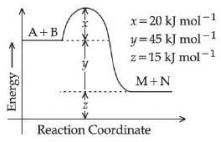
Data given for the following reaction is as follows :
\( \mathrm{FeO}_{(s)} + \mathrm{C}_{(\text{graphite})} \longrightarrow \mathrm{Fe}_{(s)} + \mathrm{CO}_{(g)} \)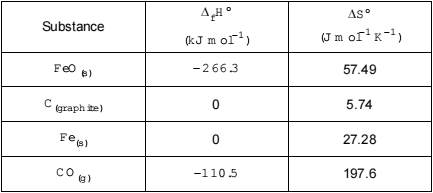
The minimum temperature in \( \text{K} \) at which the reaction becomes spontaneous is _______. (Integer answer)
Assuming ideal behaviour, the magnitude of \\( \log K \\) for the following reaction at \\( 25^\circ \text{C} \\) is \\( x \times 10^{-1} \\). The value of \\( x \\) is ________. (Integer answer)
\( 3 \, \mathrm{HC{\equiv}CH}_{ (g)} \rightleftharpoons \mathrm{C_6H_{6(\ell)}} \)
[Given: \( \displaystyle \Delta_{\text{f}}G^{\circ}(\text{HC} \equiv \text{CH}) = -2.04 \times 10^5 \, \text{J}\text{ mol}^{-1} \; ; \;\displaystyle \Delta_{\text{f}}G^{\circ}(\text{C}_6\text{H}_6) = -1.24 \times 10^5 \, \text{J}\text{ mol}^{-1}
\; ; \; R = 8.314 \, \text{J K}^{-1} \text{mol}^{-1} \)]
At \( 298 \, \text{K} \), the enthalpy of fusion of a solid (X) is \( 2.8 \, \text{kJ mol}^{-1} \) and the enthalpy of vaporization of the liquid (X) is \( 98.2 \, \text{kJ mol}^{-1} \). The enthalpy of sublimation of the substance (X) in \( \text{kJ mol}^{-1} \) is ____________. (in nearest integer)
If the standard molar enthalpy change for combustion of graphite powder is \( -2.48 \times 10^{2} \, \text{kJ mol}^{-1} \), the amount of heat generated on combustion of \( 1 \, \text{g} \) of graphite powder is ______ \( \text{kJ} \). (Nearest integer)
The standard enthalpies of \( \mathrm{Al_2O_3} \) and \( \mathrm{CaO} \) are \( -1675 \, \mathrm{kJ\,mol^{-1}} \) and \( -635 \, \mathrm{kJ\,mol^{-1}} \) respectively.
For the reaction
\( 3\mathrm{CaO} + 2\mathrm{Al} \longrightarrow 3\mathrm{Ca} + \mathrm{Al_2O_3} \) the standard reaction enthalpy \( \Delta_r H^\circ = \) ______ kJ (Round off to the Nearest Integer).
