In an ice crystal, each water molecule is hydrogen bonded to \( \_ \_ \_ \_ \) neighbouring molecules.
Two reactions are given below:\( 2\text{Fe(s)} + \dfrac{3}{2}\text{O}_2\text{(g)} \rightarrow \text{Fe}_2\text{O}_3\text{(s)},\ \Delta H^\circ = -822 \,\text{kJ/mol} \)\( \text{C(s)} + \dfrac{1}{2}\text{O}_2\text{(g)} \rightarrow \text{CO(g)},\ \Delta H^\circ = -110 \,\text{kJ/mol} \)Then enthalpy change for following reaction \( 3\text{C(s)} + \text{Fe}_2\text{O}_3\text{(s)} \rightarrow 2\text{Fe(s)} + 3\text{CO(g)} \) is _______ \( \text{kJ/mol} \).
The formation enthalpies, $\Delta\text{H}_\text{f}^\ominus$ for $\text{H(g)}$ and $\text{O(g)}$ are $220.0$ and $250.0\text{ kJ mol}^{-1}$, respectively, at $298.15\text{ K}$, and $\Delta\text{H}_\text{f}^\ominus$ for $\text{H}_2\text{O(g)}$ is $-242.0\text{ kJ mol}^{-1}$ at the same temperature. The average bond enthalpy of the $\text{O}-\text{H}$ bond in water at $298.15\text{ K}$ is $\underline{\qquad}\text{ kJ mol}^{-1}$. (Nearest integer)
When equal volume of \( 1\,\text{M} \) HCl and \( 1\,\text{M} \) \( \text{H}_2\text{SO}_4 \) are separately neutralised by excess volume of \( 1\,\text{M} \) NaOH solution, \( x \) and \( y \) kJ of heat is liberated respectively. The value of \( y/x \) is _______.
Given:$\Delta\text{H}^\ominus_{\text{sub}[\text{C(graphite)}]} = 710\text{ kJ mol}^{-1}$$\Delta_{\text{C}-\text{H}}\text{H}^\ominus = 414\text{ kJ mol}^{-1}$$\Delta_{\text{H}-\text{H}}\text{H}^\ominus = 436\text{ kJ mol}^{-1}$$\Delta_{\text{C}=\text{C}}\text{H}^\ominus = 611\text{ kJ mol}^{-1}$The$\Delta\text{H}_{\text{f}}^\ominus$ for $\text{CH}_2 = \text{CH}_2$ is ________ $\text{kJ mol}^{-1}$. (Nearest integer value)
The enthalpy of formation of ethane (\( \mathrm{C_2H_6} \)) from ethylene by addition of hydrogen where the bond-energies of \( \mathrm{C{-}H} \), \( \mathrm{C{-}C} \), \( \mathrm{C{=}C} \), \( \mathrm{H{-}H} \) are \( 414 \, \text{kJ} \), \( 347 \, \text{kJ} \), \( 615 \, \text{kJ} \) and \( 435 \, \text{kJ} \) respectively is - ______ \( \text{kJ} \).
The bond dissociation enthalpy of \( X_2 \) \( \Delta H^\circ_{\text{bond}} \) calculated from the given data is ________ \( \text{kJ mol}^{-1} \). (Nearest integer)\( \mathrm{M^+X^- (s) \rightarrow M^+ (g) + X^- (g)} \) \( \Delta H^\circ_{\text{lattice}} = 800 \, \text{kJ mol}^{-1} \)\( \mathrm{M (s) \rightarrow M (g)} \) \( \Delta H^\circ_{\text{sub}} = 100 \, \text{kJ mol}^{-1} \)\( \mathrm{M (g) \rightarrow M^+ (g) + e^-}(g) \) \( \Delta H^\circ_{i} = 500 \, \text{kJ mol}^{-1} \)\( \mathrm{X (g) + e^- (g) \rightarrow X^- (g)} \) \( \Delta H^\circ_{\text{eg}} = -300 \, \text{kJ mol}^{-1} \)\( \mathrm{M (s) + \tfrac{1}{2} X_2 (g) \rightarrow M^+X^- (s)} \) \( \Delta H^\circ_{f} = -400 \, \text{kJ mol}^{-1} \)[Given: \( \mathrm{M^+X^-} \) is a pure ionic compound and \( X \) forms a diatomic molecule \( X_2 \) in gaseous state]
When \( 400 \, \text{mL} \) of \( 0.2 \, \text{M} \; \mathrm{H_2SO_4} \) solution is mixed with \( 600 \, \text{mL} \) of \( 0.1 \, \text{M} \; \mathrm{NaOH} \) solution, the increase in temperature of the final solution is ____________ \( \times 10^{-2} \) \( \text{K} \). (Round off to the Nearest Integer)[Use : \( \mathrm{H^+ (aq)} + \mathrm{OH^- (aq)} \rightarrow \mathrm{H_2O} ; \; \Delta_\gamma H = -57.1 \, \text{kJ mol}^{-1} \)Specific heat of \( \mathrm{H_2O} = 4.18 \, \text{J K}^{-1} \text{ g}^{-1} \)Density of \( \mathrm{H_2O} = 1.0 \, \text{g cm}^{-3} \)Assume no change in volume of solution on mixing.]
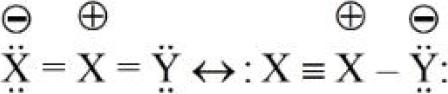
Resonance in $\text{X}_2\text{Y}$ can be represented as
The enthalpy of formation of $\text{X}_2\text{Y} \left( \text{X}\equiv\text{X (g)} + \frac{1}{2}\text{Y}=\text{Y (g)} \rightarrow \text{X}_2\text{Y (g)} \right)$ is $80 \text{ kJ mol}^{-1}$. The magnitude of resonance energy of $\text{X}_2\text{Y}$ is _______ $\text{kJ mol}^{-1}$.(Nearest integer value)
[Given : Bond energy of $\text{X}\equiv\text{X}$, $\text{X}=\text{X}$, $\text{Y}=\text{Y}$ and $\text{X}=\text{Y}$ are $940$, $410$, $500$ and $602 \text{ kJ mol}^{-1}$ respectively. Valence X : 3, Y : 2]
Given below are two statements: One is labelled as Assertion (A) and the other is labelled as Reason (R).Assertion (A): Enthalpy of neutralization of strong monobasic acid with strong monoacidic base is always \( -57 \, \mathrm{kJ} \, \mathrm{mol}^{-1} \).Reason (R): Enthalpy of neutralization is the amount of heat liberated when one mole of \( \mathrm{H}^{+} \) ions furnished by acid combine with one mole of \( \mathrm{OH}^{-} \) ions furnished by base to form one mole of water.In the light of the above statements, choose the correct answer from the options given below.
At \( 25^{\circ} \text{C} \) and \( 1 \) \( \text{atm} \) pressure, the enthalpies of combustion are as given below:
The enthalpy of formation of ethane is:
Total enthalpy change for freezing of \( 1 \) mol of water at \( 10^\circ \mathrm{C} \) to ice at \( -10^\circ \mathrm{C} \) is __________ . (Given: \( \Delta_{\mathrm{fus}}H = x \, \mathrm{kJ/mol} \) ) . \( C_p[\mathrm{H_2O(l)}] = y \, \mathrm{j\,mol^{-1}\,K^{-1}} \) , \( C_p[\mathrm{H_2O(s)}] = z \, \mathrm{j\,mol^{-1}\,K^{-1}} \)
\( \mathrm{A_2} + \mathrm{B_2} \rightarrow 2\mathrm{AB} \). \( \Delta H^{0}_f = -200 \, \text{kJ mol}^{-1} \)AB, \( \mathrm{A_2} \) and \( \mathrm{B_2} \) are diatomic molecules. If the bond enthalpies of \( \mathrm{A_2} \), \( \mathrm{B_2} \) and AB are in the ratio \( 1 : 0.5 : 1 \), then the bond enthalpy of \( \mathrm{A_2} \) is _____ \( \text{kJ mol}^{-1} \). (Nearest integer)
If \( \mathrm{C(diamond)} \rightarrow \mathrm{C(graphite)} + X \, \text{kJ mol}^{-1} \)\( \mathrm{C(diamond)} + \mathrm{O}_2(g) \rightarrow \mathrm{CO}_2(g) + Y \, \text{kJ mol}^{-1} \)\( \mathrm{C(graphite)} + \mathrm{O}_2(g) \rightarrow \mathrm{CO}_2(g) + Z \, \text{kJ mol}^{-1} \)At constant temperature. Then
For the reaction \( \mathrm{C_2H_6 \rightarrow C_2H_4 + H_2} \)the reaction enthalpy \( \Delta_r H = \) __________ \( \mathrm{kJ\,mol^{-1}} \). (Round off to the Nearest Integer).[Given: Bond enthalpies in \( \mathrm{kJ\,mol^{-1}} \) : C–C : \( 347 \), C = C : \( 611 \); C–H: \( 414 \), H–H : \( 436 \)]
$2\text{O}_3\text{(g)} \rightleftharpoons 3\text{O}_2\text{(g)}$
At $300\text{ K}$, ozone is fifty percent dissociated. The standard free energy change at this temperature and $1\text{ atm}$ pressure is $(-)\ \underline{\quad\quad\quad\quad}\ \text{J mol}^{-1}$. (Nearest integer)
$\left[\text{Given : } \ln 1.35 = 0.3 \text{ and } R = 8.3\text{ J K}^{-1}\text{ mol}^{-1}\right]$
The enthalpy change for the conversion of \( \frac{1}{2}\text{Cl}_{2}(g) \) to \( \text{Cl}^{-}(aq) \) is \( ( - ) \) _____ \( \text{kJ mol}^{-1} \) (nearest integer): Given: \( \Delta_{\text{dis}} H^{\theta}_{\text{Cl}_{2}(g)} = 240 \, \text{kJ mol}^{-1} \), \( \Delta_{\text{eg}} H^{\theta}_{\text{Cl}(g)} = -350 \, \text{kJ mol}^{-1} \), \( \Delta_{\text{hyd}} H^{\theta}_{\text{Cl}^{-}(g)} = -380 \, \text{kJ mol}^{-1} \)
Let us consider an endothermic reaction which is non-spontaneous at the freezing point of water. However, the Reaction is spontaneous at boiling point of water. Choose the correct option.
Consider the reaction \( 2\mathrm{H_2S(g)} + 3\mathrm{O_2} \rightarrow 2\mathrm{H_2O(l)} + 2\mathrm{SO_2(g)} \)The magnitude of enthalpy change for the reaction in \( \mathrm{kJ\,mol^{-1}} \) is ______. (Nearest integer)[Given: \( \Delta_\mathrm{f}H^\ominus(\mathrm{H_2S}) = -20.1 \ \mathrm{kJ\,mol^{-1}} \), \( \Delta_\mathrm{f}H^\ominus(\mathrm{H_2O}) = -286.0 \ \mathrm{kJ\,mol^{-1}} \) and \( \Delta_\mathrm{f}H^\ominus(\mathrm{SO_2}) = -297.0 \ \mathrm{kJ\,mol^{-1}} \)]
The heat of atomization of methane and ethane are ‘\( x \)’ \( \mathrm{kJ\,mol^{-1}} \) and ‘\( y \)’ \( \mathrm{kJ\,mol^{-1}} \) respectively. The longest wavelength (\( \lambda \)) of light capable of breaking the C–C bond can be expressed in SI unit as:
The correct statement amongst the following is:
For complete combustion of methanol\( \mathrm{CH_3OH(l)} + \frac{3}{2}\mathrm{O_2(g)} \rightarrow \mathrm{CO_2(g)} + 2\mathrm{H_2O(l)} \)The amount of heat produced as measured by bomb calorimeter is \( 726 \, \text{kJ mol}^{-1} \) at \( 27^\circ \mathrm{C} \). The enthalpy of combustion for the reaction is \( -x \, \text{kJ mol}^{-1} \), where \( x \) is _______________. (Nearest integer)(Given: \( R = 8.3 \, \text{J K}^{-1}\text{mol}^{-1} \))
The enthalpy of combustion of propane, graphite and dihydrogen at \( 298 \, \text{K} \) are \( -2220.0 \, \text{kJ mol}^{-1} \), \( -393.5 \, \text{kJ mol}^{-1} \) and \( -285.8 \, \text{kJ mol}^{-1} \) respectively. The magnitude of enthalpy of formation of propane \( (\mathrm{C_3H_8}) \) is _______ \( \text{kJ mol}^{-1} \). (Nearest integer)
Let us consider a reversible reaction at temperature \( T \). In this reaction, both \( \Delta H \) and \( \Delta S \) were observed to have positive values. If the equilibrium temperature is \( T_e \), then the reaction becomes spontaneous at:
A sample of n-octane \( (1.14 \, \text{g}) \) was completely burnt in excess of oxygen in a bomb calorimeter, whose heat capacity is \( 5 \, \text{kJ} \, \text{K}^{-1} \). As a result of combustion reaction, the temperature of the calorimeter is increased by \( 5 \, \text{K} \). The magnitude of the heat of combustion of octane at constant volume is __________ \( \text{kJ} \, \text{mol}^{-1} \) (nearest integer).
Consider the following data:\( \Delta_{\text{f}}\text{H}^{\ominus} (\text{methane}, \text{g}) = -\text{X} \text{ kJ mol}^{-1} \)Enthalpy of sublimation of graphite = \( y \, \text{kJ mol}^{-1} \)Dissociation enthalpy of \( \text{H}_{2} \) = \( z \, \text{kJ mol}^{-1} \)The bond enthalpy of C–H bond is given by:
\( \mathrm{C}(s) + \mathrm{O_2}(g) \rightarrow \mathrm{CO_2}(g) + 400\,\text{kJ} \)\( \mathrm{C}(s) + \dfrac{1}{2}\mathrm{O_2}(g) \rightarrow \mathrm{CO}(g) + 100\,\text{kJ} \)When coal of purity \( 60\% \) is allowed to burn in presence of insufficient oxygen, \( 60\% \) of carbon is converted into ‘\( \mathrm{CO} \)’ and the remaining is converted into ‘\( \mathrm{CO_2} \)’. The heat generated when \( 0.6 \, \text{kg} \) of coal is burnt is ________.
Which of the following mixing of \( 1 \, \text{M} \) base and \( 1 \, \text{M} \) acid leads to the largest increase in temperature ?
The standard entropy change for the reaction\( 4\mathrm{Fe}(s) + 3\mathrm{O}_2(g) \longrightarrow 2\mathrm{Fe}_2\mathrm{O}_3(s) \) is \( -550 \, \text{J K}^{-1} \) at \( 298 \, \text{K} \). [Given : The standard enthalpy change for the reaction is \( -165 \, \text{kJ mol}^{-1} \).] The temperature in \( \text{K} \) at which the reaction attains equilibrium is __________. (Nearest Integer)
\( 28.0 \, \text{L} \) of \( \text{CO}_2 \) is produced on complete combustion of \( 16.8 \, \text{L} \) gaseous mixture of ethene and methane at \( 25^\circ \text{C} \) and \( 1 \, \text{atm} \). Heat evolved during the combustion process is ______ \( \text{kJ} \).Given: \( \Delta H_c (\text{CH}_4) = -900 \, \text{kJ mol}^{-1} \) \( \Delta H_c (\text{C}_2\text{H}_4) = -1400 \, \text{kJ mol}^{-1} \)
Consider the following cases of standard enthalpy of reaction \( \left(\Delta H_x^{\,\circ} \text{ in kJ mol}^{-1}\right) \)\( \mathrm{C_2H_6(g)} + \tfrac{7}{2}\,\mathrm{O_2(g)} \rightarrow 2\mathrm{CO_2(g)} + 3\mathrm{H_2O(l)} \quad \Delta H_1^{\,\circ} = -1550 \)\( \mathrm{C(graphite)} + \mathrm{O_2(g)} \rightarrow \mathrm{CO_2(g)} \quad \Delta H_2^{\,\circ} = -393.5 \)\( \mathrm{H_2(g)} + \tfrac{1}{2}\,\mathrm{O_2(g)} \rightarrow \mathrm{H_2O(l)} \quad \Delta H_3^{\,\circ} = -286 \)The magnitude of \( \Delta H_{f \, \text{C}_2\text{H}_6(g)}^{\circ} \) \( \_\_\_\_\_\_\_\_\_\_ \) \( \mathrm{kJ\,mol^{-1}} \) \( \text{(Nearest integer)} \).
The heat of solution of anhydrous \( \text{CuSO}_4 \) and \( \text{CuSO}_4 \cdot 5\text{H}_2\text{O} \) are \( -70 \, \text{kJ mol}^{-1} \) and \( +12 \, \text{kJ mol}^{-1} \) respectively.The heat of hydration of \( \text{CuSO}_4 \) to \( \text{CuSO}_4 \cdot 5\text{H}_2\text{O} \) is \( -x \, \text{kJ} \). The value of \( x \) is ___________. (Nearest integer)
Standard enthalpy of vapourisation for \( \mathrm{CCl_4} \) is \( 30.5 \, \mathrm{kJ \, mol^{-1}} \). Heat required for vapourisation of \( 284 \, \mathrm{g} \) of \( \mathrm{CCl_4} \) at constant temperature is ___ \( \mathrm{kJ} \).(Given molar mass in \( \mathrm{g \, mol^{-1}} \): \( \mathrm{C} = 12 \), \( \mathrm{Cl} = 35.5 \))
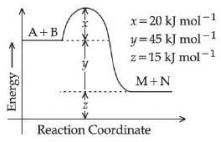
According to the following figure, the magnitude of the enthalpy change of the reaction \( \mathrm{A} + \mathrm{B} \rightarrow \mathrm{M} + \mathrm{N} \) in \( \mathrm{kJ\ mol^{-1}} \) is equal to __________. (Integer answer)
Given:(A) \( 2\mathrm{CO(g)} + \mathrm{O_2(g)} \rightarrow 2\mathrm{CO_2(g)} \) \( \Delta H_1^{\ominus} = -x \, \text{kJ mol}^{-1} \)(B) \( \mathrm{C(graphite)} + \mathrm{O_2(g)} \rightarrow \mathrm{CO_2(g)} \) \( \Delta H_2^{\ominus} = -y \, \text{kJ mol}^{-1} \)The \( \Delta H^{\ominus} \) for the reaction\( \mathrm{C(graphite)} + \dfrac{1}{2}\mathrm{O_2(g)} \rightarrow \mathrm{CO(g)} \) is:
While performing a thermodynamics experiment, a student made the following observations.\( \mathrm{HCl} + \mathrm{NaOH} \rightarrow \mathrm{NaCl} + \mathrm{H_2O} \) \( \Delta H = -57.3 \, \text{kJ mol}^{-1} \) \( \mathrm{CH_3COOH} + \mathrm{NaOH} \rightarrow \mathrm{CH_3COONa} + \mathrm{H_2O} \) \( \Delta H = -55.3 \, \text{kJ mol}^{-1} \) The entropy of ionization of \( \mathrm{CH_3COOH} \) as calculated by the student is ________ \( \text{kJ mol}^{-1} \). [Nearest integer]
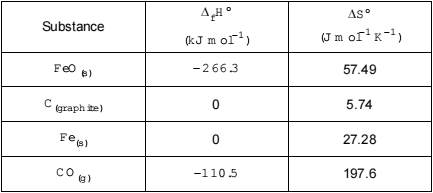
Data given for the following reaction is as follows : \( \mathrm{FeO}_{(s)} + \mathrm{C}_{(\text{graphite})} \longrightarrow \mathrm{Fe}_{(s)} + \mathrm{CO}_{(g)} \)
The minimum temperature in \( \text{K} \) at which the reaction becomes spontaneous is _______. (Integer answer)
\( 0.3 \, \mathrm{g} \) of ethane undergoes combustion at \( 27^\circ \mathrm{C} \) in a bomb calorimeter. The temperature of calorimeter system (including the water) is found to rise by \( 0.5^\circ \mathrm{C} \). The heat evolved during combustion of ethane of constant pressure is \( \_\_\_\_\_ \, \mathrm{kJ\,mol^{-1}} \). [Nearest integer](Given: The heat capacity of the calorimeter system is \( 20 \, \mathrm{kJ\,K^{-1}} \), \( R = 8.3 \, \mathrm{J\,K^{-1}\,mol^{-1}} \). Assume ideal gas behavior. Atomic mass of \( \mathrm{C} \) and \( \mathrm{H} \) are \( 12 \) and \( 1 \, \mathrm{g\,mol^{-1}} \) respectively).
Standard entropies of \( \mathrm{X_2} \), \( \mathrm{Y_2} \) and \( \mathrm{XY_5} \) are \( 70 \), \( 50 \) and \( 110 \; \mathrm{J\,K^{-1}\,mol^{-1}} \) respectively. The temperature in Kelvin at which the reaction $\frac{1}{2}\text{X}_2 + \frac{5}{2}\text{Y}_2 \rightleftharpoons \text{XY}_5 \quad \Delta\text{H}^\ominus = -35 \text{ kJ mol}^{-1}$will be at equilibrium is __________ (Nearest integer)
\( \mathrm{S(g)} + \frac{3}{2}\mathrm{O_2(g)} \rightarrow \mathrm{SO_3(g)} + 2x \,\text{kcal} \) \( \mathrm{SO_2(g)} + \frac{1}{2}\mathrm{O_2(g)} \rightarrow \mathrm{SO_3(g)} + y \,\text{kcal} \) The heat of formation of \( \mathrm{SO_2(g)} \) is given by:
Assuming ideal behaviour, the magnitude of \\( \log K \\) for the following reaction at \\( 25^\circ \text{C} \\) is \\( x \times 10^{-1} \\). The value of \\( x \\) is ________. (Integer answer) \( 3 \, \mathrm{HC{\equiv}CH}_{ (g)} \rightleftharpoons \mathrm{C_6H_{6(\ell)}} \) [Given: \( \displaystyle \Delta_{\text{f}}G^{\circ}(\text{HC} \equiv \text{CH}) = -2.04 \times 10^5 \, \text{J}\text{ mol}^{-1} \; ; \;\displaystyle \Delta_{\text{f}}G^{\circ}(\text{C}_6\text{H}_6) = -1.24 \times 10^5 \, \text{J}\text{ mol}^{-1} \; ; \; R = 8.314 \, \text{J K}^{-1} \text{mol}^{-1} \)]
The difference in energy between the actual structure and the lowest energy resonance structure for the given compound is:
The hydration energies of \(K^+\) and \(Cl^-\) are \(-x\) and \(-y\) \(\text{kJ/mol}\) respectively. If lattice energy of KCl is \(-z\) \(\text{kJ/mol}\) then the heat of solution of KCl is:
Enthalpies of formation of \( \mathrm{CCl_4(g)} \), \( \mathrm{H_2O(g)} \), \( \mathrm{CO_2(g)} \) and \( \mathrm{HCl(g)} \) are \( -105 \), \( -242 \), \( -394 \) and \( -92 \, \text{kJ mol}^{-1} \) respectively. The magnitude of enthalpy of the reaction given below is ______ \( \text{kJ mol}^{-1} \). (Nearest integer)\( \mathrm{CCl_4(g)} + 2\mathrm{H_2O(g)} \rightarrow \mathrm{CO_2(g)} + 4\mathrm{HCl(g)} \)
At \( 298 \, \text{K} \), the enthalpy of fusion of a solid (X) is \( 2.8 \, \text{kJ mol}^{-1} \) and the enthalpy of vaporization of the liquid (X) is \( 98.2 \, \text{kJ mol}^{-1} \). The enthalpy of sublimation of the substance (X) in \( \text{kJ mol}^{-1} \) is ____________. (in nearest integer)
Solid fuel used in rocket is a mixture of \( \text{Fe}_2\text{O}_3 \) and Al (in ratio \( 1:2 \)). The heat evolved (\( \text{kJ} \)) per gram of the mixture is ______ (Nearest integer) Given: \( \Delta H_f^\ominus(\text{Al}_2\text{O}_3) = -1700 \, \text{kJ mol}^{-1} \) \( \Delta H_f^\ominus(\text{Fe}_2\text{O}_3) = -840 \, \text{kJ mol}^{-1} \) Molar mass of Fe, Al and O are \( 56 \), \( 27 \) and \( 16 \, \text{g mol}^{-1} \) respectively.
If the standard molar enthalpy change for combustion of graphite powder is \( -2.48 \times 10^{2} \, \text{kJ mol}^{-1} \), the amount of heat generated on combustion of \( 1 \, \text{g} \) of graphite powder is ______ \( \text{kJ} \). (Nearest integer)
If \( 3.365 \, \text{g} \) of ethanol \((l)\) is burnt completely in a bomb calorimeter at \( 298.15 \, \text{K} \), the heat produced is \( 99.472 \, \text{kJ} \). The \( \left| \Delta H_f^{\circ} \right| \) of ethanol at \( 298.15 \, \text{K} \) is ________ \( \times 10^{2} \) \( \text{kJ} \, \text{mol}^{-1} \). (Nearest integer)Given: Standard enthalpy for combustion of graphite = \( -393.5 \, \text{kJ} \, \text{mol}^{-1} \)Standard enthalpy of formation of water \((l)\) = \( -285.8 \, \text{kJ} \, \text{mol}^{-1} \)Molar mass in \( \text{g} \, \text{mol}^{-1} \) of C, H, O are \( 12 \), \( 1 \) and \( 16 \) respectively
At \( 25^\circ\mathrm{C} \), the enthalpy of the following processes are given:\( \mathrm{H_2(g) + O_2(g) \rightarrow 2OH(g)} \quad \Delta H^\circ = 78\,\mathrm{kJ\,mol^{-1}} \)\( \mathrm{H_2(g) + \tfrac{1}{2}O_2(g) \rightarrow H_2O(g)} \quad \Delta H^\circ = -242\,\mathrm{kJ\,mol^{-1}} \)\( \mathrm{H_2(g) \rightarrow 2H(g)} \quad \Delta H^\circ = 436\,\mathrm{kJ\,mol^{-1}} \)\( \mathrm{\tfrac{1}{2}O_2(g) \rightarrow O(g)} \quad \Delta H^\circ = 249\,\mathrm{kJ\,mol^{-1}} \)What would be the value of \( X \) for the following reaction?________. (Nearest integer)\( \mathrm{H_2O(g) \rightarrow H(g) + OH(g)} \quad \Delta H^\circ = X\,\mathrm{kJ\,mol^{-1}} \)
The standard enthalpies of \( \mathrm{Al_2O_3} \) and \( \mathrm{CaO} \) are \( -1675 \, \mathrm{kJ\,mol^{-1}} \) and \( -635 \, \mathrm{kJ\,mol^{-1}} \) respectively.For the reaction\( 3\mathrm{CaO} + 2\mathrm{Al} \longrightarrow 3\mathrm{Ca} + \mathrm{Al_2O_3} \) the standard reaction enthalpy \( \Delta_r H^\circ = \) ______ kJ (Round off to the Nearest Integer).
\( 2.4 \, \text{g} \) coal is burnt in a bomb calorimeter in excess of oxygen at \( 298 \, \text{K} \) and \( 1 \, \text{atm} \) pressure. The temperature of the calorimeter rises from \( 298 \, \text{K} \) to \( 300 \, \text{K} \). The enthalpy change during the combustion of coal is \( -x \, \text{kJ} \, \text{mol}^{-1} \). The value of \( x \) is __________. (Nearest Integer) (Given: Heat capacity of bomb calorimeter \( 20.0 \, \text{kJ} \, \text{K}^{-1} \). Assume coal to be pure carbon)