18 questions from 2024
If the distance between object and its two times magnified virtual image produced by a curved mirror is \( 15 \, \text{cm} \), the focal length of the mirror must be:
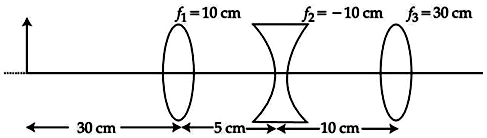
The position of the image formed by the combination of lenses is
If the refractive index of the material of a prism is \( \cot\!\left(\dfrac{A}{2}\right) \) where \( A \) is the angle of prism then the angle of minimum deviation will be :
Light from a point source in air falls on a convex curved surface of radius \( 20 \, \text{cm} \) and refractive index \( 1.5 \). If the source is located at \( 100 \, \text{cm} \) from the convex surface, the image will be formed at _______ \( \text{cm} \) from the object.
A biconvex lens of refractive index \( 1.5 \) has a focal length of \( 20 \, \text{cm} \) in air. Its focal length when immersed in a liquid of refractive index \( 1.6 \) will be:
The distance between object and its two times magnified real image as produced by a convex lens is \( 45 \, \text{cm} \). The focal length of the lens used is _____ \( \text{cm} \).
Critical angle of incidence for a pair of optical media is \( 45^\circ \). The refractive indices of first and second media are in the ratio:
A convex mirror of radius of curvature \( 30 \, \text{cm} \) forms an image that is half the size of the object. The object distance is:
Light emerges out of a convex lens when a source of light kept at its focus. The shape of wavefront of the light is:
The refractive index of a prism with apex angle \( A \) is \( \cot \frac{A}{2} \). The angle of minimum deviation is:
Given below are two statements:Statement (I): When an object is placed at the centre of curvature of a concave lens, image is formed at the centre of curvature of the lens on the other side.Statement (II): Concave lens always forms a virtual and erect image.In the light of the above statements, choose the correct answer from the options given below:
Given below are two statements:Statement I: When the white light passed through a prism, the red light bends lesser than yellow and violet.Statement II: The refractive indices are different for different wavelengths in dispersive medium.In the light of the above statements, chose the correct answer from the options given below:
The refractive index of prism is \( \mu = \sqrt{3} \) and the ratio of the angle of minimum deviation to the angle of prism is one. The value of angle of prism is ________.
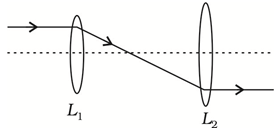
The following figure represents two biconvex lenses \( L_1 \) and \( L_2 \) having focal length \( 10 \, \text{cm} \) and \( 15 \, \text{cm} \) respectively. The distance between \( L_1 \) and \( L_2 \) is:
For the thin convex lens, the radii of curvature are at \( 15 \, \text{cm} \) and \( 30 \, \text{cm} \) respectively. The focal length the lens is \( 20 \, \text{cm} \). The refractive index of the material is:
Two immiscible liquids of refractive indices \( \frac{8}{5} \) and \( \frac{3}{2} \) respectively are put in a beaker as shown in the figure. The height of each column is \( 6 \, \text{cm} \). A coin is placed at the bottom of the beaker. For near normal vision, the apparent depth of the coin is \( \frac{\alpha}{4} \, \text{cm} \). The value of \( \alpha \) is ________.
An effective power of a combination of \( 5 \) identical convex lenses which are kept in contact along the principal axis is \( 25 \, \text{D} \). Focal length of each of the convex lens is:
The distance between object and its \( 3 \) times magnified virtual image as produced by a convex lens is \( 20 \, \text{cm} \). The focal length of the lens used is ______ \( \text{cm} \).