The width of fringe is \( 2 \, \text{mm} \) on the screen in a double slits experiment for the light of wavelength of \( 400 \, \text{nm} \). The width of the fringe for the light of wavelength \( 600 \, \text{nm} \) will be:
\( 2 \, \text{mm} \)
\( 1.33 \, \text{mm} \)
\( 4 \, \text{mm} \)
\( 3 \, \text{mm} \)
Two simple harmonic waves having equal amplitudes of \( 8 \, \text{cm} \) and equal frequency of \( 10 \, \text{Hz} \) are moving along the same direction. The resultant amplitude is also \( 8 \, \text{cm} \). The phase difference between the individual waves is _____ degree.
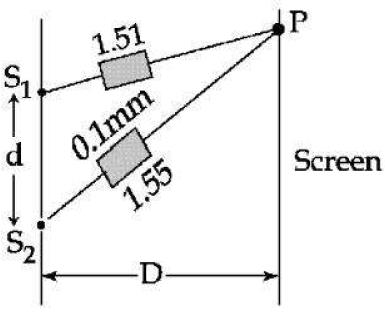
In Young’s double slit experiment, two slits \( S_{1} \) and \( S_{2} \) are \( d \) distance apart and the separation from slits screen is \( D \) (as shown in figure). Now if two transparent slobs of equal thickness \( 0.1 \, \text{mm} \) but index \( 1.51 \) and \( 1.55 \) are introduction in the path of beam \( (\lambda = 4000\ Å\ \) from \( S_{1} \) and \( S_{2} \) respectively. The central bright fringe spot will shift by ________ number of fringes.
Given below are two statements: one is labelled as Assertion A and the other is labelled as Reason R.Assertion A: The phase difference of two light waves change if they travel through different media having same thickness, but different indices of refraction.Reason R: The wavelengths of waves are different in different media.In the light of the above statements, choose the most appropriate answer from the options given below
A monochromatic light wave with wavelength \( \lambda_{1} \) and frequency \( v_{1} \) in air enters another medium. If the angle of incidence and angle of refraction at the interface are \( 45^\circ \) and \( 30^\circ \) respectively, then the wavelength \( \lambda_{2} \) and frequency \( v_{2} \) of the refracted wave are:
Two polaroide A and B are placed in such a way that the pass-axis of polaroids are perpendicular to each other. Now, another polaroid C is placed between A and B bisecting angle between them. If intensity of unpolarized light is \( I_0 \) then intensity of transmitted light after passing through polaroid B will be:
Given below are two statements :Statement I : If the Brewster’s angle for the light propagating from air to glass is \( \theta_B \), then the Bresster’s angle for the light propagating from glass to air is \( \frac{\pi}{2} - \theta_B \)Statement II : The Brewster’s angle for the light propagating from glass to air is \( \tan^{-1}(\mu_g) \) where \( \mu_g \) is the refractive index of glass.In the light of the above statements, choose the correct answer from the options given below:
A person observes two moving trains, ‘A’ reaching the station and ‘B’ leaving the station with equal speed of \( 30 \, \text{m/s} \). If both trains emit sounds with frequency \( 300 \, \text{Hz} \), (Speed of sound: \( 330 \, \text{m/s} \)) approximate difference of frequencies heard by the person will be:
In a Young’s double slit experiment, the intensities at two points, for the path differences \( \frac{\lambda}{4} \) and \( \frac{\lambda}{3} \) (\( \lambda \) being the wavelength of light used) are \( I_1 \) and \( I_2 \) respectively. If \( I_0 \) denotes the intensity produced by each one of the individual slits, then \( \frac{I_1 + I_2}{I_0} = \) ________.
The engine of a train moving with speed \( 10 \, \text{ms}^{-1} \) towards a platform sounds a whistle at frequency \( 400 \, \text{Hz} \). The frequency heard by a passenger inside the train is: (Neglect air speed. Speed of sound in air \( = 330 \, \text{ms}^{-1} \))
In Young’s double slits experiment, the position of \( 5^{\text{th}} \) bright fringe from the central maximum is \( 5 \, \text{cm} \). the distance between slits and screen is \( 1 \, \text{m} \) and wavelength of used monochromatic light is \( 600 \, \text{nm} \). The separation between the slits is:
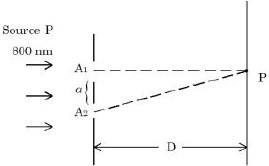
In a Young’s double slit experiment, two slits are illuminated with a light of wavelength \( 800 \, \text{nm} \). The line joining \( A_1P \) is perpendicular to \( A_1A_2 \) as shown in the figure. If the first minimum is detected at \( P \), the value of slits separation \( a \) will be:
Two light waves of wavelengths \( 800 \, \text{nm} \) and \( 600 \, \text{nm} \) are used in Young’s double slit experiment to obtain interference fringes on a screen placed \( 7 \, \text{m} \) away from plane of slits. If the two slits are separated by \( 0.35 \, \text{mm} \), then shortest distance from the central bright maximum to the point where the bright fringes of the two wavelength coincide will be ______ mm.
A single slit of width \( a \) is illuminated by a monochromatic light of wavelength \( 600 \, \text{nm} \). The value of ‘\( a \)’ for which first minimum appears at \( \theta = 30^\circ \) on the screen will be:
The ratio of intensities at two points \( P \) and \( Q \) on the screen in a Young’s double slit experiment where phase difference between two waves of same amplitude are \( {\pi}/{3} \) and \( {\pi}/{2} \), respectively are:
In a Young’s double slits experiment, the ratio of amplitude of light coming from slits is \( 2 : 1 \). The ratio of the maximum to minimum intensity in the interference pattern is :
Unpolarised light of intensity \( 32 \, \text{W m}^{-2} \) passes through the combination of three polaroids such that the pass axis of the last polaroid is perpendicular to that of the pass axis of first polaroid. If intensity of emerging light is \( 3 \, \text{W m}^{-2} \), then the angle between pass axis of fist two polaroids is ________ \( ^\circ \).
A travelling wave is described by the equation \( y(x,t) = [0.05 \sin(8x - 4t)] \, \text{m} \). The velocity of the wave is : [all the quantities are in SI unit]