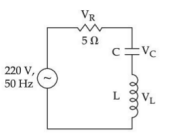
In the given circuit, the magnitude of \( V_L \) and \( V_C \) are twice that of \( V_R \). Given that \( f = 50 \, \text{Hz} \), the inductance of the coil is \( \dfrac{1}{K \pi} \, \text{mH} \). The value of \( K \) is __________.
A resistance of \( 40 \, \Omega \) is connected to a source of alternating current rated \( 220 \, \text{V} \), \( 50 \, \text{Hz} \). Find the time taken by the current to change from its maximum value to the rms value:
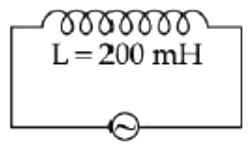
As shown in the figure an inductor of inductance \( 200 \, \text{mH} \) is connected to an AC source of emf \( 220 \, \text{V} \) and frequency \( 50 \, \text{Hz} \). The instantaneous voltage of the source is \( 0 \, \text{V} \) when the peak value of current is \( \frac{\sqrt{a}}{\pi} \, \text{A} \). The value of \( a \) is ________.
If wattless current flows in the AC circuit, then the circuit is:
An alternating emf \( E = 440\sin 100\pi t \) is applied to a circuit containing an inductance of \( \dfrac{\sqrt{2}}{\pi} \, \text{H} \). If an a.c. ammeter is connected in the circuit, its reading will be:
In a series LR circuit \( X_L = R \) and power factor of the circuit is \( P_1 \). When capacitor with capacitance \( C \) such that \( X_L = X_C \) is put in series, the power factor becomes \( P_2 \). Then ratio \( \dfrac{P_1}{P_2} \) is:
The current flowing through an ac circuit is given by \( I = 5 \sin (120\pi t) \, \text{A} \) How long will the current take to reach the peak value starting from zero?
To light, a \( 50 \, \text{W} \), \( 100 \, \text{V} \) lamp is connected, in series with a capacitor of capacitance \( \dfrac{50}{\pi \sqrt{x}} \, \mu \text{F} \), with \( 200 \, \text{V} \), \( 50 \, \text{HZ} \) AC source. The value of \( x \) will be ______.
To increase the resonant frequency in series LCR circuit.
A direct current of \( 4 \, \text{A} \) and an alternating current of peak value \( 4 \, \text{A} \) flow through resistance of \( 3 \, \Omega \) and \( 2 \, \Omega \) respectively. The ratio of heat produced in the two resistance in same interval of time will be:
A \( 72 \, \Omega \) galvanometer is shunted by a resistance of \( 8 \, \Omega \). The percentage of the total current which passes through the galvanometer is:
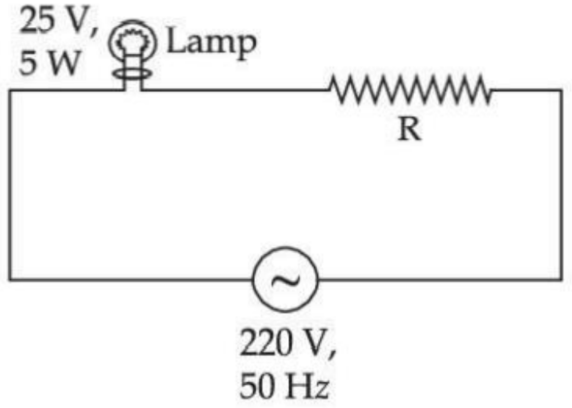
A \( 220 \, \text{V}, 50 \, \text{Hz} \) AC source is connected to a \( 25 \, \text{V}, 5 \, \text{W} \) lamp and an additional resistance \( R \) in series (as shown in figure) to run the lamp at its peak brightness, then the value of \( R \) (in ohm) will be ______.
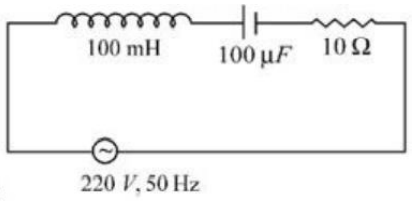
In a series LCR circuit, the inductance, capacitance and resistance are \( L = 100 \, \text{mH} \), \( C = 100 \, \mu \text{F} \) and \( R = 10 \, \Omega \) respectively. They are connected to an AC source of voltage \( 220 \, \text{V} \) and frequency of \( 50 \, \text{Hz} \). The approximate value of current in the circuit will be __________ \( \text{A} \).
The frequencies at which the current amplitude in an \( LCR \) series circuit becomes \( \dfrac{1}{\sqrt{2}} \) times its maximum value, are \( 212 \, \text{rad s}^{-1} \) and \( 232 \, \text{rad s}^{-1} \). The value of resistance in the circuit is \( R = 5 \, \Omega \). The self inductance in the circuit is __________ \( \text{mH} \).
The equation of current in a purely inductive circuit is \( 5 \sin(49\pi t - 30^\circ) \). If the inductance is \( 30 \, \text{mH} \) then the equation for the voltage across the inductor, will be:{Let \( \pi = \dfrac{22}{7} \)}
For a series LCR circuit, \( I \) vs \( \omega \) curve is shown:(a) To the left of \( \omega_r \), the circuit is mainly capacitive(b) To the left of \( \omega_r \), the circuit is mainly inductive(c) At \( \omega_r \), impedance of the circuit is equal to the resistance of the circuit(d) At \( \omega_r \), impedance of the circuit is \( 0 \).Choose the most appropriate answer from the options given below:
An inductor of \( 0.5 \, \text{mH} \), a capacitor of \( 200 \, \mu\text{F} \) and a resistor of \( 2 \, \Omega \) are connected in series with a \( 220 \, \text{V} \) ac source. If the current is in phase with the emf, the frequency of ac source will be ______ \( \times 10^{2} \, \text{Hz} \).
A sinusoidal voltage \( V(t) = 210\sin(3000t) \) volt is applied to a series LCR circuit in which \( L = 10\,\text{mH} \), \( C = 25\,\mu\text{F} \) and \( R = 100\,\Omega \). The phase difference \( (\phi) \) between the applied voltage and resultant current will be:
A series LCR circuit has \( L = 0.01 \, \text{H} , \ R = 10 \, \Omega \) and \( C = 1 \, \mu \text{F} \) and it is connected to ac voltage of amplitude \( (V_m) \) \( 50 \, \text{V} \). At frequency \( 60 \% \) lower than resonant frequency, the amplitude of current will be approximately:
A \( 100 \,\mathrm{V} \), \( 50 \,\mathrm{Hz} \), AC source is connected in the circuit (as shown in figure). The current through the resistance \( 55 \,\Omega \), at resonance in the circuit, will be __________ \( \mathrm{A} \).