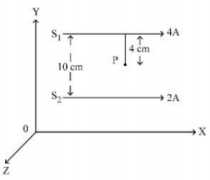
Two long parallel conductors \( S_1 \) and \( S_2 \) are separated by a distance \( 10 \, \text{cm} \) and carrying currents of \( 4 \, \text{A} \) and \( 2 \, \text{A} \) respectively. The conductors are placed along x-axis in X-Y plane. There is a point \( P \) located between the conductors (as shown in figure). A charge particle of \( 3\pi \) coulomb is passing through the point \( P \) with velocity \( \vec{v} = (2 \hat{i} + 3 \hat{j}) \, \text{m/s} \); where \( \hat{i} \) & \( \hat{j} \) represents unit vector along \( x \) & \( y \) axis respectively. The force acting on the charge particle is \( 4 \pi \times 10^{-5} \, (-x \hat{i} + 2 \hat{j}) \, \text{N} \). The value of \( x \) is: