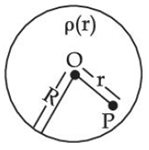
A spherically symmetric charge distribution is considered with charge density varying as is the distance from the centre O (as shown in figure). The electric field at point P will be:
\( \dfrac{\rho_0 r}{4\varepsilon_0}\left( \dfrac{3}{4} - \dfrac{r}{R} \right) \)
\( \dfrac{\rho_0 r}{3\varepsilon_0}\left( \dfrac{3}{4} - \dfrac{r}{R} \right) \)
\( \dfrac{\rho_0 r}{4\varepsilon_0}\left( 1 - \dfrac{r}{R} \right) \)
\( \dfrac{\rho_0 r}{5\varepsilon_0}\left( 1 - \dfrac{r}{R} \right) \)
A bar magnet having a magnetic moment of \( 2.0 \times 10^{5} \, \text{J}\,\text{T}^{-1} \), is placed along the direction of uniform magnetic field of magnitude \( B = 14 \times 10^{-5} \, \text{T} \). The work done in rotating the magnet slowly through \( 60^\circ \) from the direction of field is:
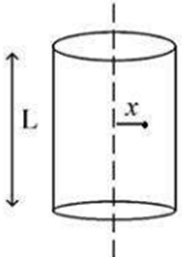
A long cylindrical volume contains a uniformly distributed charge of density \( \rho \). The radius of cylindrical volume is \( R \). A charge particle (\( q \)) revolves around the cylinder in a circular path. The kinetic energy of the particle is:
Three point charges of magnitude \( 5 \, \mu\text{C} \), \( 0.16 \, \mu\text{C} \) and \( 0.3 \, \mu\text{C} \) are located at the vertices A, B, C of a right angled triangle whose sides are \( AB = 3 \, \text{cm} \), \( BC = 3\sqrt{2} \, \text{cm} \) and \( CA = 3 \, \text{cm} \) and point A is the right angle corner. Charge at point A experiences __________ \( \text{N} \) of electrostatic force due to the other two charges.
Two uniformly charged spherical conductors A and B of radii \( 5 \, \text{mm} \) and \( 10 \, \text{mm} \) are separated by a distance of \( 2 \, \text{cm} \). If the spheres are connected by a conducting wire, then in equilibrium condition. The ratio of the magnitudes of the electric fields at the surface of the sphere A and B will be:
A vertical electric field of magnitude \( 4.9 \times 10^{5} \, \text{N}/\text{C} \) just prevents a water droplet of a mass \( 0.1 \, \text{g} \) from falling. The value of charge on the droplet will be: (Given \( g = 9.8 \, \text{m}/\text{s}^{2} \))
A long cylindrical volume contains a uniformly distributed charge of density \( \rho \, \text{C m}^{-3} \). The electric field inside the cylindrical volume at a distance \( x = \dfrac{2 \varepsilon_{0}}{\rho} \, \text{m} \) from its axis is ______ \( \text{V m}^{-1} \).
Given below are two statements.Statement I: Electric potential is constant within and at the surface of each conductor.Statement II: Electric field just outside a charged conductor is perpendicular to the surface of the conductor at every point.In the light of the above statements, choose the most appropriate answer from the options given below.
Two electric dipoles of dipole moments \( 1.2 \times 10^{-30} \, \text{Cm} \) and \( 2.4 \times 10^{-30} \, \text{Cm} \) are placed in two different uniform electric fields of strengths \( 5 \times 10^{4} \, \text{NC}^{-1} \) and \( 15 \times 10^{4} \, \text{NC}^{-1} \) respectively. The ratio of maximum torque experienced by the electric dipoles will be \( \dfrac{1}{x} \). The value of \( x \) is ________.
Two point charges \( Q \) each are placed at a distance \( d \) apart. A third point charge \( q \) is placed at a distance \( x \) from mid-point on the perpendicular bisector. The values \( x \) at which charge \( q \) will experience the maximum Coulomb’s force is:
Two identical charged particles each having a mass \( 10 \ \text{g} \) and charge \( 2.0 \times 10^{-7} \ \text{C} \) are placed on a horizontal table with a separation of \( L \) between them such that they stay in limited equilibrium. If the coefficient of friction between each particle and the table is \( 0.25 \), find the value of \( L \). [Use \( g = 10 \ \text{ms}^{-2} \)]
Sixty four conducting drops each of radius \( 0.02\,\text{m} \) and each carrying a charge of \( 5\,\mu\text{C} \) are combined to form a bigger drop. The ratio of surface density of bigger drop to the smaller drop will be:
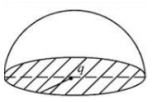
If a charge \( q \) is placed at the centre of a closed hemispherical non-conducting surface, the total flux passing through the flat surface would be:
The volume charge density of a sphere of radius \( 6 \, \text{m} \) is \( 2 \, \mu\text{C cm}^{-3} \). The number of lines of force per unit surface area coming out from the surface of the sphere is ________ \( \times 10^{10} \, \text{N C}^{-1} \).(Given : Permittivity of vacuum \( \in_{0} = 8.85 \times 10^{-12} \, \text{C}^{2} \text{N}^{-1} \text{m}^{-2} \))
\( 27 \) identical drop are charged at \( 22 \, \text{V} \) each. The combine to form a bigger drop. The potential of the bigger drop will be ________ \( \text{V} \).
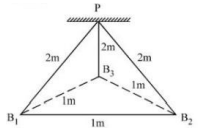
Three identical charged balls each of charge \( 2 \, \text{C} \) are suspended from a common point \( P \) by silk threads of \( 2 \, \text{m} \) each (as shown in figure). They form an equilateral triangle of side \( 1 \, \text{m} \). The ratio of net force on a charge ball to the force between any two charged balls will be:
A charge of \( 4 \, \mu \text{C} \) is to be divided into two. The distance between the two divided charges is constant. The magnitude of the divided charges so that the force between them is maximum, will be:
Given below are two statements:Statement-I: A point charge is brought in an electric field. The value of electric field at a point near to the charge may increase if the charge is positive.Statement-II: An electric dipole is placed in a non-uniform electric field. The net electric force on the dipole will not be zero.Choose the correct answer from the options given below:
A positive charge particle of \( 100 \, \text{mg} \) is thrown in opposite direction to a uniform electric field of strength \( 1 \times 10^{5} \, \text{N C}^{-1} \). If the charge on the particle is \( 40 \, \mu\text{C} \) and the initial velocity is \( 200 \, \text{m s}^{-1} \), how much distance it will travel before coming to the rest momentarily:
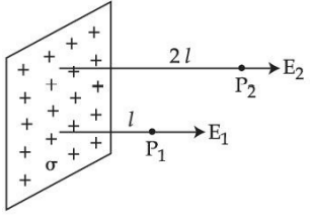
In the figure, a very large plane sheet of positive charge is shown. \( P_1 \) and \( P_2 \) are two points at distance \( l \) and \( 2l \) from the charge distribution. If \( \sigma \) is the surface charge density, then the magnitude of electric fields \( E_1 \) and \( E_2 \) at \( P_1 \) and \( P_2 \) respectively are:
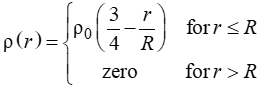 is the distance from the centre O (as shown in figure). The electric field at point P will be: