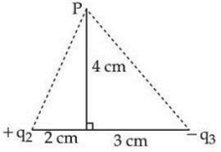
If the net electric field at point P along Y axis is zero, then the radius of \( \left|\dfrac{q_{2}}{q_{3}}\right| \) is \( \dfrac{8}{5\sqrt{x}} \), where \( x = \) ______.
An infinite plane sheet of charge having uniform surface charge density \( +\sigma_{s} \, \text{C} \, /\text{m}^{2} \) is placed on x–y plane. Another infinitely long line charge having uniform linear charge density \( +\lambda_{\ell} \, \text{C} \,/ \text{m} \) is placed at \( z = 4 \, \text{m} \) plane and parallel to y-axis. If the magnitude values \( |\sigma_{s}| = 2|\lambda_{e}| \) then at point \( (0, 0, 2) \), the ratio of magnitudes of electric field values due to sheet charge to that of line charge is \( \pi \sqrt{n} : 1 \). The value of \( n \) is __________.
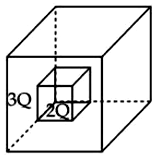
\( C_1 \) and \( C_2 \) are two hollow concentric cubes enclosing charges \( 2Q \) and \( 3Q \) respectively as shown in figure. The ratio of electric flux passing through \( C_1 \) and \( C_2 \) is:
A thin metallic wire having cross sectional area of \( 10^{-4} \, \text{m}^2 \) is used to make a ring of radius \( 30 \, \text{cm} \). A positive charge of \( 2\pi \, \text{C} \) is uniformly distributed over the ring, while another positive charge of \( 30 \, \text{pC} \) is kept at the centre of the ring. The tension in the ring is __________ \( \text{N} \); provided that the ring does not get deformed (neglect the influence of gravity). \( \left( \text{given, } \frac{1}{4\pi \epsilon_0} = 9 \times 10^{9} \, \text{SI units} \right) \)
Suppose a uniformly charged wall provides a uniform electric field of \( 2 \times 10^{4} \, \text{N/C} \) normally. A charged particle of mass \( 2 \, \text{g} \) being suspended through a silk thread of length \( 20 \, \text{cm} \) and remain stayed at a distance of \( 10 \, \text{cm} \) from the wall. Then the charge on the particle will be \( \dfrac{1}{\sqrt{x}} \, \mu \text{C} \) where \( x = \_\_\_\_\_\_\_\_\_\_ \). [use \( g = 10 \, \text{m/s}^{2} \) ]
Two identical charged spheres are suspended by strings of equal lengths. The strings make an angle of \( 37^\circ \) with each other. When suspended in a liquid of density \( 0.7\ \text{g}/\text{cm}^3 \), the angle remains same. If density of material of the sphere is \( 1.4\ \text{g}/\text{cm}^3 \), the dielectric constant of the liquid is ______ \( \left( \tan 37^\circ = \dfrac{3}{4} \right) \).
In hydrogen like system the ratio of coulombian force and gravitational force between an electron and a proton is in the order of:
Two charges of \( 5Q \) and \( -2Q \) are situated at the points \( (3a, 0) \) and \( (-5a, 0) \) respectively. The electric flux through a sphere of radius \( 4a \) having center at origin is:
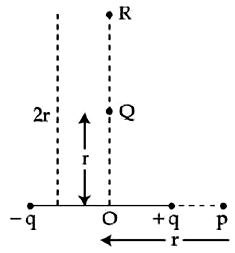
The electric field at point \( p \) due to an electric dipole is \( E \). The electric field at point \( R \) on equatorial line will be \( \dfrac{E}{x} \). The value of \( x \):
Given below are two statements: one is labelled as Assertion (A) and the other is labelled as Reason (R).Assertion (A): Work done by electric field on moving a positive charge on an equipotential surface is always zero.Reason (R): Electric lines of forces are always perpendicular to equipotential surfaces.In the light of the above statements, choose the most appropriate answer from the options given below:
The electric potential at the surface of an atomic nucleus \( (z = 50) \) of radius \( 9 \times 10^{-13} \, \text{cm} \) is __________ \( \times 10^{6} \, \text{V} \).
A charge \( q \) is placed at the center of one of the surface of a cube. The flux linked with the cube is:
The electrostatic potential due to an electric dipole at a distance ' \( r \) ' varies as:
Two charges \( q \) and \( 3q \) are separated by a distance \( r \) in air. At a distance \( x \) from charge \( q \), the resultant electric field is zero. The value of \( x \) is:
Two charged conducting spheres of radii \( a \) and \( b \) are connected to each other by a conducting wire. The ratio of charges of the two spheres respectively is:
An electron is moving under the influence of the electric field of a uniformly charged infinite plane sheet $S$ having surface charge density $+\sigma$. The electron at $t = 0$ is at a distance of $1\text{ m}$ from $S$ and has a speed of $1\text{ m/s}$. The maximum value of $\sigma$ if the electron strikes $S$ at $t = 1\text{s}$ is $\alpha\left[\frac{m\epsilon_0}{e}\right]\frac{\text{C}}{\text{m}^2}$, the value of $\alpha$ is ________.
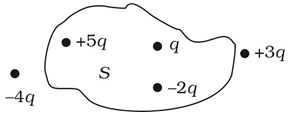
Five charges \( +q \), \( +5q \), \( -2q \), \( +3q \) and \( -4q \) are situated as shown in the figure. The electric flux due to this configuration through the surface \( S \) is:
An electronic field, $\vec{E} = \frac{2\hat{i} + 6\hat{j} + 8\hat{k}}{\sqrt{6}}$ passes through the surface of $4\text{ m}^2$ area having unit vector $\hat{n} = \left(\frac{2\hat{i} + \hat{j} + \hat{k}}{\sqrt{6}}\right)$. The electric flux for that surface is ______ $\text{V m}$.
Force between two point charges \( q_1 \) and \( q_2 \) placed in vacuum at \(' r' \, \text{cm} \) apart is \( F \). Force between them when placed in a medium having dielectric constant \( K = 5 \) at \( '{r}/{5}' \, \text{cm} \) apart will be:
An infinitely long positively charged straight thread has a linear charge density \( \lambda \, \text{Cm}^{-1} \). An electron revolves along a circular path having axis along the length of the wire. The graph that correctly represents the variation of the kinetic energy of electron as a function of radius of circular path from the wire is:
Two identical charged spheres are suspended by strings of equal lengths. The string make an angle \( \theta \) with each other. When suspended in water the angle remains the same. If density of the material of the sphere is \( 1.5 \, \text{g/cc} \), the dielectric constant of water will be ______. [Take density of water = \( 1 \, \text{g/cc} \)]
At the center of half ring of radius \( R = 10 \, \text{cm} \) and linear charge density \( 4 \, \text{n C m}^{-1} \), the potential is \( x \pi \, \text{V} \). The value of \( x \) is ________.
The vehicles carrying inflammable fluids usually have metallic chains touching the ground:
An electric charge \( 10^{-6} \, \mu\text{C} \) is placed at origin \( (0, 0) \, \text{m} \) of \( X - Y \) co-ordinate system. Two points \( P \) and \( Q \) are situated at \( (\sqrt{3}, \sqrt{3}) \, \text{m} \) and \( (\sqrt{6}, 0) \, \text{m} \) respectively. The potential difference between the points \( P \) and \( Q \) will be :
\( \sigma \) is the uniform surface charge density of a thin spherical shell of radius \( R \). The electric field at any point on the surface of the spherical shell is:
An electric field is given by \( (6\hat{i}+5\hat{j}+3\hat{k}) \, \text{N/C} \). The electric flux through a surface area \( 30 \, \hat{i}{ m}^2 \) lying in YZ-plane (in SI unit) is:
Two identical conducting spheres \( P \) and \( S \) with charge \( Q \) on each, repel each other with a force \( 16 \, \text{N} \). A third identical uncharged conducting sphere \( R \) is successively brought in contact with the two spheres. The new force of repulsion between \( P \) and \( S \) is: