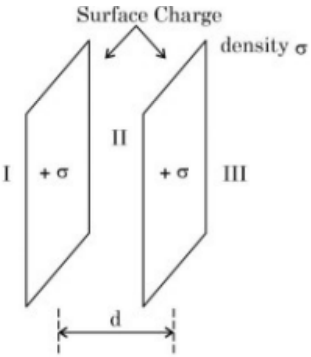
Let \( \sigma \) be the uniform surface charge density of two infinite thin plane sheets shown in figure. Then the electric fields in three different region \( {E}_{I} \), \({E}_{II} \) and \( {E}_{III} \) are:
\( \vec{E}_{I}=0, \, \vec{E}_{II}=\dfrac{\sigma}{\epsilon_{0}}\hat{n}, \, \vec{E}_{III}=0 \)
\( \vec{E}_{I}=-\dfrac{\sigma}{2\epsilon_{0}}\hat{n}, \, \vec{E}_{II}=0, \, \vec{E}_{III}=\dfrac{\sigma}{2\epsilon_{0}}\hat{n} \)
\( \vec{E}_{I}=-\dfrac{\sigma}{\epsilon_{0}}\hat{n}, \, \vec{E}_{II}=0, \, \vec{E}_{III}=\dfrac{\sigma}{\epsilon_{0}}\hat{n} \)
\( \vec{E}_{I}=\dfrac{2\sigma}{\epsilon_{0}}\hat{n}, \, \vec{E}_{II}=0, \, \vec{E}_{III}=\dfrac{2\sigma}{\epsilon_{0}}\hat{n} \)